The Kuomintang (KMT) nationalists ruled China until fleeing to Taiwan after losing the civil war to the Communist Party revolutionaries in 1949. The enmity persisted for decades. After Taiwan's democratization, the exiled party renounced the use of force to retake the mainland in 1991. Over the years, with China's economic boom and Taipei's stagnation, both sides of the strait began to draw closer, with Beijing expanding trade, tourism, and transportation during the KMT's last term from 2008 to 2016. Now, ironically, the Xi Jinping regime sees this party, the opposition leader in an island that de facto operates as an independent country, as the only path to the desired peaceful "reunification."
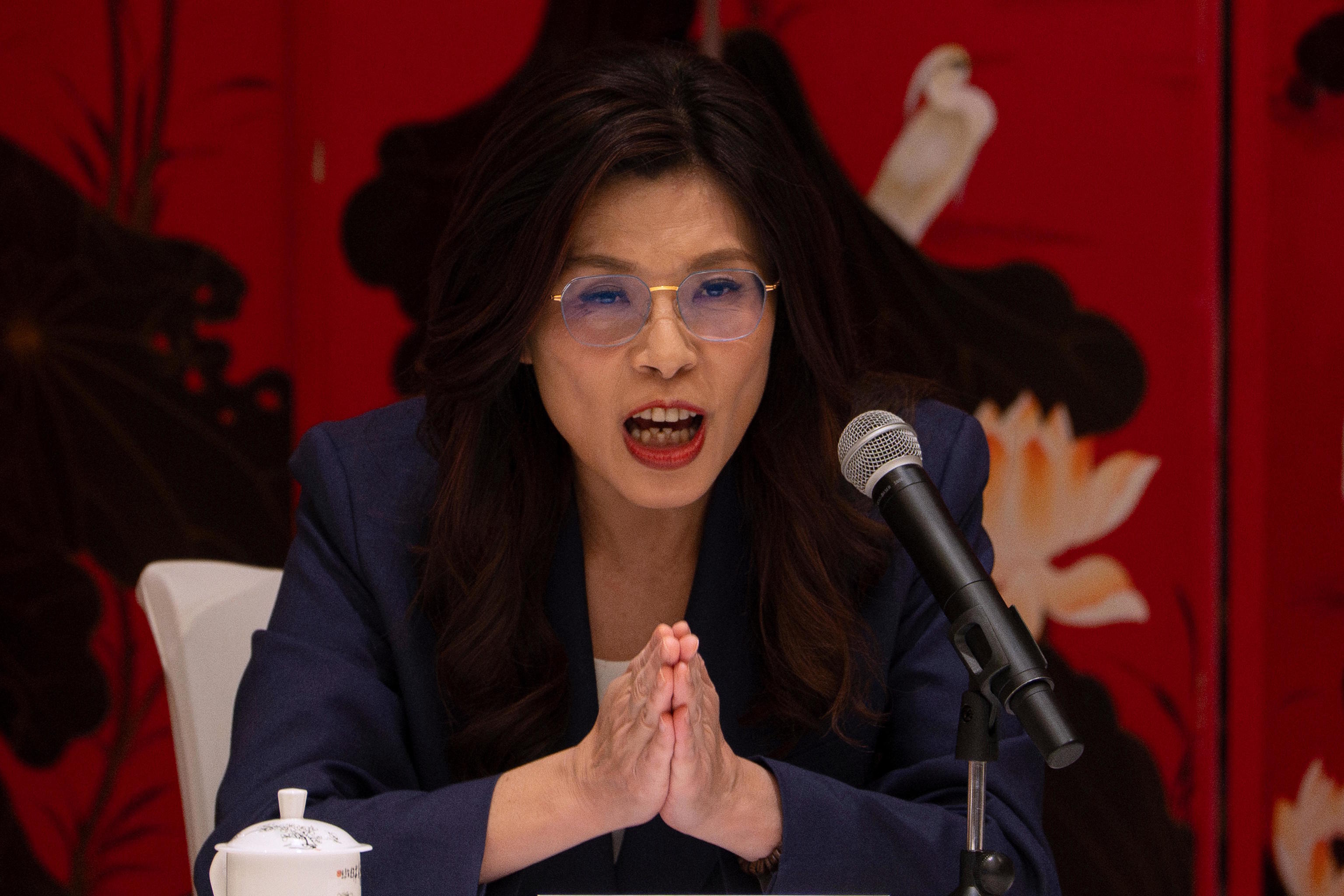
It is in this context that the visit to Beijing by Cheng Li-wun, the new president of the KMT, and the meeting held this Friday with Xi Jinping, gains significance. More than a protocol gesture, the meeting holds deep symbolic and strategic value. Since 2016, no significant party leader had set foot in the Chinese capital, and this visit comes amid tensions in the strait, with Chinese military maneuvers and a hardening of the pro-independence rhetoric in Taiwan.
Cheng framed the visit as an attempt to "sow the seeds of peace," a formulation that reflects the delicate balance she seeks to maintain: getting closer to Beijing without alienating an increasingly wary Taiwanese society of Chinese influence.
At 56, the leader embodies the pragmatic evolution of the KMT, which has shifted from advocating a shared Chinese identity to defending the status quo: neither formal independence nor immediate unification, but stability, trade, and open channels of dialogue.
Xi Jinping, on his part, once again presented what some experts call "his narrative of historical inevitability." In his meeting with Cheng, he emphasized that "the great trend of the rejuvenation of the Chinese nation will not change," a phrase laden with political significance. For Beijing, Taiwan is not just a territorial issue but a central piece in the narrative of national rise and overcoming the "century of humiliation." However, the Chinese leader also left room for tactical ambiguity by mentioning "strengthening exchanges and dialogue" with all Taiwanese parties, implicitly pointing to the KMT as the preferred interlocutor.
This calculation is not random. Faced with a government in Taipei led by Lai Ching-te of the Democratic Progressive Party (DPP), which Beijing labels as "separatist," the KMT presents itself as the only political force with which China can maintain a viable political channel. For the regime, indirectly supporting this party not only serves to isolate the DPP but also projects the image that "reunification" can be achieved without resorting to force.
During her trip, which included stops in the cities of Shanghai and Nanjing—the latter being the former nationalist capital—Cheng emphasized that Taiwan should not become a "geopolitical pawn." The statement is directed at both Beijing and Washington. The United States remains the island's main security guarantor, but its increasing involvement also fuels fears that Taiwan may get caught in the rivalry between major powers.
In Taiwan, where polls show a sustained increase in self-identity and significant support for eventual independence, the trip has been perceived by many as a risky concession. In Washington, the move is being observed cautiously, especially at a time when the KMT is blocking increases in military spending aimed at strengthening the island's defense capabilities.