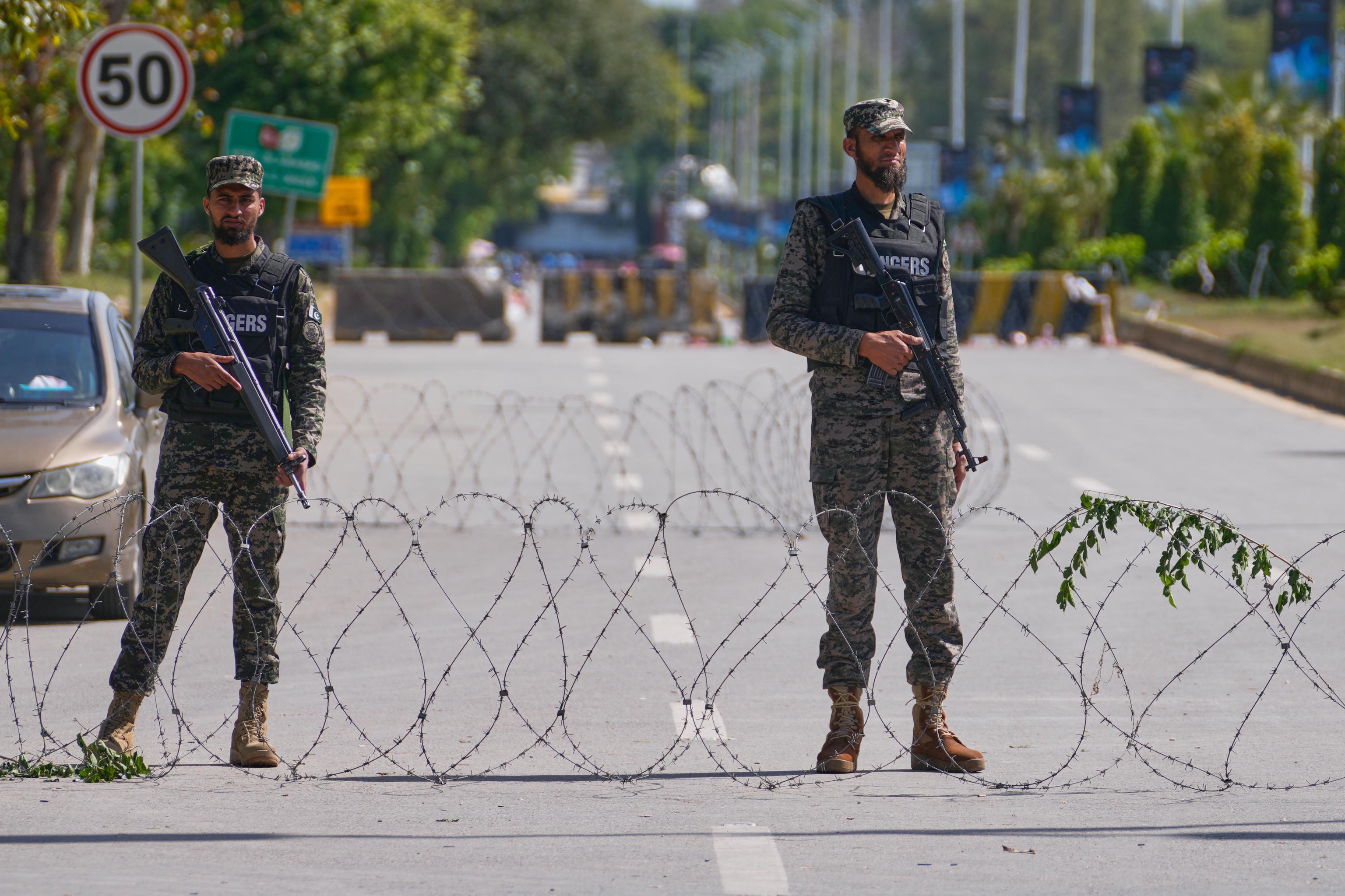
In Islamabad, municipal brigades have painted the sidewalks, set up fences, and cleaned roundabouts while columns of police and military personnel have consolidated an impregnable perimeter. The chaotic capital of Pakistan, designed for bureaucracy at the foothills of the Himalayas, has transformed into a fortress awaiting a long-awaited diplomatic meeting filled with uncertainty. This weekend, in its monitored avenues and under the shadow of the Margalla hills, the first direct talks between Washington and Tehran since the outbreak of the war that has shaken the Middle East are taking place.
All global attention is now focused on what happens in Islamabad, which emerged as the most functional mediator six weeks after United States and Israel launched an offensive that decapitated the Iranian power structure with the death of Ayatollah Ali Jamenei. The operation triggered a conflict present on multiple fronts: thousands dead, cross-border attacks in several countries, and an unprecedented disruption with the blockade of the Strait of Hormuz, the planet's energy artery.
After weeks of bombings, tense markets, soaring oil prices, and increasing pressure on economies dependent on Gulf-imported energy, it is finally time to sit at the negotiation table. Acting as the main neutral arbiter will be Pakistani Prime Minister Shehbaz Sharif, who has managed to capitalize on open channels with both parties to enforce a two-week provisional ceasefire.
Local television has reported in recent hours on the security deployment with over 10,000 personnel deployed on the streets. Authorities have declared two holidays to reduce traffic and facilitate control. Some highways surrounding the capital have been closed, and ministry employees have been asked to work from home. Islamabad does not want to fail in its role as a host or risk an incident derailing the diplomatic attempt.
The so-called Red Zone, where ministries and embassies are concentrated, has been completely sealed off. The luxurious Serena Hotel Islamabad, located next to the Ministry of Foreign Affairs, has been evacuated and turned into the de facto headquarters. Here, the delegations will sleep and, presumably, it will also be the venue for the meetings. "We want to inform you that the Government of Pakistan has requisitioned our hotel for an important event, until Sunday night," read a statement signed by the hotel manager.
On the US side, the White House has confirmed the presence of Vice President JD Vance, accompanied by negotiator Steve Witkoff and Jared Kushner. On the Iranian side, it was expected that the talks would be led by the Parliament President, Mohammad Bagher Ghalibaf, and the Foreign Minister, Abbas Araghchi, both with a background or links to the regime's security apparatus. The possible presence of representatives from the Revolutionary Guard remains a mystery that could set the tone for the negotiations.
The initial talks were scheduled to start on Saturday morning (local time). But at this moment, it is not entirely clear if Iran will attend. Iranian state media claimed on Friday that "no delegation has left Tehran" for Islamabad, while other reports in Western media, citing regional officials, have suggested that Araghchi and Ghalibaf traveled to the Pakistani capital on Thursday night.
Media outlets like Al Jazeera have reported that the planned format avoids direct contact. The delegations will be located in separate rooms, and Pakistani mediators will act as intermediaries, a scheme that highlights the depth of distrust.
For Tehran, the memory of recent contacts interrupted by US attacks remains very present. In that context, Vance's involvement, some analysts point out, is seen as a sign of greater political weight, although not necessarily of greater flexibility.
In recent hours, Washington and Tehran have been at odds over the scope of the agreed ceasefire, especially regarding the front in Lebanon. The brutal Israeli attacks on Lebanese territory have escalated tensions. And negotiations could fail before starting because some Iranian sources have stated that they will not sit at the table unless the ceasefire also covers Lebanon.
"The terms of the ceasefire are clear and explicit. US must choose: ceasefire or ongoing war through Israel. It cannot have both," Iranian Minister Abbas Araghchi wrote yesterday, quoting the April 7 announcement by Pakistani Prime Minister Sharif, declaring that the ceasefire applied "everywhere, including Lebanon."
The starting positions are far from converging. Iran comes with a ten-point plan that includes its reinforced control of the Strait of Hormuz — including the controversial ship toll policy — the withdrawal of US forces from the region, and the end of operations against allied militias. Washington, on the other hand, focuses its demand on the delivery of Iranian enriched uranium, a condition that Tehran currently seems to consider non-negotiable.