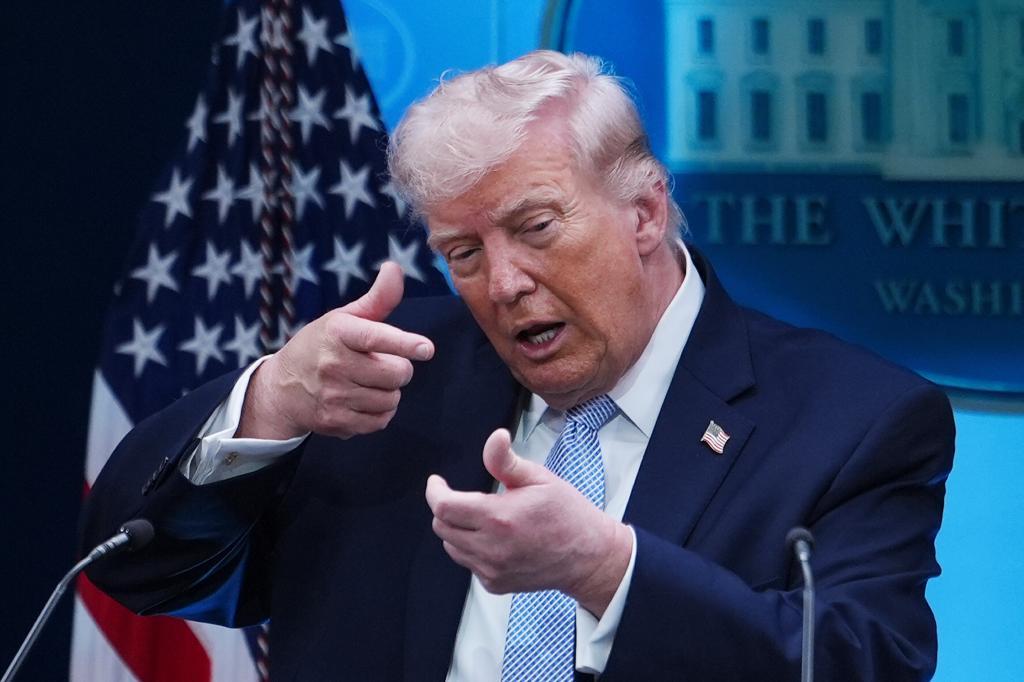
In two messages from the President of the United States, almost everything was said. "Nobody in this group, including our very disappointing NATO, understands anything unless pressure is exerted on them!!!" "NATO wasn't there when we needed them, and they won't be there if we need them again. Remember Greenland, that huge and poorly managed piece of ice!!!" he wrote on his social media. The roadmap after the chaos in Iran, the drop in popularity ratings at home, and the loss of prestige and credibility worldwide couldn't be clearer: pressure, risk of rupture, and even the possibility of forced annexation.
Donald Trump has a serious issue with the Atlantic Alliance, and it's no secret. It fits into the worldview he has held since at least the 1980s that the rest of the world takes advantage of the U.S., abuses its kindness, patience, and resources. He thinks about it commercially and certainly militarily. That's why his entire first term revolved around his partners being "freeloaders." He said it to their faces at summits in Brussels or London, to the media, to the Russians, and at home, bitterly complaining and demanding that everyone increase their contributions, threatening not to defend those who did not comply with the common commitment made in Wales in 2014.
His second term is even worse. It's not just about money, although that too, as he has forced the other 30 members to promise to increase Defense spending (broadly defined) to 5%, something that is only realistically achievable by buying American equipment. His strategy is now much more aggressive. Although the U.S. needs its European bases, European support, the essential springboard to project itself in the Middle East and Asia, Trump and his team have made it clear that they no longer trust NATO and that Russia (the reason for the Alliance's existence) is not a priority at all. Nor is it a top-level rival, as it has been until now. Almost the opposite. That's why he urges Europeans to start taking care of their own affairs. And that's why he also tries to make them follow his orders and wishes without too many questions. When that doesn't happen, as in the Iran war, everything blows up.
"It is often said that Trump is most like a schoolyard bully, cowardly with the strong and brutal with the weak. The image is partially correct but needs a complement. He resembles more an abusive partner, who takes out his personal or work frustrations on those closest to him. In this case, his allies," summarizes a diplomatic source pointing out how his fear or respect for Russia or China, and the helplessness with Iran, will be paid for by those who most need U.S. support: Ukraine, Gulf countries, or NATO.
In Brussels and the main capitals, there is currently a sense of enormous concern. According to Der Spiegel, the American president demanded behind closed doors on Wednesday to Mark Rutte that NATO countries step up immediately to ensure the security of the Strait of Hormuz. No more words or goodwill, actions. Or there will be very serious consequences. Hours earlier, the German economic newspaper Handelsblatt reported that allies were considering a naval mission to secure the strait, in an attempt to "appease" Trump.
"It's serious, much more serious than it even seems and than previous major crises," explains an allied source referring to what happened with the Iraq war or the famous snub by De Gaulle. "I have never seen anything like this and I don't even see a moderately bad outcome," says a second military source.
Fears, just a few weeks before the July summit in Ankara, are plentiful. Formally, Trump cannot pull the U.S. out of NATO without the support of Congress, thanks to legislation passed by Marco Rubio, now U.S. Secretary of State. But NATO only makes sense under the umbrella of collective defense. If the main member washes its hands, the rest is meaningless. Trump can leave the Alliance heartless, can break the idea that all members are equal with selective punishments. Or he can go further, trying a dramatic move in Greenland to offset the bad image seen in Iran, where the U.S. and Israel killed the government's top officials and destroyed many facilities but have been unable to reopen the Strait of Hormuz or force a real regime change.
"The moment we start questioning the alliance as a single, united entity, ready to act jointly and decisively, then, of course, its role is lost (...) Donald Trump has done more to undermine the credibility of the Alliance in the past few weeks than Vladimir Putin has achieved in many years. This, of course, is not good news," said Czech President Petr Pavel, a retired NATO general and former Chairman of the Alliance's Military Committee, on Thursday.
The Secretary-General, Mark Rutte, traveled to Washington this week. He met with Rubio, senators, gave speeches, and met with Trump, but unlike previous times, only behind closed doors, without joint appearances or media questions. Rutte came with a well-rehearsed script, without flaws. "The world is safer today than before the war in Iran, and that's thanks to Donald Trump and his leadership", he said on CNN. In the interview, the Dutchman admitted that the meeting at the White House had been truly tense and did not deny that the president is considering breaking up NATO, as his spokesperson suggested hours earlier. "He clearly told me what he thought about what happened in the last two weeks. He is clearly disappointed with many NATO allies, and I understand his point of view. But, at the same time, I could also point out to him that the vast majority of European nations have provided support in terms of bases, logistics, and overflights, as well as ensuring they meet their commitments," Rutte added, trying to appease his anger but also openly exposing some of the allies.
On the other hand, German Chancellor Friedrich Merz, in response to Trump's recent criticisms and the possibility that Washington may decide to "punish" Spain or Germany by reducing deployed troops or even closing a base, stated that in Berlin "no one wants, and I don't want, a division in NATO. NATO guarantees our security, including—and above all—Europe's," he emphasized.