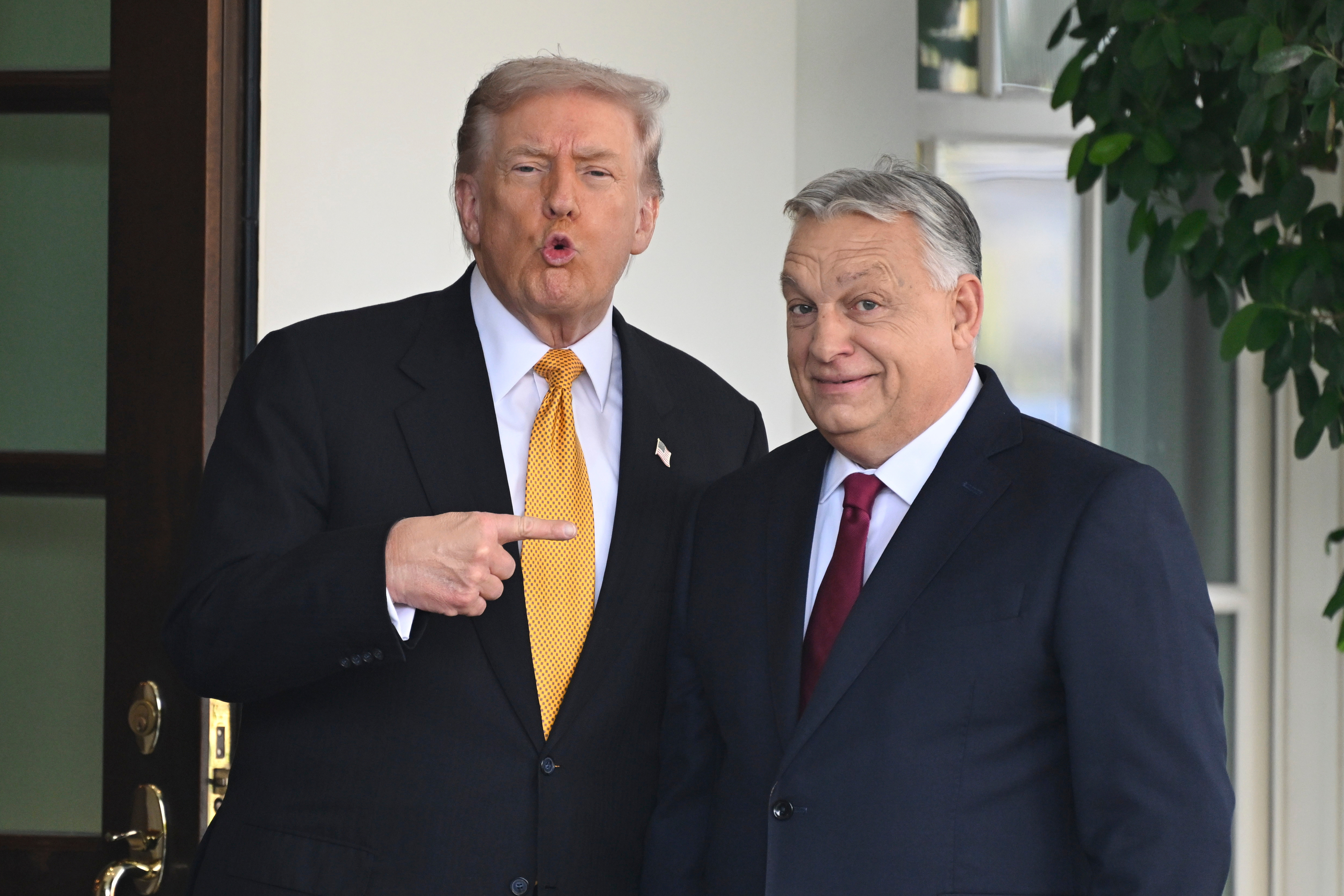
Brussels wanted to get rid of Viktor Orban. It sighed for his defeat, and that is exactly what happened this Sunday in Hungary: Péter Magyar's overwhelming victory will make things much easier in the European capital, should put an end to the continuous leaks of information to Moscow, and Budapest will no longer be a constant problem in aid measures to Ukraine. And the President of the European Commission, Ursula von der Leyen, already celebrates it.
"Hungary has chosen Europe. Europe has always chosen Hungary. Together we are stronger. A country regains its European path. The Union is strengthened," assured the German official on her X social media profile.
"Congratulations to the Member of the European Parliament, Péter Magyar, for the victory in today's national elections in Hungary. Hungary's place is in the heart of Europe," posted the President of the European Parliament, Roberta Metsola.
One of the most affected by this result, President Volodymyr Zelensky, celebrated in X: "Ukraine has always aspired to maintain good neighborly relations with everyone in Europe, and we are ready to intensify our cooperation with Hungary." He emphasized his desire to carry out "joint constructive work for the benefit of both nations, as well as for peace, security, and stability in Europe."
French President Emmanuel Macron has already spoken with the incoming Hungarian president "to congratulate him on his victory in Hungary." "France welcomes a victory of democratic participation, of the Hungarian people's attachment to the values of the European Union, and for a Hungary in Europe. Together, let's advance a more sovereign Europe, for the security of our continent, our competitiveness, and our democracy," he stated on his social media.
German Chancellor Friedrich Merz also congratulated his "dear Péter Magyar," who like him belongs to the popular family. "I look forward to our collaboration for a strong, secure, and, above all, united Europe," he added. "I look forward to working closely with Péter Magyar to make Europe stronger and more prosperous," pointed out the President of the European Council, António Costa. "Today Europe and European values win," posted the Spanish Prime Minister, Pedro Sánchez. And the leader of the PP assured that "in times of uncertainty, Hungary has massively voted for a pro-European party to strengthen stability on the continent." "Those of us who believe in liberal democracy, the rule of law, and the need to help Ukraine have reasons for optimism," he added.
References to the future of Europe, stability, and values are a constant in the reactions of European leaders. It is a good night in the European capital, in the vast majority of the Member States, and ultimately for the future of the European Union.
Now, the granting of the €90 billion credit to Ukraine should be accelerated. This measure was approved by the European Council back in December, and Orban committed not to block it on the condition that it did not affect him financially. But at the last moment, and when his approval was only needed for the European budget to support the debt issuance for the loan, he decided to block it.
The reason, he said, was Volodymyr Zelensky's sabotage to Hungary and the energy blackmail through the attack on the Druzhba pipeline. Now the situation should be unblocked, also by Kiev, whose relationship with Budapest has been very complicated, although Slovakia has already indicated that they are willing to block the credit if Hungary changes its stance. But even so, everything will be much simpler in Brussels from now on, and it will also be for key negotiations such as the next European budget, the approval of sanctions against Russia.
Zelensky himself has already stated that they are "prepared for meetings and for joint constructive work for the benefit" of Hungary and Ukraine, "as well as for peace, security, and stability in Europe."