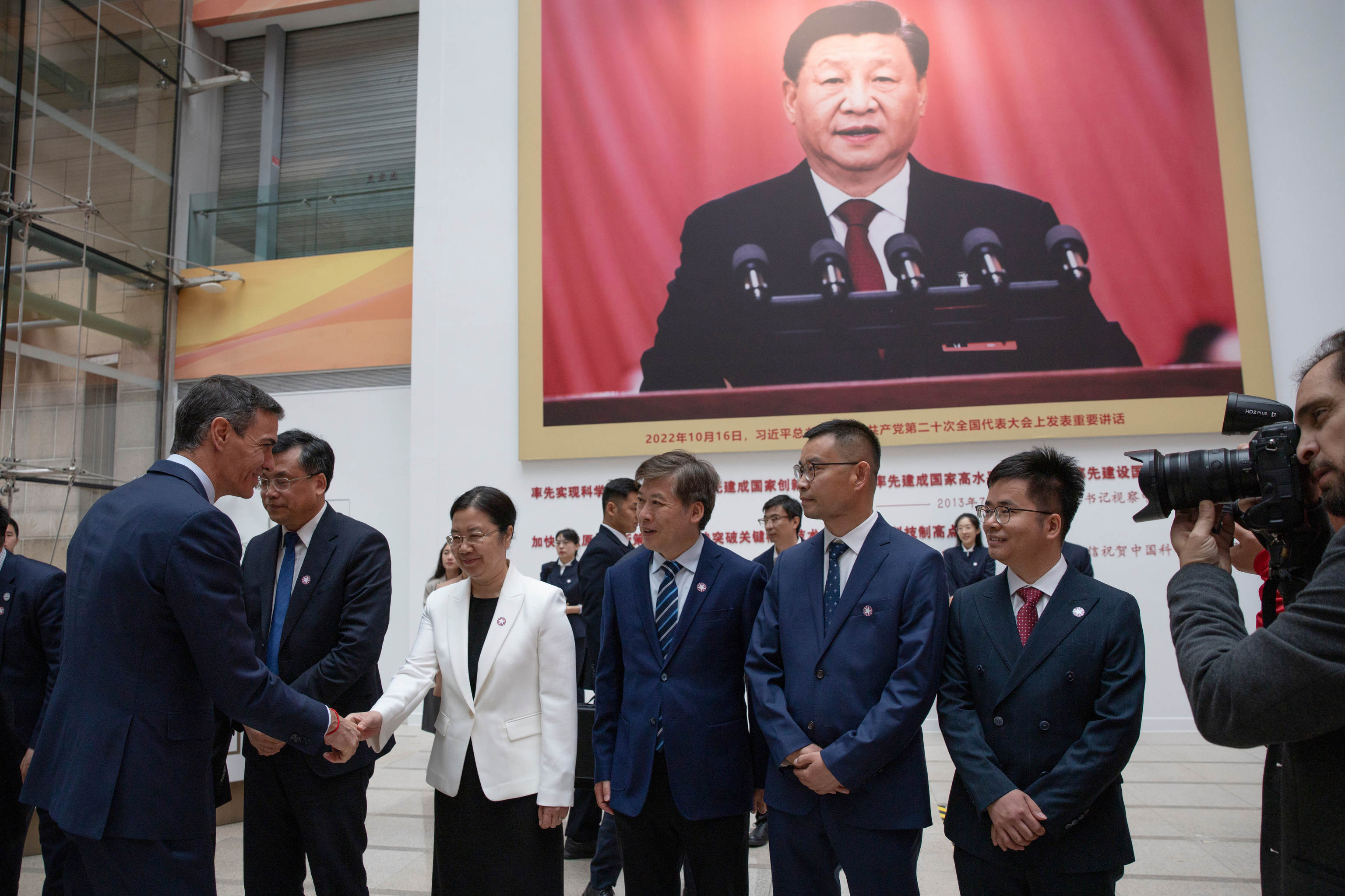
"A few months ago I was in Spain. It seems like a very interesting country to me, I want to learn more about it." Students from the School of Economics and Management, Social Sciences, International Relations, and the Languages Department of the University of Tsinghua, one of the most prestigious and selective in China, pass the time by checking their photos, chatting on social media, or some looking up information about Spain on their phones. Others are browsing recipes or making plans for the week. In the back rows of the auditorium, two students are checking what our country's flag looks like. Pedro Sánchez has started his official agenda in China, on his fourth visit in recent years to this country, with a lecture to university students. There, he made a plea for understanding between the European Union and China: "We are called to understand each other and to cooperate."
The relationship with China does not generate a unified position within the EU. There are different sensitivities. The Moncloa government advocates a firm position: getting closer to the Asian giant, being at the forefront of openness and understanding, at a time when another major market like USA is closing off, with Donald Trump prioritizing protectionism. Sánchez is clear that Asia is an opportunity, which is why in recent years he has been deploying an intense international agenda in this region, with a focus on intensifying trade relations with India and China. Spain leads the push for market diversification - Asia, Latin America - a philosophy that also prevails in EU action.
The economy is key. The trade deficit that the EU and Spain have with the Asian country. Sánchez has not sugarcoated the reality: the unbalanced trade and dependency. The head of the government has asked China to help them "correct the current trade deficit, which grew by 18% last year and is unsustainable for our societies in the medium and long term." In the specific case of Spain, he pointed out that the trade deficit with China accounts for 74% of our country's total deficit.
The trade deficit keeps growing
The data is concerning for Spain because despite the economic ties and the relationship with China bearing fruit, especially in terms of the presence of Spanish companies and products, the trade deficit continues to grow. The trade deficit with China increased in 2025 to 42.278 billion euros, compared to 37.706.6 billion in 2024, even though exports to the Asian country rose by 6.8%, after three consecutive years of decline. In total, Spain's trade deficit increased by 41.6% in 2025, reaching 57.054 billion. Hence, China's weight is 74% of the total.
Faced with the reservations that China generates in Europe, and with the US in a position of clash and distance with Europe, Sánchez sends a clear and direct message. "We need China to open up so that Europe does not have to close itself off." The President of the Government has warned of the danger of "isolationist movements." Europe wants to embark on a path towards open strategic autonomy, but while taking steps in key sectors such as technology, security, or defense, it needs powers like China not to close their doors. Sánchez has requested that, as happened four centuries ago, Europe and China advance in their understanding and cooperation.
Although Sánchez is leading an official visit as the leader of Spain, he has played a role as a spearhead for the EU, taking the opportunity to navigate the difficult path of relations with the Asian giant. Seeking national interest without forgetting the European perspective. "Europe is a key player. Without a united Europe, there can be no stable international order or prosperous future, just as there cannot be one without China's participation. We are called to understand each other."
Calls for more Chinese involvement for peace
Sánchez has delivered a well-thought-out intervention, with a deep look at the international geopolitical context and in Spanish. He went to the university accompanied by Begoña Gómez, who is accompanying him on this trip.
In addition to a message of openness, he has made a second request to China: greater involvement in world peace. The Asian giant plays a key role in conflicts such as those in Iran or Ukraine due to its alliances and political position with Russia and Iran.
The President of the Government, in light of the US proposals, believes that China should assume a greater role and play a stabilizing function. "China can do more by demanding, as it is doing, that international law be upheld in conflicts such as those in Lebanon, Iran, Gaza, the West Bank, as well as Ukraine, because international law is the basis of everything."
Precisely, in the last few hours, Donald Trump has threatened China with 50% tariffs if it sends military equipment to Iran.
During his visit in 2023, Sánchez already asked Xi to speak with Volodymyr Zelensky and defended the EU peace plan.