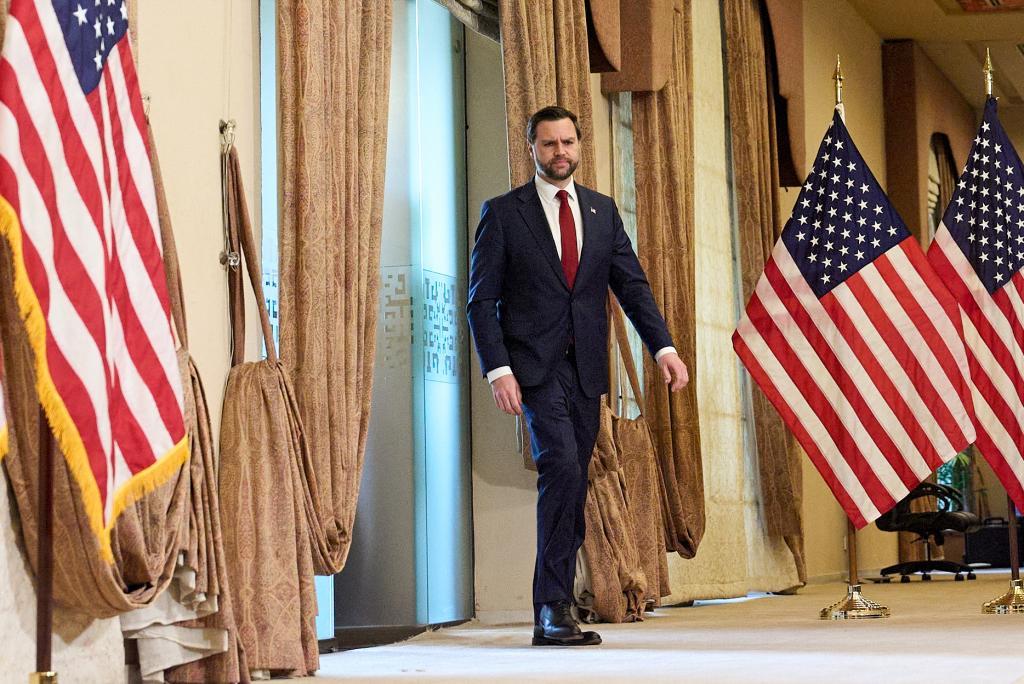
At the beginning of last week, during an Easter lunch at the White House, President Donald Trump made one of his characteristic unexpected turns in public interventions to address the possibility of using his Vice President JD Vance as a negotiator to end the war in Iran. "If it is not achieved, I will blame JD," he said, causing laughter among those present, "but if it is achieved, I will take all the credit," he concluded.
There is much seriousness in the 'joke' of the American leader, and it also says a lot about himself, his country, and its history. There are few things more Trumpian from the man who claims to have personally ended nine or 10 wars and to have won the Nobel Prize than blaming others for failures and systematically attributing all successes to himself. "I don't care if there is an agreement or not. Whatever happens, we win," he said on Saturday. But there is also a reflection of the institutional design. In the US, Vice Presidents have almost always had a secondary role, in perpetual tension and rivalry with the President. They were chosen for electoral reasons, not for affinities, and the relationship was almost always uncomfortable. The last Vice President, Kamala Harris, actually laments in her memoirs the little support from her boss and how Joe Biden's team did everything possible to belittle her and ensure she had little public presence, so as not to overshadow him.
Presidents are the ones who appear in photos mediating in wars (Middle East, Balkans, Africa), those who win the Nobel Prize (Teddy Roosevelt, Woodrow Wilson, Jimmy Carter, Barack Obama). Only one Vice President has won the award, Al Gore, and it was for his position on climate change. This makes Vance's choice much more interesting, probably the highest-ranking official in the US administration who was most against the war in Iran, against the umpteenth US operation in the Middle East, against dreams always turned into nightmares of nation-building and regime changes.
The reasons for Vance to be the mediator are actually many, starting with the most important: it interests everyone. Himself because he desperately needs to score points with Trump, gain political weight in the country, take advantage of opportunities no matter how complicated they may be, especially after analysts have been pointing out for months that Marco Rubio has been gaining ground in the fight for the leader's favor. Vance was not in the command room when Maduro was captured, he was not there at the beginning of the bombings in Iran (nor the day Netanyahu made the presentation that convinced Trump), and he is generally perceived as hostile to military expansion and interventionism. Media reconstructions of the decisions in these weeks show a skeptical Vice President, aware of the danger, but who in no case wanted to antagonize the leader.
In addition to Vance, the choice interests the President, eager to test the skills of the man, whom he barely knew, whom he chose in 2024 as his heir, despite his very short political experience (just two years as a senator) and the criticisms he had directed at him in the past. There is nothing juicier than putting the critic of wars at the center of one, taking responsibility for the negotiations. Also, linking both of their futures to his success. As noted by Karim Sadjadpour, an Iran expert at the Carnegie Endowment for International Peace, "although Trump hoped to determine the future of Iran, now it is Tehran who could determine his own. Iran has a veto power over Trump's legacy and the political future of his Vice President."
Ironically, the Iranians also seem very interested in Vance being their interlocutor. Because he is a heavyweight in the administration, not just any diplomat. Because Trump has shown that, unlike his predecessors, he gives him a lot of prominence and invites him when he meets all world leaders (in his first term, Trump sent his Vice President Mike Pence to Turkey or Israel for delicate peace negotiations). Because, of all the MAGA figures, he apparently is the one most eager to return to America First and forget about the Middle East. Because Vance has more interest than anyone in succeeding in his ambition. Because he is not an expert. And above all, because he is neither Jared Kushner, Trump's son-in-law, nor his special envoy, Steve Witkoff, perceived for obvious reasons not only as very close to Israel and Netanyahu but also to the Gulf countries, with which both have very strong economic and business interests.
For Vance, who in 2025 went to the Munich Conference to shake up US relations with Europe, who has been appointed as the anti-fraud Czar at home, and who this week was in Budapest helping Viktor Orban, dealing with Iran is by far the most challenging, demanding, and complicated task of his vice presidency. He has no experience in these tasks, no knowledge of the region, the problems, the nuances. He has much to gain, but also much to lose if the negotiations fail, as they are by far the highest-level talks between the two countries since the Islamic revolution of 1979. Barack Obama and Hasan Rouhani spoke on the phone in 2013, but never met.
Trump seems to have grown tired of the war, seen that it leads to nothing good, that it diminishes his popularity, so he has incentives to end it soon, but also for someone else to take responsibility if it does not happen quickly. Iran knows it is an election year in the US and that Republican weariness is significant. Vance did not actively participate in the indirect talks between Washington and Tehran prior to the unstable two-week ceasefire. Witkoff and Kushner were the ones leading the way, with many conflicting interests, but they also have no experience with the ayatollahs. The Obama administration spent over two years on the nuclear deal; the European Union mediated for the last seven years, in vain, to try something similar. Now, on the table, are that issue, but also sanctions, the opening of the Strait of Hormuz, the delicate situation of neighboring countries, the pressure from Russia and China. Too much for a novice, too little time. But when everything else has failed time and time again, the definition of insanity is to keep trying the same thing.