Located in northeast Beijing, nestled between the Summer Palace, the former imperial court's summer retreat, and a mega-technological park, Tsinghua University has evolved from a technical school inspired by Western models to become one of China's most prestigious universities. Founded in 1911, it is a center of academic excellence that focuses on leadership in science, technology, engineering, and mathematics. But it is not just a breeding ground for engineers and scientists; it is also a major hub of political power.
This university forges connections that later extend to the highest levels of Zhongnanhai, the headquarters of the ruling Communist Party (CPC). Chinese Supreme Leader Xi Jinping studied Chemical Engineering here, also earning a doctorate in Marxist theory.
Several presidents, prime ministers, and high-ranking members of the powerful Politburo have passed through this university, solidifying its reputation as a kind of "Harvard of the Communist Party." A place where, despite its purely technical DNA, the proximity between the faculty and the centers of power makes Tsinghua function as a strategic axis: many students who emerge from its classrooms end up weaving networks of influence that will last for decades.
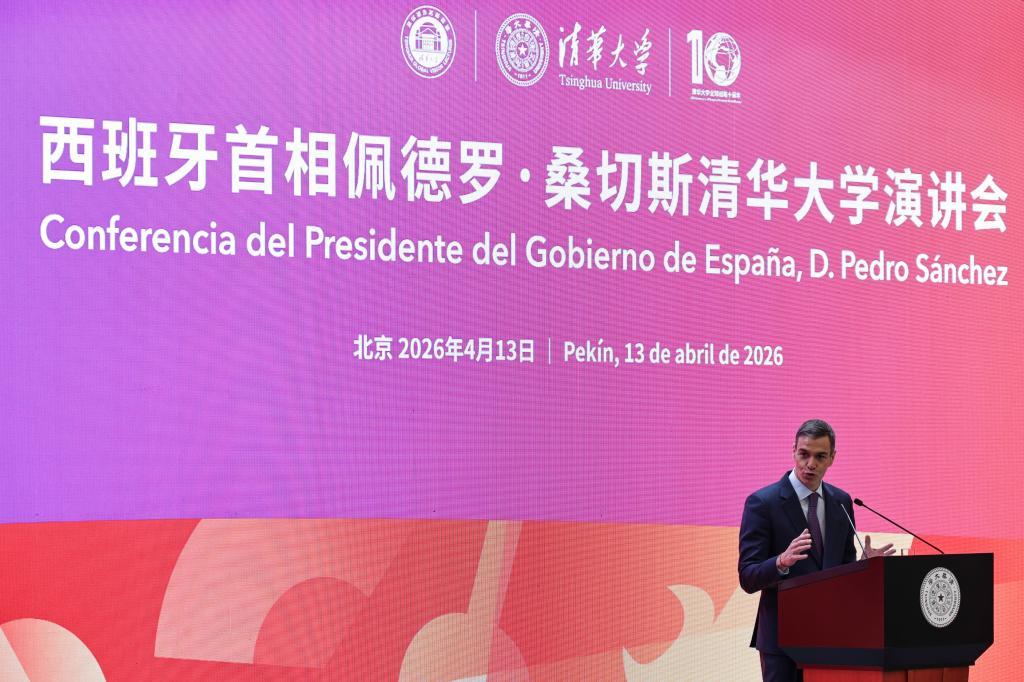
Spanish President, Pedro Sánchez, who is on an official visit to China, visited the main campus of Tsinghua on Monday accompanied by his wife, Begoña Gómez. There, after a speech in front of the students, he met with a group of prestigious academics, some of whom also advise the Chinese government.
In present-day China, power often speaks the language of equations. Unlike Western political elites shaped in Law or Political Science faculties, many of the current leaders of the country have backgrounds in engineering, physics, or chemistry. Figures like Xi, or former President Hu Jintao, share this technocratic origin. This is the result of a historical process that was consolidated after the reforms of the reformist leader Deng Xiaoping when the CPC decided that the country's modernization should be in the hands of individuals capable of literally building it from the ground up.
This university has traditionally been a fertile ground for CPC political cliques, internal networks where loyalty and family connections determine careers in the regime's elite. And Tsinghua's influence extends even beyond China: distinguished alumni hold prominent positions in international organizations and major U.S. technology companies.
In the scientific and technological field, its laboratories lead research in artificial intelligence, semiconductors, renewable energies, and applied physics. Academic prestige combines with the goal of turning innovation into a global competitive advantage. Each project reflects the vision of a country that sees science and technology as extensions of its economic and geopolitical power.
The backbone of technological development
Many of the professors and researchers at Tsinghua also hold significant positions in the Chinese Academy of Sciences (CAS), the country's main center for research and scientific thought, an innovation machinery that covers everything from quantum physics to AI, renewable energies, and biotechnology.
President Sánchez also visited the CAS facilities, where he was introduced as "Professor Sánchez" after receiving an honorary professorship from the university associated with this center. A title that has been awarded to several Nobel Prize winners and also to Prince Andrew, Duke of York, now discredited due to his connections to the Epstein case.
The CAS has an extensive network managing over 100 institutes throughout the country, with tens of thousands of researchers on staff, many of whom are world leaders in their fields. In a nation where scientific research is closely linked to state policy, CAS acts as the backbone of technological and scientific development.
One of the projects developed by CAS researchers that Sánchez aims to bring to Spain is the world's first AI-based hybrid pollination robot, which is expected to significantly improve crop yields.
During his visit to the center, Sánchez also learned about one of CAS's projects involving Spanish institutions: the Einstein Probe, a space mission that seeks cosmic phenomena such as gamma-ray bursts, black holes, or neutron stars using an innovative optical system inspired by Albert Einstein's ideas. Launched in 2024, the satellite can scan large portions of the sky in real-time.
One of the most well-known space programs developed at CAS is the Micius quantum satellite, launched in 2016, which made China a pioneer in quantum communications from space, enabling the transmission of virtually uninterceptable encrypted information. Building on this satellite, researchers have promoted quantum communication networks between cities in the country, laying the groundwork for a future quantum internet with enormous implications for cybersecurity and defense.
In the field of space exploration, CAS has played a key role in missions like Chang'e 4, the first to achieve a lunar landing on the far side of the Moon.