Not long ago, until the endless military offensive of Netanyahu and the heinous crimes committed in Gaza among other consequences politically divided Europe, the Eurovision Song Contest, beyond its festive nature and television program, was synonymous with the same values that are part of the community. Diversity, tolerance, freedom, and respect for minorities have been essential to the contest for decades, an event that goes far beyond music. Today, the Festival is going through an existential crisis, precisely as it celebrates its 70th anniversary, marked by Israel's presence and the boycott of several key countries in the competition, including Spain. It is in these circumstances that Eurovision gains more relevance than ever in the 21st century, becoming the Festival that offends our tyrants and leaders of the illiberal and anti-European drift, then Trumpian, with the now defeated Viktor Orban at the helm.
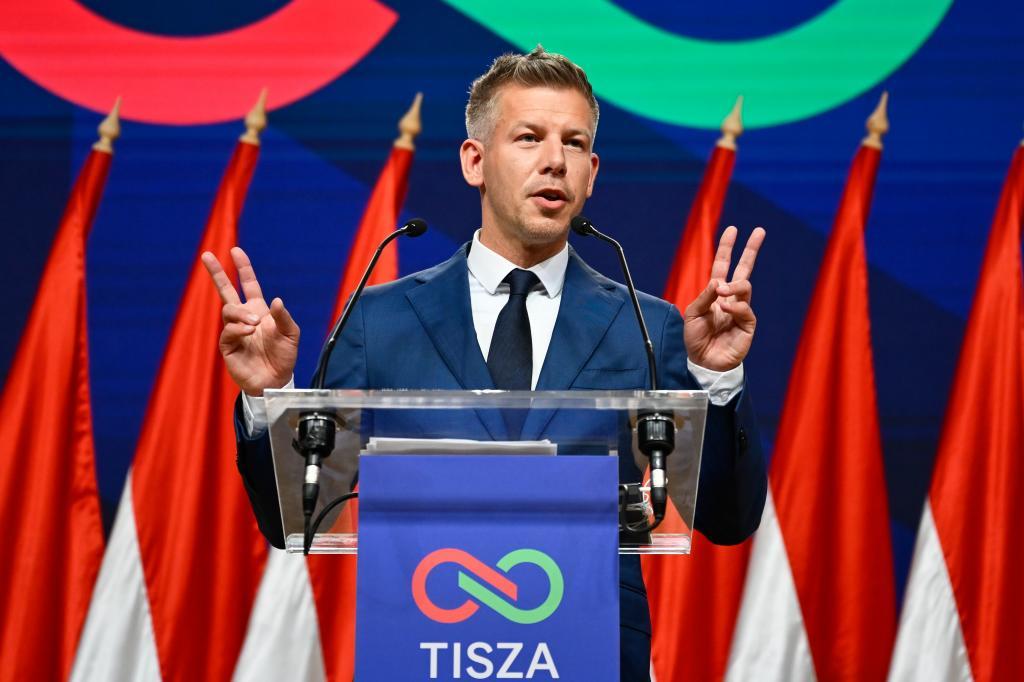
So much so that the newly elected winner of the legislative elections in Hungary and future Prime Minister, Péter Magyar, raised his voice last summer to demand his country's return to the contest. "Eurovision is a European platform that allows us to showcase our culture and musical talent to the world. Hungary needs to be present on that stage again and leverage its artistic potential," emphasized Magyar, who was already riding the wave of change that was being felt in Budapest and other cities of the nation. It is worth remembering the massive LGBTQ+ Pride march held in the capital at the end of June, a symbolic and unequivocal citizen challenge to the authoritarian Orban, whose government had banned the march after tightening the appalling laws against the "promotion" of homosexuality.
Magyar demanded Hungary's return to Eurovision, from which it has been absent since 2019 when their last representative, Joci Pápai, participated in the edition held in Tel Aviv. There was never an official explanation from the Hungarian public broadcaster MTVA regarding the reasons for withdrawing from the contest. However, it was common knowledge that it was an order from Orban's government, which ordered the withdrawal precisely because they considered that the Festival showcased values that he had tried to combat like an Attila. In particular, the numerous nods to the LGBTQ+ community in the contest irritated the Fidesz leader.
Magyar stressed that Hungary's presence in the Festival "would improve the country's external image, promote a greater sense of national unity, and strengthen its relationship with the European Union." The opposite of what Orban intended, of course. "The Eurovision Song Contest is not just a music competition, but also an opportunity to express our identity and cultural values in Europe," added the now winner of the legislative elections, who was clear on the matter: "It is a mistake not to participate, and we should not have withdrawn."
Furthermore, in stark contrast to Orban, Magyar also supported the EBU's decision in 2022 to exclude Russia and Belarus from the contest following the large-scale invasion of Ukraine. "I agree with the exclusion of Russia; we should not allow any war criminals to participate," stated the opposition leader who led Hungary.
Erdogan and "normal people"
Hungary is not the only Central European country concerned about this issue. Turkey withdrew from the Festival in 2012, which had millions of viewers, when Erdogan, in his authoritarian and Islamist drift as Prime Minister, deemed that his political project was incompatible with the freedoms that Eurovision exuded. The Turkish leader has never gotten over his Eurovision obsessions. "Eurovision poses a threat to traditional family values," he declared in 2024. He went on to say that participants in the contest are "Trojan horses of social corruption" (sic) and that in the event "it has become impossible to meet a normal person". Despite this, Turks had to resort to piracy or digital links for many years to continue watching the contest without national representatives.
In Turkey as well, the return to the contest has become a desire of the besieged opposition, as it symbolizes embracing the European values that are currently suppressed by an almost autocratic personalistic regime. Opposition candidate Kemal Klçdarolu - who, leading a broad coalition, tried to wrest the Presidency from Erdogan in 2023 - denounced the "shameful decision" to withdraw from the Eurovision Song Contest. Klçdarolu criticized the Ankara government for preventing Turkish artists from participating in the most-watched music contest in the world and, above all, for banning citizens from watching it.
The fury of ultra and populist parties in Europe against the contest has increased in recent times. In Latvia, the Parliament had to debate in 2024 the country's continuity in the contest, following a campaign against it that claimed participants "tend to behave obscenely" (sic). The Saeima - the unicameral legislative body in the Republic of Latvia - held a session to discuss the matter, and a motion presented by the ultras leading the march was rejected. The director of programming of the national public television had previously explained the importance of the contest for the local music industry, as well as the huge following and impact of a contest watched by almost 200 million people worldwide.
Similarly, in neighboring Lithuania, the national public broadcasting authority had to respond to a request, promoted among others by the controversial MEP Petras Grazulis, to stop the nation's participation.
Both cases were inspired by what had already happened in Hungary. Magyar's overwhelming victory at the polls promises to steer Budapest back towards the European path. And if he keeps his promise, one of the most visible symbolic gestures of Hungary returning to the European common home will be seen in 2027 with the anticipated return to the Festival, much more than a song contest, as geopolitics continues to demonstrate.