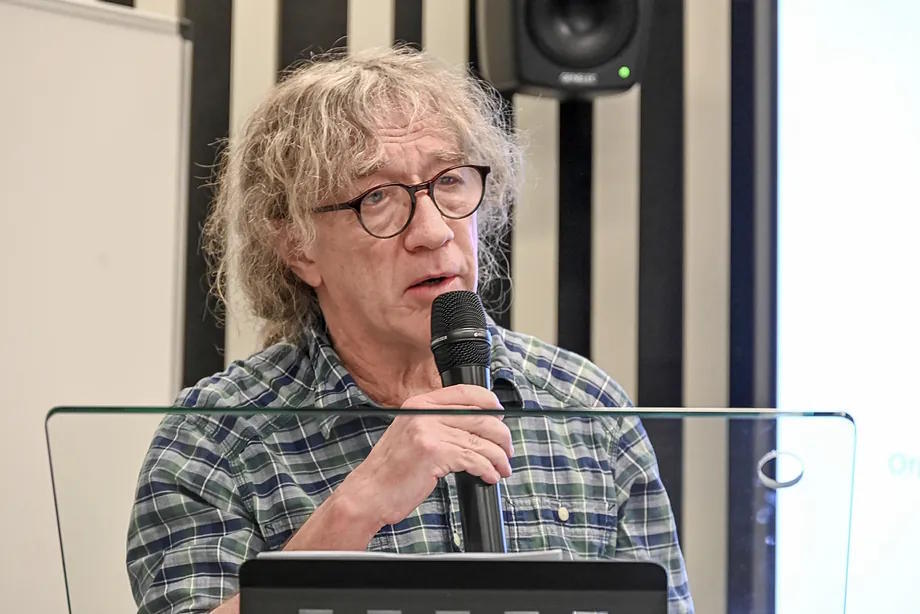
Sociologist István Hegedüs (Budapest, 1957) presides over the NGO Hungarian Society for Europe and has been involved in politics since the fall of the communist regime in his country in 1989. As a delegate of opposition groups, he participated in negotiations on Hungary's transition to democracy. He analyzes the end of another regime, that of Viktor Orban.
Question. Did you expect Orban's defeat to be so decisive?
Answer. Yes, because reliable research institutes had been predicting a massive victory for Tisza. Median, which is the most rigorous polling agency, had exactly that forecast in recent weeks. However, the official polls spoke of a crushing victory for Fidesz, and although I didn't believe them because they are part of Orban's propaganda machinery, you never know. You are here in the center of Budapest and have no idea what is happening in rural areas. But they were cheating. They were trying to appear and mobilize their followers.
Q. Considering that Peter Magyar belonged to Fidesz until 2024, what has allowed him to shed the image of a "system man" and be seen as a real alternative?
A. For me, it was quite convincing from the very beginning. It was evident that he was fed up with what was happening within the party. At first, everyone was very cautious. Gradually, it became clear that he was not a Fidesz infiltrator sent by Orban to the opposition. Both intellectually and morally, he increasingly convinced skeptics. That is just one of the reasons for his victory, but he did not win just for being a dissident, but because he had enough talent to take advantage of a new movement after so many Fidesz scandals. He managed to unite people and first gain control of the opposition space. Then he went further, with direct rhetoric, clear language, sharp messages, and a lot of work. Voters who wanted to get rid of Orban had many issues with the so-called "old opposition," whether they had been there since the fall of communism or were relatively new. Step by step, voters became convinced that Péter Magyar was a reliable alternative. Whether they were left-wing, green, socialist, moderate conservatives, or liberals, they decided to form a kind of citizen coalition to support him. Some are truly Magyar supporters, but others simply began to believe that he is finally the man capable of defeating Orban.
Q. In yesterday's press conference, Magyar stated: "We have no time to waste; the country has been looted and burdened with debts." Do you think these words will mark the starting point of his government?
A. It may take a few weeks, or perhaps a month, until he is sworn in as prime minister. But yes, it is expected that he will start with a very rapid change, with a new government structure and new policies, especially on key national policy issues such as healthcare, education, or the economy, among others. But there will also be changes in the international sphere: he will leave behind that pro-Russian and anti-Ukrainian stance to align with the majority European position. That is what I foresee for the coming weeks.
Q. After several very difficult years with Orban, what can the European Union expect from the next Hungarian prime minister?
A. Cooperation and alignment with the European mainstream: he will stop vetoing any decision that other member states want to push through. During his campaign, he said we have to choose between East and West, and he is, of course, betting on the West, which in Hungarian rhetoric means Europe. On Sunday, during the celebrations and the "day of liberation," people were chanting "Europe, Europe!" So I believe the EU will encounter a new partner, not someone who blames Brussels—whatever that means to him—for everything: for war, sanctions, or inflation, as Orban did. For EU and member state leaders, the change will be drastic. There is now a politician and a new government willing to collaborate on the most important issues. Magyar wants to unlock frozen funds destined for Hungary and is willing to accept all imposed conditions: I refer to the clauses on human rights and the rule of law that any member state should default to.
Q. Can Ukraine expect a significant shift in Hungary's policy?
A. Of course, there will be a change, and it is already noticeable in the rhetoric. Ukraine is no longer blamed for everything. Orban almost criminalized Ukraine, turning it, according to his discourse, into Hungary's enemy. He went too far, and one of the reasons for his defeat may be precisely that many people did not believe that narrative. Many people do believe that there is a danger that Hungarians will have to go to war, and that is why Magyar always emphasizes that Hungarians will not have to go to fight under any circumstances. But beyond that, I think he aims to improve relations with our neighbors, including Ukraine. Perhaps he will not travel to Kyiv tomorrow, but I hope that, sooner or later, he will manage to forge a much better relationship.
Q. Do you expect Russia to counterattack?
A. I do not think Russia has many chances to undermine Magyar's government. In reality, what was happening was that the Hungarian government itself was using and spreading Russian disinformation and fake news. It was not a discourse that came directly from Russia, but a Hungarian version of the Russian narrative, portraying Ukraine as the aggressor and not the victim. I believe that is over. It will be very difficult for Russia to interfere because the anti-Russian sentiment is much stronger than it was six months ago. On Sunday, the young people celebrating the opposition's victory were chanting "Russians, go home!" which is an old Hungarian slogan from the 1956 revolution. This indicates that Russians will not find it easy to impose their narrative in this new stage of Hungarian politics. We may see some covert Russian propaganda directed at extremists or the harder sectors of Fidesz, but I do not think their influence will be decisive.
Q. Does this weaken the influence and narrative of Donald Trump in Europe, or is it just a local setback for the global populist movement?
A. All this international populism has received a blow, a resounding defeat. What happened with Orban affects not only Hungary but all illiberal populism internationally. Although people in the US will not decide their vote based on Orban losing power, it is a symbolic blow. Trump saw Orban as a very solid ally within the EU, and that is over. Now there will be a much more pragmatic relationship between Hungary and the US, like the one that exists with any other EU member state. Trump has never been popular in Hungary, just as he is not in other Union countries. Trump's support or J.D. Vance's visit to Hungary last week did not matter at all; they did not change the mood of a population that had already decided whom to support. People who are fed up with Orban, whether for ideological reasons or, in the case of rural areas, due to everyday wear and tear and national politics, no longer buy into that image of a "strong man." The fact that Trump has a special relationship with him is no advantage. In fact, having such close ties with Putin and Trump did not benefit him at all. The idea that Orban is a strong leader capable of deciding our global future only resonates with a small part of the population.
Q. The future prime minister has very conservative convictions. What can minorities expect from his government?
A. He is not as conservative as he might seem. He simply comes from Fidesz, which 20 years ago was less conservative than it is now and, of course, much less liberal than he is today. Magyar seems to have understood that he has received a lot of support from left-wing, liberal, and green voters, among others. I would say he is more center-right than pure center, especially on issues like migration or "political correctness," but he is very pro-European. He is in favor of a liberal economic policy, human rights, and also minority rights; and in Hungary, talking about minorities mainly refers to the Roma people. In his electoral list, there were five Roma candidates, and I believe all of them have entered Parliament because they held prominent positions. This shows that he is trying to be more open and does not use that conservative, Christian, or markedly nationalist rhetoric. He may be more nationalist than someone with a radical progressive stance, but he is center-right. He is by no means a reactionary.