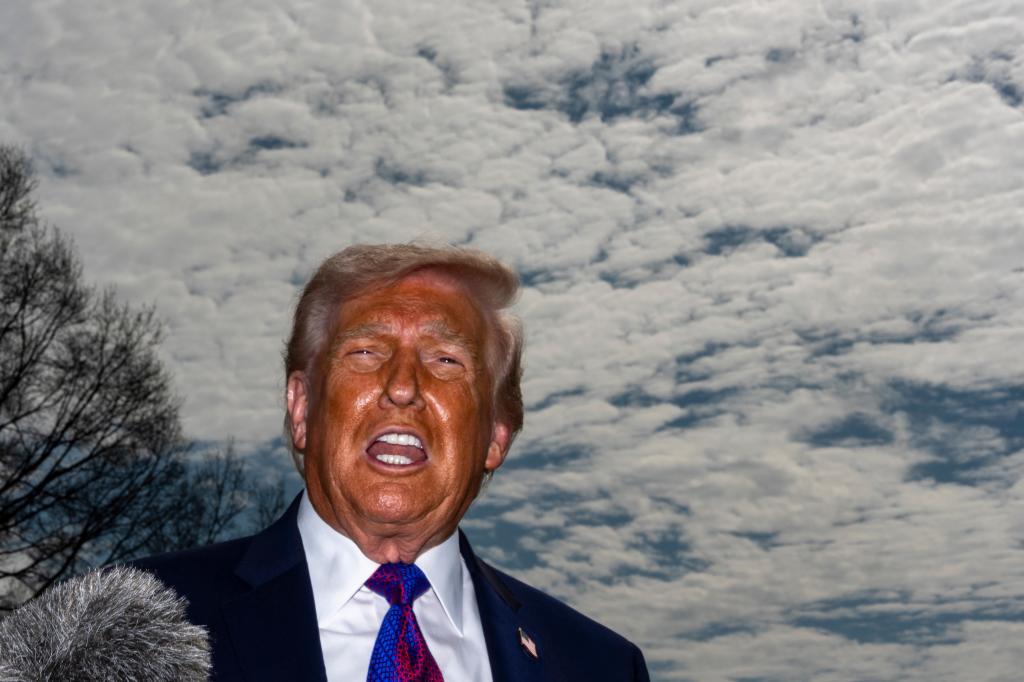
The President of the United States, Donald Trump, has opened a new front of media and political battle against Pope Leon XIV (Robert Prevost), accusing him of interfering in state affairs. Tensions have escalated to unprecedented levels after the president posted an image generated by artificial intelligence in which he is depicted with a messianic aesthetic, similar to a healing Christ, sparking a wave of global outrage. Through his social network, Truth Social, Trump launched a harsh attack against the Pontiff, urging him to "focus on being a great Pope, not a politician," as he believes that he is "harming the Catholic Church."
The U.S. president did not hold back on insults, stating that "Leon should step up as a Pope, use common sense, stop pleasing the radical left." The origin of the conflict lies in the Vatican's criticism of Washington's foreign policy, especially following the bombings in Iran and the attacks in Lebanon. Trump was clear: "I don't want a Pope who thinks it's okay for Iran to have a nuclear weapon. I don't want a Pope who finds it terrible that the United States has attacked Venezuela (...). And I don't want a Pope who criticizes the President of the United States when I am doing exactly what I was elected to do."
Trump's provocation went further with the dissemination of an AI image where he is seen laying hands on a sick person in a sacred manner. Although the image was removed after criticism from Catholic and evangelical sectors, the president justified it with irony: "I thought I looked like a doctor. Because I make people feel better."
From the White House's perspective, there seems to be a superficial understanding of Vatican dynamics, even suggesting that Leon XIV, being American (born in Chicago), should align with Washington's interests. Pope Leon XIV, known as the "Latin Yankee" for his missionary experience in Peru, responded calmly aboard the papal flight to Algiers.
"I don't want to engage in a debate with him. I don't believe that the message of the Gospel is meant to be used in the way some people are using it," declared the Pontiff. Far from being intimidated, the Pope reaffirmed his commitment to active neutrality: "I will continue to speak out firmly against war, seeking to promote peace, fostering dialogue and multilateral relations between states to find fair solutions to problems."
With total composure, he added to journalists: "No, I am not afraid of the Trump administration, nor of proclaiming the message of the Gospel loudly, which is what I believe I should be here for." The attack has led to a strong defense of the Pope. The President of the U.S. Conference of Catholic Bishops, Paul Coakley, lamented Trump's words: "Pope Leon is not his rival; nor is the Pope a politician. He is the Vicar of Christ, speaking from the truth of the Gospel and for the care of souls." In Europe, leaders like Giorgia Meloni have described the U.S. president's words as "unacceptable," safeguarding the spiritual authority of the Pontiff against Washington's political onslaught.