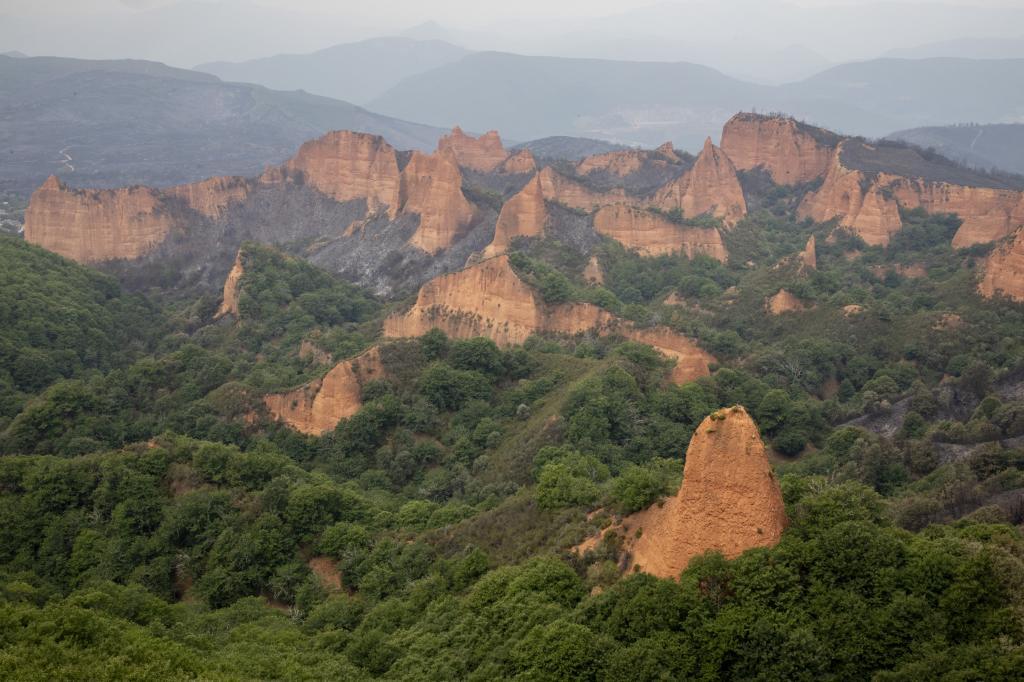
At the foot of the Aquilanos mountains and next to the valley of the Sil river, in the Leonese region of El Bierzo, there is a landscape of reddish spires, tunnels, and cavities that seems to be taken from another planet. However, what we admire today as a unique natural environment is actually the result of one of the largest mining operations of Antiquity.
We are referring to Las Médulas, an environment formed by an ancient gold mine of the Roman Empire. Its value is such that it was declared a Cultural Heritage Site in 1996 and a World Heritage Site by UNESCO the following year.
The secret behind Las Médulas, the largest gold mine of the Roman Empire
Over two thousand years ago, the Romans completely transformed this territory to extract gold on a large scale. They used a technique known as ruina montium, which consisted of excavating galleries inside the mountain and then flooding them with water to cause their collapse.
"It was applied to reach at once the levels that contained more gold, above which there were levels of considerable thickness, but poorer in gold," explain from the Superior Council of Scientific Investigations (CSIC). It is estimated that during the 1st and 2nd centuries, this mine produced tons of gold destined to finance the vast Roman Empire.
The exploitation was abandoned in the 3rd century and the native vegetation of the place took over the landscape. At the same time, the cultivation of chestnut trees expanded.
The result of the technique used by the Romans is the spectacular current landscape with towers of reddish earth, caves, and passageways. In total, over 400 kilometers of channels were built, and some of them can still be explored.
Hiking routes to discover Las Médulas
Exploring some of the hiking routes of Las Médulas is the best way to get to know this wonderful place. Among the most well-known is the Valiñas trail, 18.1 kilometers long and of moderate difficulty. "It starts from the town of Las Médulas and can be done on foot or by bike, as it is mostly paved," say from the Las Médulas Foundation.
Other popular routes are the Perimetral trail, circular and 14.6 kilometers long, the Zufreiros del Frade trail, 6.5 kilometers long, or the Somido Lake trail, very easy and less than 2 kilometers long. It is best to go to the Visitor Reception Center of Las Médulas, located in the small town of the same name, where they will recommend which one to choose depending on the time you have and your level.
All routes are well signposted and allow you to take a journey into the past to discover one of the greatest achievements (and excesses) of the Roman Empire.