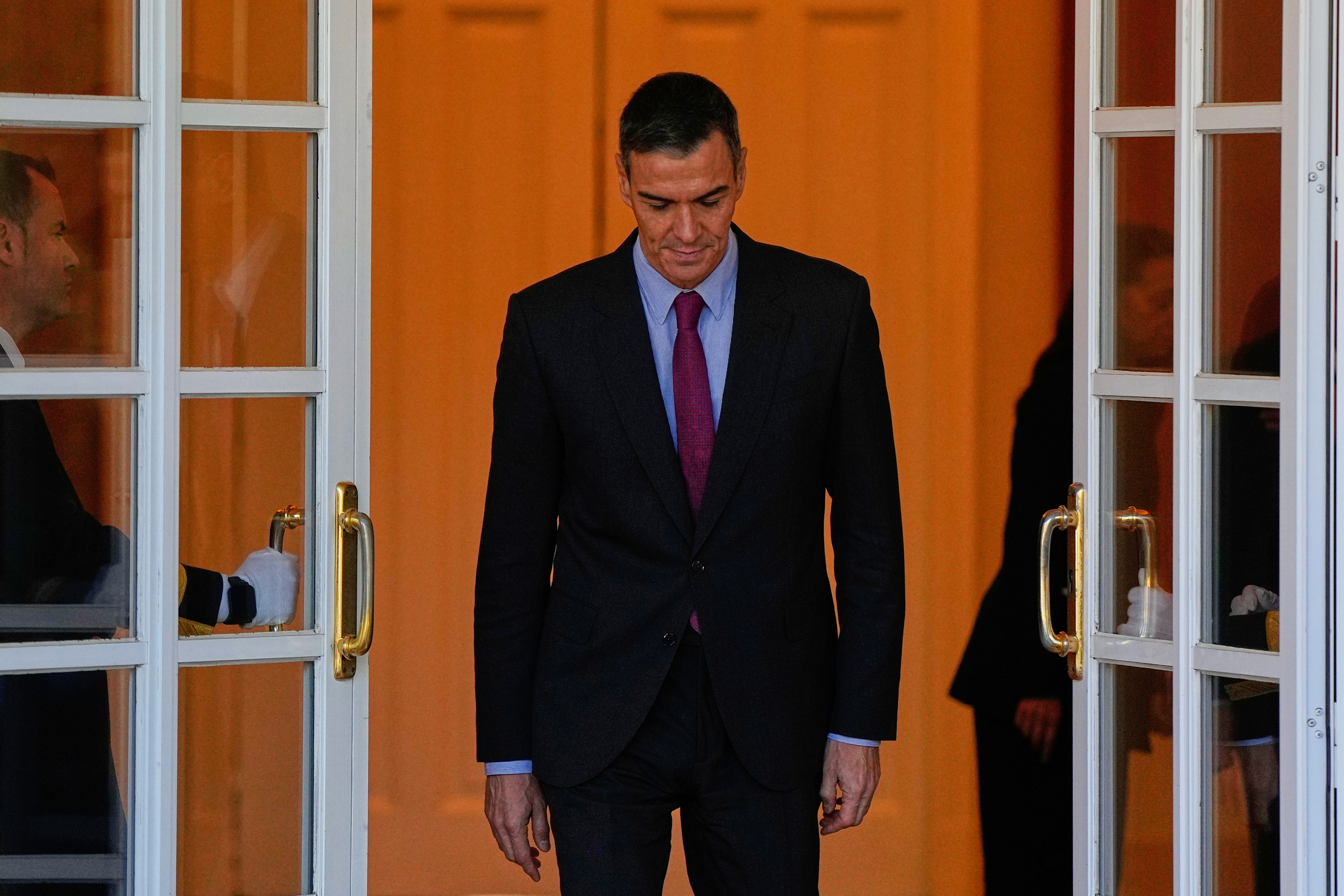
In the Great Hall of the People, under the meticulous liturgy of Chinese diplomacy, Pedro Sánchez and Xi Jinping yesterday staged great harmony. The start of the meeting, open to accredited Spanish press, offered the image of an understanding without edges and a shared argument: defense of multilateralism and rejection of a "return to the law of the jungle." This is not a casual or improvised phrase. It is another piece of China's rhetorical repertoire, polished over the years, with which Beijing criticizes the global chaos that Donald Trump has accentuated since his return to the White House.
But, as is usual in these types of meetings held on the grand institutional stage of the regime, what is seen in public is only part of the script. The other half - denser, more political - is written afterwards, in the official statements that China uses not only to inform, but to take a position and, sometimes, to reinterpret the words of its interlocutors.
In front of the cameras, Xi concluded with another of his usual formulas: both leaders, he said, are "willing to stand on the right side of history." A recurring phrase in his diplomacy, used with partners considered pragmatic or receptive. All of this was reflected in the Spanish coverage. What was missing, as is almost always the case in these types of meetings, was the other half of the story: the official Chinese version of a meeting that lasted for about an hour.
Beijing's statement, published hours later, reproduces part of that script, but adds nuances - and omissions - that reveal more about China's interests than about the verifiable content of the meeting. Xi insists on the praise: "China and Spain are countries with principles and morally upright," the note states, before advocating for "strengthening communication" and "opposing the regression of the world to the law of the jungle." Up to that point, continuity.
The significant part comes when the text introduces quotes attributed to Sánchez that were not heard in the segment open to the press, but diplomatically are the most weighty. According to Beijing, the Spanish president stated that Spain "greatly values China's position as a major power and is committed to developing a strong strategic alliance." Even more delicate, especially for Moncloa, is the following point: the Mandarin-language statement maintains that Sánchez affirmed that "Spain firmly adheres to the principle of one China." The translated version in Spanish starts with the phrase "Spain is committed to...".
The semantics here are key. Spain, like most Western countries, has traditionally supported the "one China policy": an ambiguous formula that recognizes the People's Republic as the legitimate government but avoids explicitly pronouncing on Taiwan's sovereignty. The "principle of one China," on the other hand, is Beijing's formulation, which asserts unequivocally that Taipei is an inalienable part of China. This is not a technical detail but a diplomatic red line. For example, during Sánchez's visit to Beijing in 2024, the Chinese side stated that the Spanish president "firmly adheres to the one China policy," not to the "principle."
For Taiwan, an island that operates de facto as an independent state, with its own constitution, army, and democratically elected leaders, these nuances make the difference between respecting its current status quo and taking a more pro-China stance. And for Xi, who has reiterated on multiple occasions the aspiration for "reunification" - including the use of force if necessary - having a European leader endorse its "principle" would be a significant support.
Moncloa's response to Beijing's statement refers to the information on Taiwan published on the Ministry of Foreign Affairs website: "Spain is committed to the 'one China policy' and therefore does not maintain diplomatic relations with Taiwan. However, there is economic and cultural cooperation managed through the Chamber of Commerce of Spain in Taiwan, the only contact organization between the respective authorities." This version of Spain's official position contradicts the statement published by Xi's government.
The Chinese document goes further. It also attributes to Sánchez opposition to a "new Cold War" and support for "enhanced cooperation" between Europe and China, two common themes in the discourse of the giant Asian nation. And it adds a particularly significant phrase that did not come out in the public part of the meeting: "Spain actively supports four global initiatives proposed by Xi Jinping."
These are a set of projects (including the Global Governance Initiative) with which Beijing seeks to redefine the rules of the international system. These proposals, presented in forums such as the Shanghai Cooperation Organization alongside China's allies like the Russian Vladimir Putin, are part of the strategy to consolidate an alternative bloc to the one led by Washington.
In this context, China seeks to capitalize on the wear and tear of the United States and expand its network of partners in Europe and the so-called Global South. By attributing certain words to Sánchez, Beijing now projects an image of alignment that reinforces its own strategic interests in the old continent. This is where it is worth pausing. Because these "Chinese readings" - common after each bilateral meeting - do not always find reflection in the versions of the other party. And in that asymmetry, in what is said and what is suggested, lies an essential part of the battle for the narrative.