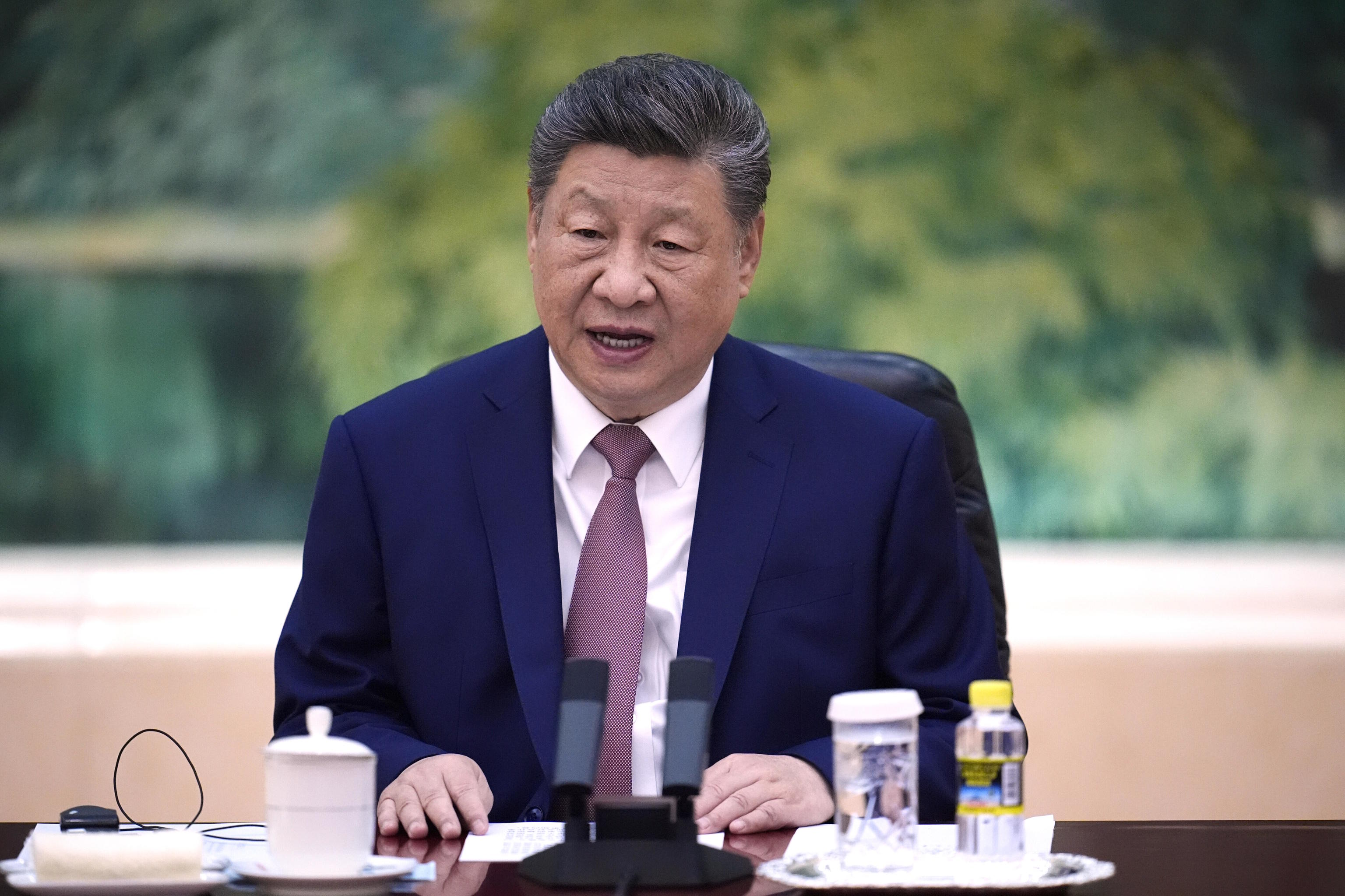
In just 48 hours, the Great Hall of the People's Republic of China has become a high-voltage diplomatic runway. After receiving Sheikh Mohamed bin Zayed, Crown Prince of the United Arab Emirates, and Spanish President Pedro Sánchez, Chinese leader Xi Jinping continued his marathon of meetings with Russian Foreign Minister Sergei Lavrov. Also on the immediate agenda is To Lam, recently enthroned as the supreme leader of Vietnam.
From the Chinese capital, it is conveyed that as the international order creaks at multiple seams, the Asian superpower aims to position itself as an essential node of stability and, if necessary, as an arbiter.
At a time when Beijing intensifies its diplomacy around the Iranian conflict, Lavrov has informed Xi that Moscow could help alleviate China's energy shortage amid the U.S. blockade of the Strait of Hormuz, cushioning a potential energy shock in the Asian giant.
The offer is significant: Since the invasion of Ukraine, Russia has established itself as one of China's main energy suppliers, in a relationship that combines economic pragmatism and strategic alignment against the West.
China purchases nearly 90% of the oil exported by Iran - much of it bypassing sanctions - and is also the largest customer of Saudi Arabia and other Gulf producers. Approximately 40% of the world's oil and a significant portion of liquefied natural gas pass through Hormuz. Any sustained disruption strains prices, increases maritime insurance costs, and necessitates route redesign.
"Russia and China stand unyielding in the face of any adversity, and these ties contribute to the high degree of resilience of their countries against the upheavals that have shaken the world," stated the Russian minister. The meeting with Lavrov comes a day after Xi, for the first time since the United States and Israel attacked Iran on February 28, directly addressed the war in the Middle East.
"The authority of the international rule of law must be respected and cannot be used when convenient and discarded when not. We must not allow the world to return to the law of the jungle," Xi said in his meeting with bin Zayed.
The phrase "law of the jungle" was used again in the meeting with Sánchez, understood as an implicit criticism of the U.S. and its war against Iran, which has strangled oil supply chains and plunged global energy markets into chaos.
Beyond rhetoric, Xi put forward a four-point proposal to "safeguard the stability of the Middle East." The scheme - vague but recognizable - emphasizes national sovereignty, the central role of the United Nations, and the construction of a "common security architecture" in the Gulf. The idea is not new: China has advocated for it in various formats, seeking to introduce a cooperative security model to the region that limits dependence on traditional military alliances and opens space for its own mediation.
"Security is an indispensable requirement for development, and development is the guarantee of security," affirmed the leader of the world's second-largest economy. "China is willing to share the opportunities offered by Chinese modernization to strengthen the foundations of regional development and stability."
The Elpis, a tanker with links to China, was the first to transit the Hormuz after Trump's blockade began this week. It is believed to have been carrying a cargo of methanol and was already sanctioned by the U.S. under its previous name, Chamtang, for being part of the so-called "ghost fleet" of ships used to transport Iranian oil, gas, and crude-derived products.
Many observers these days raise the question of whether Washington would risk deteriorating its relationship with Beijing - the U.S. leader is scheduled to travel to Beijing in May - by intercepting a Chinese ship or any vessel carrying products purchased by China.
"The United States has further intensified its military deployment and taken selective blockade actions, which will only exacerbate contradictions, increase tensions, undermine the already fragile ceasefire, and further disrupt the security of transit through the strait," criticized Guo Jiakun, spokesperson for the Chinese Ministry of Foreign Affairs, on Tuesday. "This behavior is dangerous and irresponsible," he added.
Xi's diplomacy seeks to weave a network of interlocutors that allows China to present itself as an alternative to Western crisis management. The approach to Gulf countries, dialogue with Europe - embodied this week in Sánchez's visit - and coordination with Russia are part of a strategy to diversify support and reinforce China's image as a power capable of engaging with everyone.