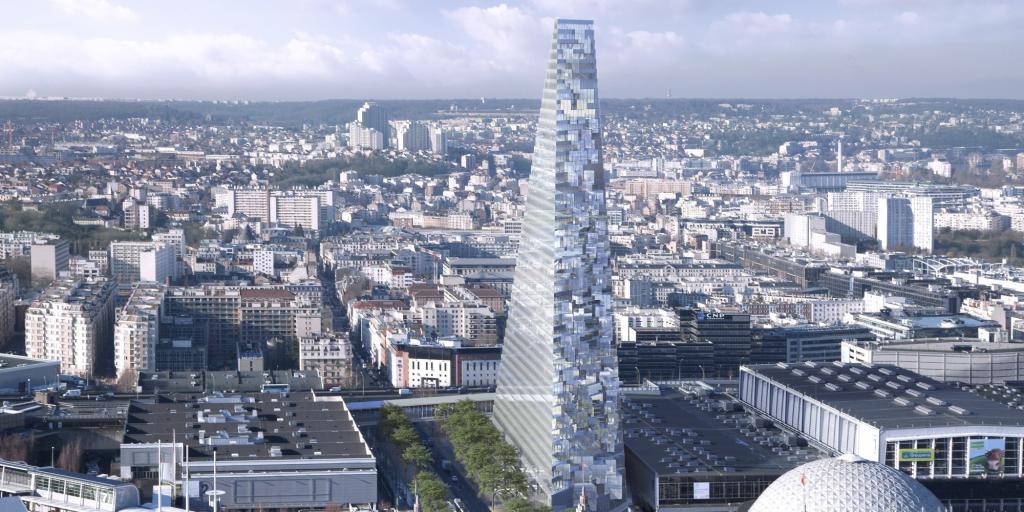
It was baptized as "the ugliest building in the most beautiful city". It even ranked as the second in the ranking of "the ten most hated constructions in the world". It has also been known as "the tower that Parisians love to hate". Its main attraction was the observatory on the 56th floor, "because it was the only place from which you could see the city in all its splendor and without the dark spot on the horizon."
The Montparnasse Tower, that glass monolith of 209 meters that rivals in height with the Eiffel Tower in the Paris "skyline", has temporarily closed its doors to undergo an image and efficiency makeover, months after the Pompidou Center did the same, the other great breakthrough of modern architecture from the seventies in the city of light.
Unlike the colorful "Beaubourg", so integrated into the urban fabric that it has ended up appropriating the name of the neighborhood, the Montparnasse Tower stands almost like a colossal glass tombstone near the cemetery of the same name, associated for decades with the interwar bohemia of Picasso, Hermingay, and James Joyce. All the Parisian essence of those streets was buried in 1973 under the ominous shadow of the chocolate-colored tower, which opened a deep wound to the south of the city.
It has become so unpopular that several mayoral candidates, such as Nathalie Kosciusko-Morizet in 2014, included the proposal to "make it disappear" as an electoral promise. "If I could tear down the Montparnasse Tower and create a garden in its place, I would be very happy", recently acknowledged Philippe Goujon, the "mayor" of the 15th district.
But demolishing it would not only be costly but also a serious threat to local health, due to the presence of asbestos on several floors. The building that was supposed to catapult Paris into the 21st century has aged very poorly and now seems like a relic of another era. Its impact was such that Paris decided to reintroduce a height limit within its perimeter and move skyscrapers outside the city (La Défense).
In decline for decades, developers held a competition won in 2017 by the collective AOM for the unavoidable renovation of the tower, which remained at 25% occupancy after Covid. Bureaucratic problems delayed the start of the works until March 31 when the bell finally rang with the closure of the observatory, which has welcomed 30 million visitors over the years.
"There are still some moves to be completed, but there is no one left working or living in the tower," confirmed shortly after Germain Aunidas, a representative of Axa, one of the main co-owners. The works, budgeted at over 600 million euros, will begin in the coming months and will last until 2030.
The "metamorphosis" of the most hated tower in Paris will start with the facade, which will become transparent. The building will grow by 12 meters to house an agricultural greenhouse where food will be grown, alongside the completely renovated observatory and lobby. The base of the tower will be enlarged, and there will be balconies up to the 14th floor, which will have a large garden area. There will be a luxury hotel and apartments on the top floors, although the main use will still be for offices.
"We are not demolishing anything, we are just transforming it", recently acknowledged Renzo Piano, co-author with Richard Rogers of the Pompidou Center, who has taken on the almost impossible mission of giving new life to the dying shopping center where the Galeries Lafayette used to be and which now looks like the setting of a dystopian movie, with tents and carts of the homeless.
Against all odds, Daniel Libeskind -author of the One World Trade Center- has taken the opportunity to defend Jean Saubot, Eugène Beaudouin, Urbain Cassan, and Louis de Hoÿm, the architects who conceived the Parisian "monolith". "The Montparnasse Tower may not have been the work of a genius, but at the time, it introduced the notion of the city of the future", Libeskind stated in the New York Times. "The reality is that today we have moved away from that radical approach and are in more civically fearful times."
Paris has always had a conflicted relationship with towers, and the comparison with what happened in the day with Gustave Eiffel's emblematic work could not be missing. The splendid symbol of the 1889 Universal Exhibition also faced strong opposition, reflected in the famous letter signed by 40 writers and artists (including Alejandro Dumas, Guy de Maupassant, or Charles Garnier) in defense of the "previously untouched beauty" of Paris...
"In the name of taste, art, and threatened French history, we are against the erection in the heart of our capital of the useless and monstrous Eiffel Tower, which public wit, often possessing common sense and a spirit of justice, has already baptized as the Tower of Babel."
To which Gustave Eiffel himself replied: "I believe, for my part, that the tower will have its own beauty. Are not the true conditions of strength always compatible with the secret conditions of harmony? (...) Besides, the colossal always has its own attraction and charm."