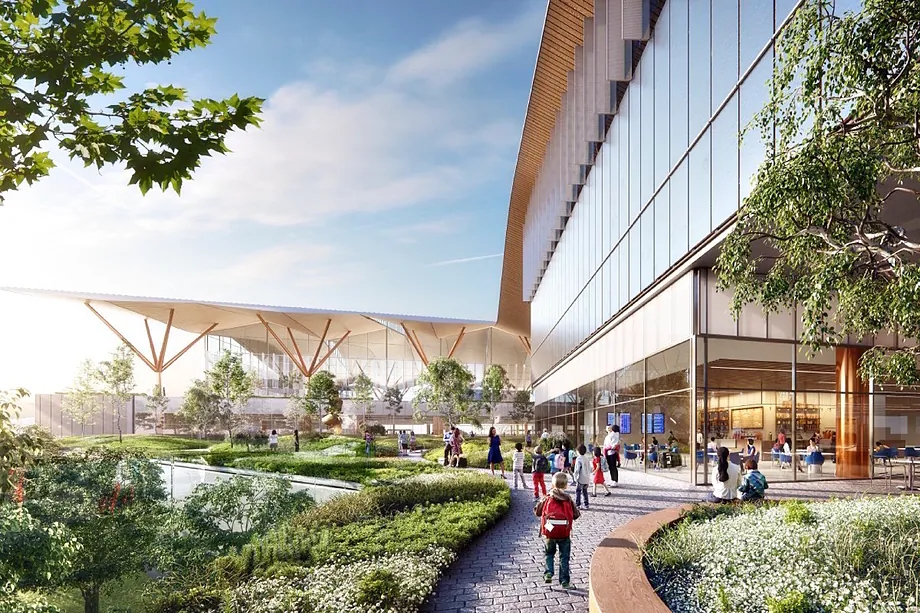
The T2 of Heathrow, Terminal E of Boston, the two terminals of Santiago de Chile International Airport, and the Zaragoza Airport building are all part of the portfolio of architect Luis Vidal (Barcelona, 1969). Previously, Vidal worked on the T4 of Barajas with Richard Rogers and dedicated his Final Project to the London City Airport, the fifth airport in London, the most central of all. The journey that began then now leads to Pittsburgh, the city in Pennsylvania that entrusted Vidal's Madrid studio with the renovation of its airport, an infrastructure that had become oversized and obsolete. The works were completed last November. And this spring, with the end of the region's long winter, the airport managers are receiving unexpected requests: several couples want to celebrate their weddings in its gardens and lobbies.
First things first: What should we know about Pittsburgh? "There are three rivers that converge and there is a very vertical orography. It is a mountainous city, full of viewpoints and funiculars. Pittsburgh seems to me like a gem waiting to be discovered. Its industry once produced 50% of the world's steel. There were prodigious fortunes. Messrs. Carnegie and Mellon were much richer than Mr. Rockefeller and they were from Pittsburgh," says Luis Vidal.
"They have the pioneering organ transplant hospital, which remains the best hospital in the world. They have several excellent universities. The University of Pennsylvania is the state university, and it is very good. The best of the private ones is Carnegie Mellon. Uber was born in Pittsburgh. There is a Pittsburgh company that travels to the Moon almost weekly. There is also a tremendous heritage of industrial architecture: the iron bridges... And there are very influential cultural institutions born from the philanthropy of Carnegie and Mellon. Warhol was born in Pittsburgh; Calder too. Fallingwater by Frank Lloyd Wright is nearby... And, at the same time, there are areas of Pittsburgh where the aftermath of the successive industry crises can be seen."
The city's airport was one of them: "It was an airport built in the 1970s, conceived as a hub for US Airways. It reached a point where it had almost 20 million annual passengers." In other words, slightly less than what Malaga Airport has and as many as the sum of Gran Canaria and Lanzarote, but in a city of 300,000 inhabitants (2.3 million people in the metropolitan area) and without significant tourism. "Being a hub airport meant that passengers transited through Pittsburgh and did not visit the city. Then, when US Airways changed ownership, it closed the hub and the airport fell into a depression. It ended up with less than seven million passengers who were exclusively locals and people traveling to Pittsburgh."
So, there was excess infrastructure, and at the same time, the facility was not very functional. A hub airport handles large passenger flows but does not need to have major access from the city. Nor does it need to project an image to the world or be prepared for complex baggage operations. "It took a new CEO to arrive and say: gentlemen, let's wake up because this is no longer a hub, this is an origin and destination airport with a different business model. We have to ensure that the city's engines generate enough traffic for people to come here and, at the same time, the airport becomes an engine for the city, creating economy," says Vidal.
The Spanish architect shows a video recorded from a taxi's glove compartment and played in fast motion: it is the journey from downtown Pittsburgh to the airport. On the way there, the car enters a tunnel. When it emerges, it is in a forest. The wooded area continues until reaching the airport, and this fact is crucial because the terminal designed by Luis Vidal also functions as a kind of pavilion in the park, a place to end Sunday strolls, have a meal on a terrace, see an exhibition, listen to a concert... or celebrate a wedding. "On the return, the taxi takes the tunnel in the opposite direction, and when it emerges from the tunnel into the light, it overlooks the city center from above, like a balcony." A bit like arriving in Bilbao from Sondica? Something like that, yes.
The images of the tunnel and the balcony are important because they explain that Pittsburgh airport operates through a succession of spaces that contract and expand. A corridor with low ceilings, theatrical lights, and sculptural texture leads from the entrance hall to the waiting area where passengers await their flights. Large space-small space-large space. At the end of the sequence, travelers are in an elevated position, on another balcony overlooking the space.
"It is important for the user to understand the place they are arriving at, to be able to read it and make decisions. If they want to browse shops or have a pizza, they should know where to go. If they want to read or work, they should know where to find silence." Studies, Vidal says, show that passengers spend more at airports if they are relaxed, if they know in advance where their boarding gate is and how to get there.
Going back in time: when Luis Vidal designed the Terminal E of Boston, he patented a red tone that iridesced and tended towards orange, named Boston Red. Upon arriving in Pittsburgh, it was assumed that the new airport would be yellow, like the successful local American football team and its iron bridges. "The conclusion we reached was that Pittsburgh is much more than a color. Instead, we coined a word, nateco: nature, technology, community."