Iran warned on Wednesday that it will not allow any type of export or import in the Persian Gulf, the Sea of Oman, and the Red Sea if the United States continues its "illegal" naval blockade of Iranian commercial and oil tankers in the Strait of Hormuz.
"If the aggressive and terrorist United States intends to continue its illegal naval blockade (...) the powerful Armed Forces of Iran will not allow the continuity of any type of export or import in the Persian Gulf region, the Sea of Oman, and the Red Sea," warned the commander of the Central Headquarters Jatam al Anbiya, Major General Ali Abdolahi, as reported by the Tasnim agency.
Abdolahi stated that any attempt by Washington to maintain the maritime blockade in the region would, in practice, violate the two-week ceasefire agreement reached with the US, which came into effect last Wednesday.
United States denies having agreed to extend the ceasefire with Iran
The United States has not formally agreed to extend the ceasefire with Iran, a senior US official told AFP on Wednesday, following reports indicating that negotiators were close to reaching such an extension.
"Discussions between the United States and Iran continue to reach an agreement," said the senior official on condition of anonymity.
A Hezbollah deputy says that the meeting with Israel opens a "wrong path" to division
The parliamentarian of the Lebanese Shiite group Hezbollah, Hasan Fadlala, warned on Wednesday that the meeting held the day before with Israel has opened a "wrong path" towards internal division and called on the authorities to agree on a "united" national stance.
"Are the authorities aware of the danger of what they have done? Do they know that they have entered a wrong path that will only increase the division among the Lebanese? They have not achieved anything from the enemy other than praise, without achieving any objective," Fadlala said at a press conference from the Legislature. "We know that in Lebanon there are political divisions, but what is requested is to act according to the spirit of the Constitution: to unite the Lebanese, not divide them with wrong decisions," he added, advocating for the adoption of a "united" national stance regarding the Jewish state, as reported by Efe.
Lebanon and Israel held their first direct talks in decades in Washington on Tuesday in the presence of US Secretary of State Marco Rubio, a first contact to seek a way out of the war without the participation of Hezbollah, the main Lebanese contender.
Iran insists it has the right to enrich uranium to a negotiable level
The Iranian Foreign Minister, Esmaeil Baqei, reiterated on Wednesday that Tehran's right to enrich uranium is "indisputable" but that the level of enrichment is "negotiable," as reported by Afp.
In his weekly press conference, Baqei said that no one can "snatch" Iran's right to make peaceful use of nuclear energy, neither "by coercion nor through war."
Erdogan praises Pedro Sánchez for his "firm stance" against Israel's attacks in Gaza
The President of Turkey, the Islamist Recep Tayyip Erdogan, congratulated the President of the Government of Spain, Pedro Sánchez, on Wednesday for his "firm stance" against Israel for its attacks on the civilian population in Gaza.
"From here, I sincerely congratulate the President of the Government of Spain, Sánchez, who has maintained a firm stance against the butcher of Gaza, (Israeli Prime Minister, Benjamin) Netanyahu. Likewise, I congratulate the friendly Spanish people on behalf of my country and my nation," Erdogan said to his party's deputies, the AKP. The Turkish head of state pointed out that Israel will not succeed in "silencing brave hearts."
Furthermore, he accused the Netanyahu government of trying to sabotage the ceasefire reached between Iran and the United States, stating that if there is peace in the Middle East, it will be "despite the Zionist regime" of Israel.
Mediators closer to extending the ceasefire between the US and Iran
Mediators were nearing an extension of the ceasefire between the United States and Iran on Wednesday and the resumption of negotiations to save the fragile truce before it expires next week.
The blockade of Iranian ports by the United States and renewed threats from the Islamic Republic have jeopardized the agreement in place for a week, but regional officials stated on Wednesday that they were making progress, and told The Associated Press that Washington and Tehran had reached a "preliminary agreement" to extend it and give more room for diplomacy.
Before the two-week ceasefire ends on April 22, mediators are pushing for a compromise on the three main points of friction that derailed direct talks last weekend - Iran's nuclear program, the Strait of Hormuz, and compensation for war damages - according to one regional official involved in the mediation efforts.
Emirati and Iranian officials discuss ways to "reduce tensions"
The Vice President of the United Arab Emirates held a telephone conversation with the President of the Iranian Parliament, reported the Emirati news agency on Wednesday, in the first contact of this level between the two countries since the start of the war in the Middle East.
Sheikh Mansour bin Zayed and Mohammad Bagher Ghalibaf "discussed regional events and ways to reduce tensions in the region," Wam agency reported.
In retaliation for a US-Israeli attack on February 28, Iran carried out attacks in the Gulf, particularly against the United Arab Emirates, which had withdrawn its ambassador in Tehran. A temporary ceasefire of the fighting is currently in effect.
Iran warns it will block trade in the region if the US maintains the blockade of Ormuz
Iran warned on Wednesday that it will not allow any type of export or import in the Persian Gulf, the Sea of Oman, and the Red Sea if the United States continues its "illegal" naval blockade of Iranian commercial and oil tankers in the Strait of Hormuz.
"If the aggressive and terrorist United States intends to continue its illegal naval blockade (...) the powerful Armed Forces of Iran will not allow the continuity of any type of export or import in the Persian Gulf region, the Sea of Oman, and the Red Sea," warned the commander of the Central Headquarters Jatam al Anbiya, Major General Ali Abdolahi.
Abdolahi stated that any attempt by Washington to maintain the maritime blockade in the region would, in practice, violate the two-week ceasefire agreement reached with the US, which came into effect last Wednesday.
The Iranian Revolutionary Guard had already warned, two days before the US blockade of the strategic Strait of Hormuz, that military vessels approaching the area would be "subject to a strong response."
Trump says he asked Xi Jinping not to supply arms to Iran
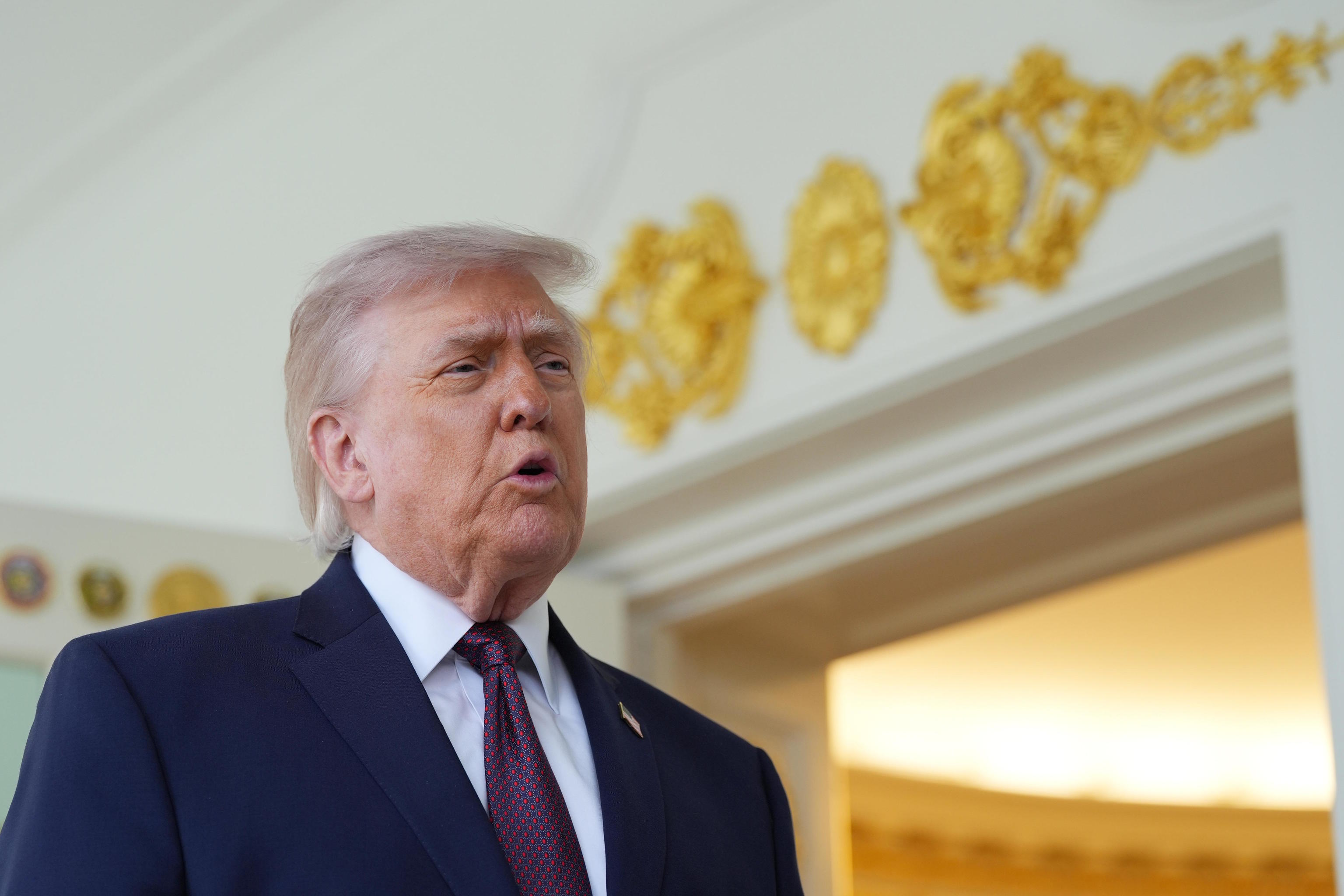
The US President, Donald Trump, stated that he asked his Chinese counterpart, Xi Jinping, not to supply arms to Iran, and Xi responded that he is not doing so, in an interview broadcast on Wednesday on the Fox Business network.
"He responded to a letter I had written to him because I had heard that China was providing arms to Iran," explained Donald Trump to journalist Maria Bartiromo.
"I sent him a letter asking him not to do it, and he wrote me a letter saying, essentially, that he is not doing it," he added.
Meloni cools off her most uncomfortable friendships: from clashing with Trump to questioning Israel
A year before the end of the legislature and after the failure of her judicial reform, Italian Prime Minister Giorgia Meloni has cooled off some of her most thorny international alliances, entering into a crossfire of reproaches with US President Donald Trump or weakening defense collaboration with Israel.
The repositioning of the Italian far-right leader comes just a year and a half before the general elections and amid the war in Iran and the Middle East, with the consequent fear of the havoc it could cause in the country's economy.
There was a time when the 'strong woman' of European right-wing politics had earned the trust of Trump upon his return to the White House, so much so that even the European Commission sent her to Washington to try to soften the Republican's tariff check.
Erdogan praises Turkey for working to extend the ceasefire between Iran and the US and maintain the talks
The President of Turkey, Tayyip Erdogan, stated on Wednesday that Ankara is working to extend the ceasefire between the United States and Iran, reduce tensions, and ensure the continuity of negotiations, adding that Turkey hopes that the dialogue will progress despite the difficulties.
In an address to lawmakers in Parliament, Erdogan noted that Israel's attacks in Lebanon are undermining hopes for peace, and added that the window of opportunity created by the ceasefire should be seized. He said that the most complex issues between the parties could be resolved if they focus on the benefits of peace.