In China of improbable stories, destiny once again crossed two lives marked by tragedy under the red lanterns of a collective wedding ceremony. It happened at the end of last year in the city of Changsha, the capital of Hunan province. Among 37 couples dressed in traditional Han-style attire, one story stood out: that of Liu Ximei and Liang Zhibin, united by a vital debt dating back to one of the most devastating disasters in the history of the giant Asian country.
Let's go back to 2008, to the epicenter of the Sichuan earthquake, a catastrophe that left almost 90,000 dead and missing. Liang Zhibin was then a 22-year-old soldier who was part of the troops sent to the southwestern province of China to participate in rescue operations. Amidst the chaos of the ruins and bodies buried under tons of concrete, Liang and his team located a girl trapped on the second floor of a collapsed building.
She, Liu Ximei, was barely ten years old. She was immobilized under steel bars and bricks. For four hours, the rescuers tirelessly excavated until they freed her. Then, they transported her to a hospital. They had saved her life.
The reunion came 15 years later: a chance encounter at a public event. Liu, as reported by local media, immediately recognized her rescuer. He, on the other hand, could barely associate that adult face with the girl he had helped extract from the rubble. From there, they began to stay in touch and, months later, started a relationship.
The wedding was not private. It took place within the fifth edition of a collective ceremony in Changsha, a format that has gained popularity in several Chinese cities in recent years. These group weddings, sometimes promoted by local governments or cultural associations, combine tradition, economy, and often a spectacle component.
Liu Ximei and Liang Zhibin newlyweds in a montage shared on the social network Weibo.EM
The ceremonies often recreate ancient rituals: imperial clothing, formal bows, ceremonial music, and an aesthetic that draws from old dynasties. For many young couples, they represent a more affordable alternative to the increasing cost of individual weddings in China, where expenses, from the banquet to the dowry, are a considerable financial burden unaffordable for many couples.
Mass weddings also have a political background. Because in a country concerned about declining birth rates and delayed marriage age, these events serve as a soft tool for social promotion internally that fits into the official narrative: celebrating union, reinforcing traditional values, and projecting an image of community harmony.
In this scenario, the story of Liu and Liang fits perfectly. The soldier who saves a girl and, years later, marries her. This connects with the heroic imagery that the Chinese state has cultivated for decades.
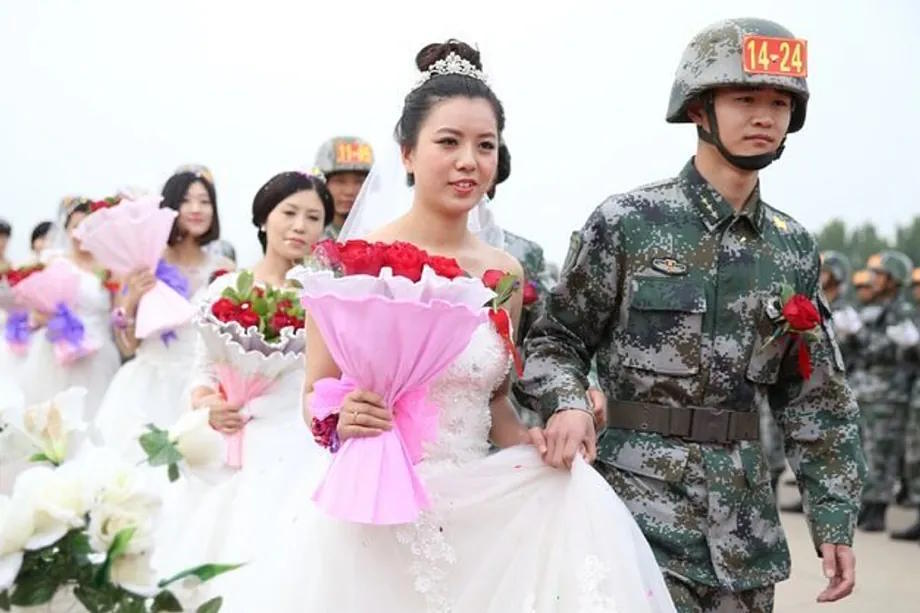
This year, group weddings within the Chinese army have gone viral on Chinese social media. In February, a Navy ship became a floating altar for a day: 52 couples paraded on the deck, among red flags and dress uniforms, in a ceremony that mixed military discipline and choreographed sentimentality. The grooms, dressed in impeccable uniforms, arrived with their partners on armored vehicles, in a setting that seemed more like a military parade than a wedding ceremony.
Last week, in Shenyang, in the northeast, another ceremony also brought together 52 couples in a symbolic space, the southern square of the former imperial palace, transformed into a massive wedding stage with an almost cinematic aesthetic. And in various parts of the country, from units of the Armed Police in Chongqing to brigades of the People's Liberation Army, similar weddings have been repeated in recent months.
Group weddings within the army are not new, but they are becoming more frequent. In an aging China, the state is increasingly visible in private life. In a country suffering the accumulated consequences of decades of radical demographic control, the total number of births last year was the lowest since 1949.
In 2025, China lost 3.39 million inhabitants, marking its fourth consecutive year of population decline. Additionally, the nation is aging at an unprecedented rate: over 22% of the population is now over 60 years old, meaning more than 300 million people. All of this poses a significant problem for an economy that has relied on a massive and young workforce for decades.
The Armed Forces, in particular, have received a clear message: marry earlier, have children earlier. And do it in public rituals where the individual dissolves into the collective, where love integrates into a larger choreography.