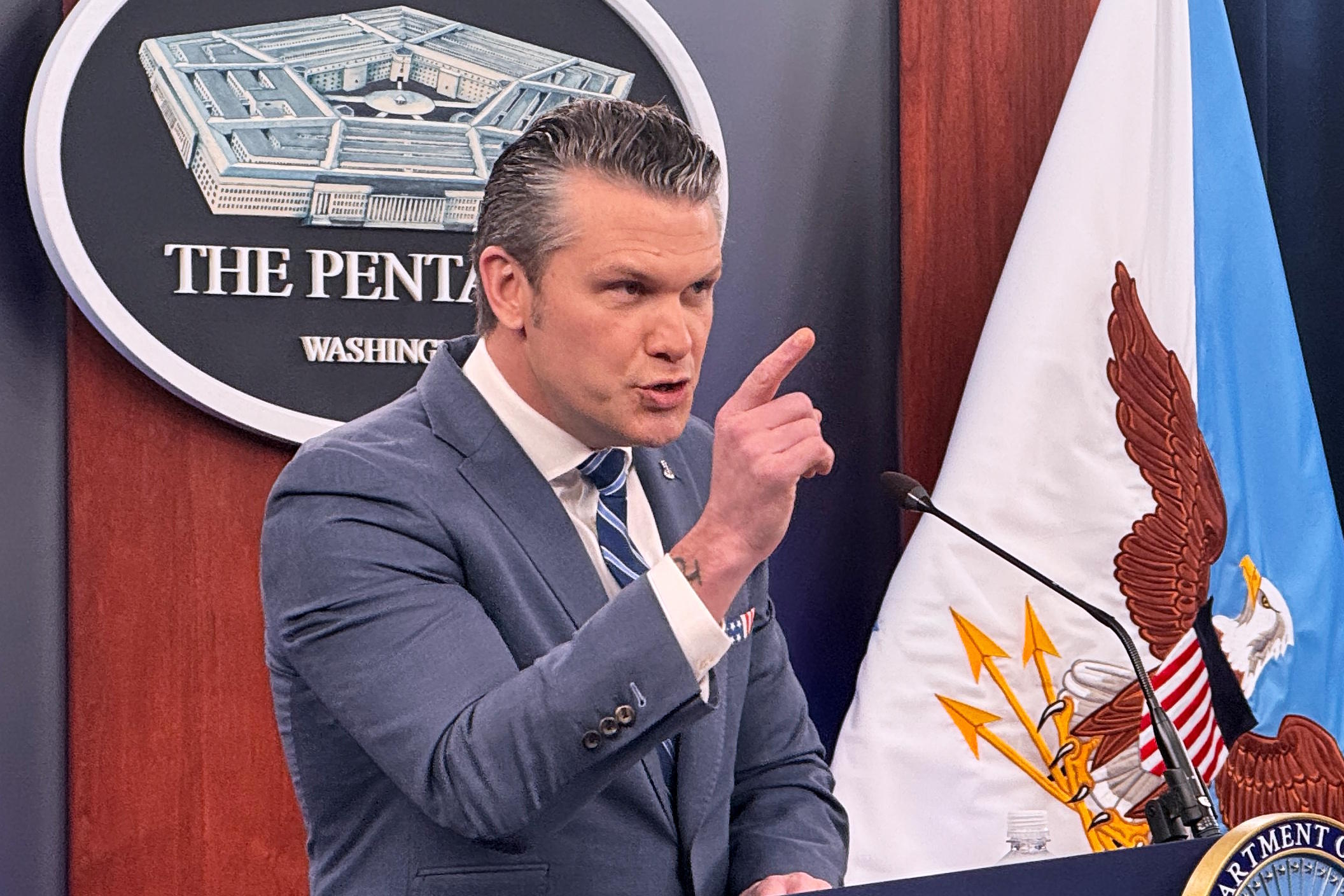
The US threatens to resume war in the Middle East if Iran does not soon accept an agreement. This Thursday, the Secretary of Defense, Pete Hegseth, specified that he downplayed the Iranian blockade of the Strait of Hormuz and expressed readiness to both extend their own country's blockade for "as long as necessary" and to resume attacks. "If Iran does not make the right decision, it will not only face a blockade, bombs will fall on them," was the threat formulated by Hegseth.
"If the blockade is not complied with, we will use force," warns the US Chief of Staff
Alongside Hegseth, the US Chief of Staff, General Dan Caine, appeared in Washington, clarifying that the "blockade applies to all ships, regardless of their nationality, heading to or leaving Iranian ports."
Caine referred to the blockade imposed by the US on ships entering and leaving Iranian ports, including those covertly trying to support the Iranian regime. This blockade, he detailed, applies both in Iranian waters and international waters. According to data, so far, 13 vessels attempting to cross it have opted to turn around, and none have been boarded yet.
"If the blockade is not complied with, we will use force," the senior military official warned, in line with the Secretary of Defense.
The President of Lebanon does not have a scheduled call with Netanyahu, according to sources from that country
The President of Lebanon, Joseph Aoun, is not planning to have a phone conversation with the Israeli Prime Minister, Benjamin Netanyahu, in the near future, as reported by three Lebanese officials to Reuters on Thursday. It was the US President, Donald Trump, who announced that the leaders of both countries would speak.
Two of the Lebanese officials cited by Reuters added that the Lebanese embassy in Washington informed the US administration that Aoun would not speak with Netanyahu, as they had done before the call between Aoun and the Secretary of State, Marco Rubio.
Spain rejects participating in a military intervention in the Strait of Hormuz
Spain rejects participating in any military intervention related to the war in Iran, including an intervention in the Strait of Hormuz, emphasize government sources before participating this Friday in a meeting convened by France and the United Kingdom to address the blockade of the area.
The French President, Emmanuel Macron, and the British Prime Minister, Keir Starmer, will co-chair this conference that will bring together by video conference countries "not belligerent" willing to collaborate in a purely defensive mission to restore freedom of navigation in the Strait of Hormuz when security conditions allow it," as indicated by sources from the Elysee Palace.
Government sources affirm that Spain's position is clear: they are concerned about the situation in Hormuz and defend the right to free navigation, but "remain firm in their stance of opposing participation in any military operation that may be linked to the war in Iran, including an intervention in the Strait of Hormuz."
Hegseth: "If Iran does not make the right decision, it will not only face a blockade, bombs will fall on them"
The US Secretary of Defense is currently appearing. Before the media, Pete Hegseth assures that it is currently the United States, and particularly its navy, that controls the Strait of Hormuz and criticizes Iranian threats to shoot at ships attempting to transit it. "What you are doing is terrorism, it is piracy, we have real control," he asserts, addressing the Iranian government and stating that the United States can maintain its blockade "for as long as necessary."
Throughout his appearance, Hegseth insists that his country is prepared to resume bombings and then urges the ayatollah regime to accept the peace proposals put forward by the US. "If Iran does not make the right decision, it will not only face a blockade, bombs will fall on them." The Secretary of Defense emphasizes Trump's idea that "Iran will not have nuclear weapons" and complains about the coverage of the war in some media.
An Israeli attack destroys the last bridge connecting southern Lebanon with the rest of the country
An Israeli attack has destroyed the last bridge connecting southern Lebanon with the rest of the country, as declared to Reuters by a senior Lebanese security official, who added that the attack "destroyed" the bridge and leaves no possibility of repair.
Iran could allow ships to pass through the Omani side of the Strait of Hormuz, according to a Reuters source
Iran could allow ships to navigate freely through the Omani side of the Strait of Hormuz without the risk of attacks, according to proposals presented in talks with the US, provided an agreement is reached to prevent the conflict from reigniting, as stated by a source informed by Tehran to Reuters.
The proposal seemed more like a gesture than a measure that, on its own, would offer an immediate breakthrough for the hundreds of ships waiting to pass through this key maritime route, through which around 20% of global flows of oil and liquefied natural gas transit.
The source, who preferred to remain anonymous due to the sensitivity of the matter, stated that Iran could be willing to allow ships to use the other side of the strait, in Omani waters, without any obstacles from Tehran.
"We welcome any measure that allows the safe passage of ships through the established traffic separation system," declared a spokesperson for the International Maritime Organization (IMO), the United Nations' maritime transport agency.
The Pakistani Army Chief meets with the President of the Iranian Parliament
The Chief of the Pakistani Army, Asim Munir, met this Thursday with the President of the Iranian Parliament, Mohammad Bagher Ghalibaf, as reported by Iranian state media and collected by Afp, within the ongoing efforts for a possible resumption of talks between Iran and the United States.
The exact location of the meeting has not been specified by state television, but the Mizan agency published X photographs of both leaders. The Pakistani delegation had arrived in Iran on Wednesday, shortly before Washington mentioned the possibility of a second round of negotiations with Tehran.
The Israeli Minister of Innovation, Gila Gamliel, had said on the Israeli army radio that the Israeli Prime Minister, Benjamin Netanyahu, "will speak" with the Lebanese President, Joseph Aoun.
"The Prime Minister will speak for the first time with the President of Lebanon after so many years of total rupture of dialogue between the two countries, and it is to be hoped that this step will finally lead to the prosperity and development of Lebanon as a State," stated Gamliel, without specifying when or how the conversation will take place, as reported by Afp.
The President of Lebanon emphasizes the importance of a ceasefire before direct negotiations with Israel
The Lebanese President, Joseph Aoun, highlighted this Thursday the importance of a ceasefire with Israel before engaging in direct negotiations, the holding of which has not been confirmed.
"The ceasefire that Lebanon demands from Israel is the natural starting point for direct negotiations between the two countries," Aoun stated in a press release.
The US President Donald Trump announced that the "leaders" of Israel and Lebanon would have a conversation on Thursday, and an Israeli minister declared this Thursday that the Israeli Prime Minister Benjamin Netanyahu "will speak" with Aoun.
One dead in an Israeli attack on the road connecting Beirut and Damascus
One person died in an Israeli attack that targeted a vehicle on Thursday on the main road connecting Beirut to Damascus, far from the border with Israel, reported a state media, as collected by Afp.
The attack took place in the Dahr el-Baidar area, in the mountain east of Beirut, as specified by the National News Agency (ANI).