In September 2013, during a trip to Kazakhstan, the President of China, Xi Jinping, presented an ambitious project that would soon become the cornerstone of his foreign policy: the Belt and Road Initiative (BRI). Media-rebranded as "the new Silk Road," it is a global infrastructure financing program that aims to weave networks of trade, transportation, and energy from Asia to Europe and Africa. Since its launch, with the support of Chinese state-owned construction companies and loans from Beijing's development banks, roads, bridges, airports, railways, power plants, and telecommunications centers have been built worldwide.
More than 150 countries have subscribed to the BRI through memorandums of understanding. Spain is not on that list, although it actively participates as a recipient of investments linked to Xi's initiative (infrastructure, logistics, and energy), and Spanish companies have entered Chinese projects in third countries. But Beijing would like Madrid to take a step further.
Chinese officials reveal to EL MUNDO that their government wants Spain to formally join this new Silk Road, and they have conveyed this to Pedro Sánchez's government. It would be a symbolic step, but such gestures to Beijing, immersed in a global charm offensive with its influence spreading to more corners, carry significant diplomatic weight.
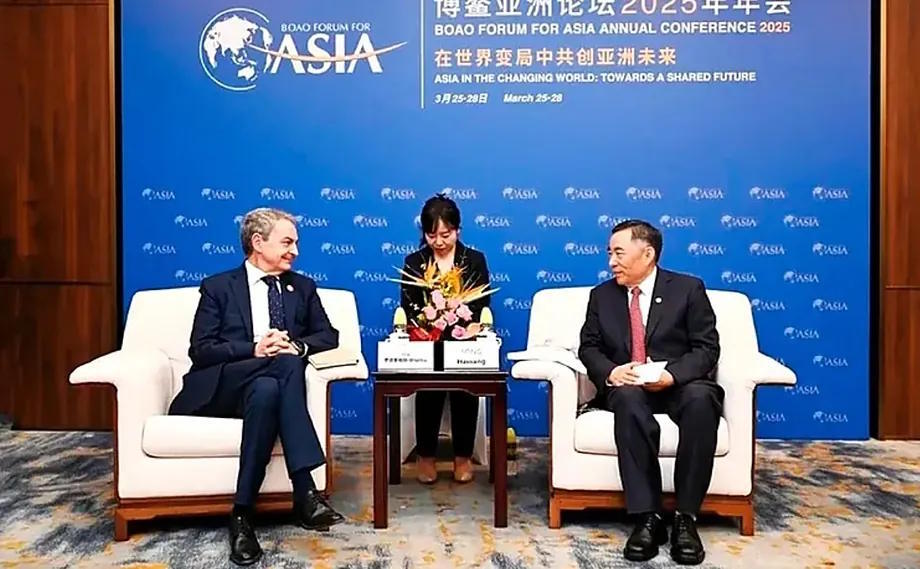
Two years after the launch of the BRI, as warnings in the West grew about unsustainable debts for developing countries, especially in Africa, the Chinese project found a staunch supporter in Spain: former President José Luis Rodríguez Zapatero.
Since 2015, the historic socialist began to strengthen ties with Beijing, facilitating connections between large Chinese state corporations and the European market, especially in renewable energy sectors. His trips to economic and diplomatic forums organized by institutions linked to the Communist Party reinforced his profile as a key interlocutor.
During one of those early trips as a former president, Zapatero praised the BRI as an "important link between Eastern and Western civilizations" and a project that "promotes world peace". It was not until 2019 when, in China's eyes, he officially became one of Xi's international endorsers of the mega-plan. In Beijing that year, he was one of the most active participants in a BRI promotion forum that included representatives from over a hundred countries, including Russian President Vladimir Putin.
Last year, in conversations with this newspaper, a delegate from the CCP of a major state-owned company assured that the Alliance of Civilizations promoted by Zapatero - the global cooperation initiative formalized at the UN in 2005 - had been a source of inspiration for the diplomatic part of the Chinese president's flagship program.
In Europe, the BRI has elicited a mosaic of responses. Politically, Beijing has focused its efforts on Central and Eastern Europe, getting several countries to sign cooperation frameworks, while powers like the UK, France, or Germany have avoided formal commitments.
Italy joined in 2019, being the only G-7 country to participate. In contrast, the current Prime Minister Giorgia Meloni withdrew her country from the project in 2023, citing the need to protect national interests against financial and geopolitical risks. Similar criticisms have arisen, especially in the United States, where the BRI is seen as a tool of "debt diplomacy" capable of compromising the sovereignty of the most vulnerable states.
In Spain, although there are no projects with the official BRI label, there are abundant Chinese-linked investments such as those of the state-owned company COSCO, which controls terminals at the ports of Valencia and Bilbao, two key nodes in the entry of Asian goods into Europe.
Simultaneously, the Spanish railway network has also opened its doors to Chinese companies: the construction giant China Railway Construction Corporation controls almost all of the construction company Aldesa, involved in ADIF projects, while the government explores collaborations with Chinese manufacturers for future high-speed rail lines.
Another state-owned company from the Asian country, China Communications Construction Company, acquired full control of Grupo Puentes through a subsidiary. And dozens of Chinese companies (such as CATL, Chery, or BYD) are developing projects in Spain related to batteries and electric vehicles, some with the aim of using the peninsula as a "Made in Europe" production platform. These operations have sparked debate about technological and strategic dependence on Beijing, as well as the transparency of contracts.
Internationally, the BRI has raised suspicions due to the opacity of its loans, questionable environmental and social standards, and its potential to strengthen Chinese political influence in foreign governments. Because the new Silk Road, in addition to embracing an immense infrastructure network, has in recent years become a mirror of the global ambitions of Xi Jinping's regime and the challenges that some countries face when interacting with an actor that combines investment, diplomacy, and power projection.