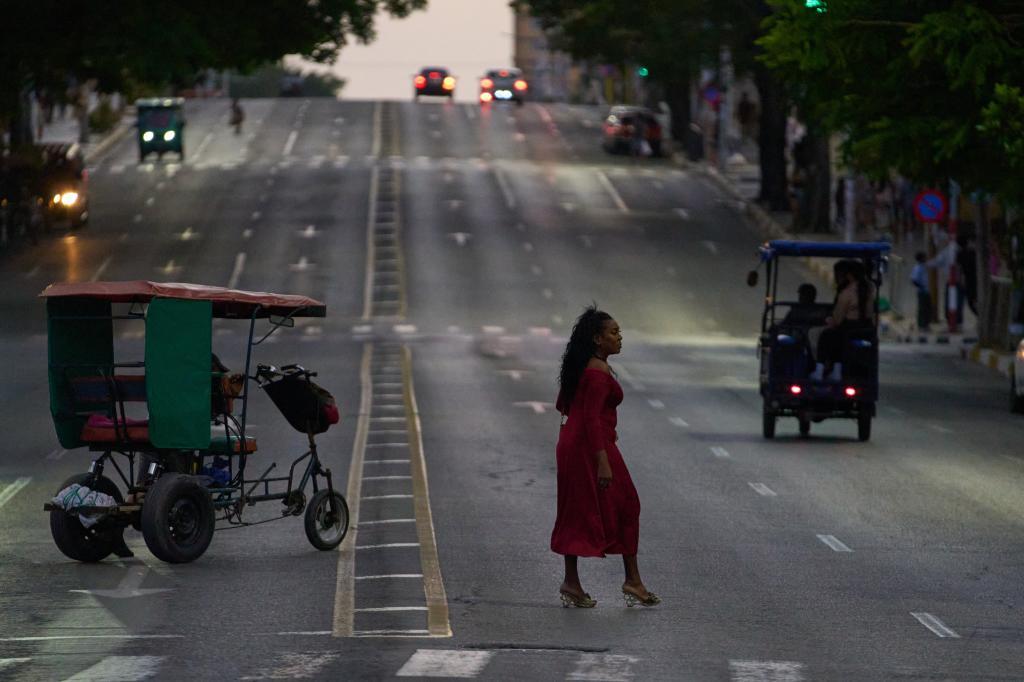
Through remittance agents who charge hefty commissions; with online stores that deliver products to homes; in travelers' suitcases... Cuban immigrants residing in Spain desperately seek to send money, food, and medicines to their relatives living on the island, a historical practice of the diaspora that intensified this year since the regime stopped receiving aid from the dictator Nicolás Maduro.
«The Cuban dictatorship survives thanks to the remittances we send its victims, who are us, the exiles», says Néstor Rodríguez Lobaina, who has been living in Palma de Mallorca since 2011 as an asylee after spending 14 years as a political prisoner. At 60 years old, he works as a cook during the summer season. During periods of employment, he manages to send about 200 euros per month to his 89-year-old father, in a context where the average monthly salary on the island is 6,830 Cuban pesos, equivalent to 14 euros at the real exchange rate.
«Those who have a relative abroad survive there. My mother passed away without me being able to say goodbye, and my father is going through a very tough time. All I can do is send him a little money, and for that, maneuvers have to be made. I am trying to send him medicines because at the moment there are not even aspirins available», laments Nestor.
For sending money to the island, Cuban-Spaniards turn to the figure of the remittance agent.«I make a Bizum payment here, and then my daughter goes to a house or store and receives the equivalent in Cuban pesos», explains Sayde Chaling-Chong García, a musician exiled in Spain and activist. «It's a contact you know through word of mouth». These are unofficial networks that operate with collaborators in Spain and Cuba, and according to the exiles interviewed by Crónica, it is inconceivable that they operate without the endorsement of regime authorities.
Sayde's daughter, whom she has not been able to see since she emigrated in 2002, runs a nail painting stand in Havana and has a five-year-old son. «Now, due to power cuts, they are cooking with charcoal, so every week I send money so they can buy it. Some months they need 200 euros, others 50 euros are enough. But without this help, the child wouldn't be able to have milk», she points out.
In addition to the remittance agents, the three million Cubans living outside their country — 287,000 of them in Spain — have a way to send food and other items bypassing Díaz-Canel's dictatorship customs. There are online stores like Supermarket 23 or Cuba Llama where Cuban immigrants from anywhere in the world can select products for purchase and have them delivered to their families' homes.
«Cuba has lived and lives off the remittances of those expelled from their country and called scum. But how can one stop helping their family, making sure they can have a chicken to eat?»
What is outrageous is that they are paid at prices that are exorbitant for the inhabitants of the island ruled by the Castros: two kilos of chicken breast for 10 euros, 30 eggs for seven euros, an electric generator for a thousand euros. The latter equivalent to 71 average salaries.
This supplement also visited the Madrid office of Cuba Llama, which offers a wide range of services ranging from phone top-ups, online shopping, and parcel deliveries to a news portal.
Some of these companies, allegedly handling millions, have been linked to the regime. For example, according to Diario de Cuba, Supermarket 23 is linked to the heirs of the revolutionary commander Guillermo García Frías.
«I have used them occasionally when my father was ill. In the stores, there is nothing like that for a Cuban. It's very frustrating to end up there, but humanity wins», says Dayana Prieto, who lives in Madrid as a political asylee with her husband, the playwright Yunior García, since 2021. «My father passed away two years ago, and I couldn't say goodbye. I have my grandparents, a 15-year-old brother, Yunior's 15-year-old son. It's horrible what they are going through. They no longer talk about power outages but 'blackouts,' because they go 48 hours without electricity and then have it for a while», she describes.
Dayana is part of a network of Cubans in Spain trying to send aid to the island but avoiding remittance agents and platforms, which they consider as "blackmail" benefiting the regime. The mechanism works thanks to passengers' suitcases traveling to Havana. Most are emigrants with Spanish nationality who can move freely between the two countries.
«It's an alternative humanitarian corridor, without institutional support, among friends who organized themselves during the pandemic to transport medicines and food», says 40-year-old Dayana. In parallel, in Facebook groups of Cubans in Spain, there are posts offering suitcase transfers, charging based on weight.
«I don't send all the help I would like to, we are not in an economic situation for my family in Cuba to live entirely off what we send them», laments Dayana, who works as a shop assistant. «Cuba has lived and lives off the remittances of those expelled from their country and called scum. But how can one stop helping their family, making sure they can have a chicken to eat?», she adds.
A month ago, the desperation to send insulin for her diabetic uncle led her to the check-in line for a flight to Havana from Barajas: she asked all passengers about to board until she found solidarity from one heading to the city of Holguín, where her family lives.
Osiris Puerto, who arrived in Barcelona after being shot by the police in an opposition protest in Havana, adjusts his expenses to be able to send 120 euros each month to his wife, who stayed on the island with their 16 and two-year-old daughters. «It pains me to go so long without seeing them. But knowing that from here I am their support gives me strength», he says, while waiting for his appointment in Barcelona to undergo surgery for a hernia caused by the dictatorship's bullets.