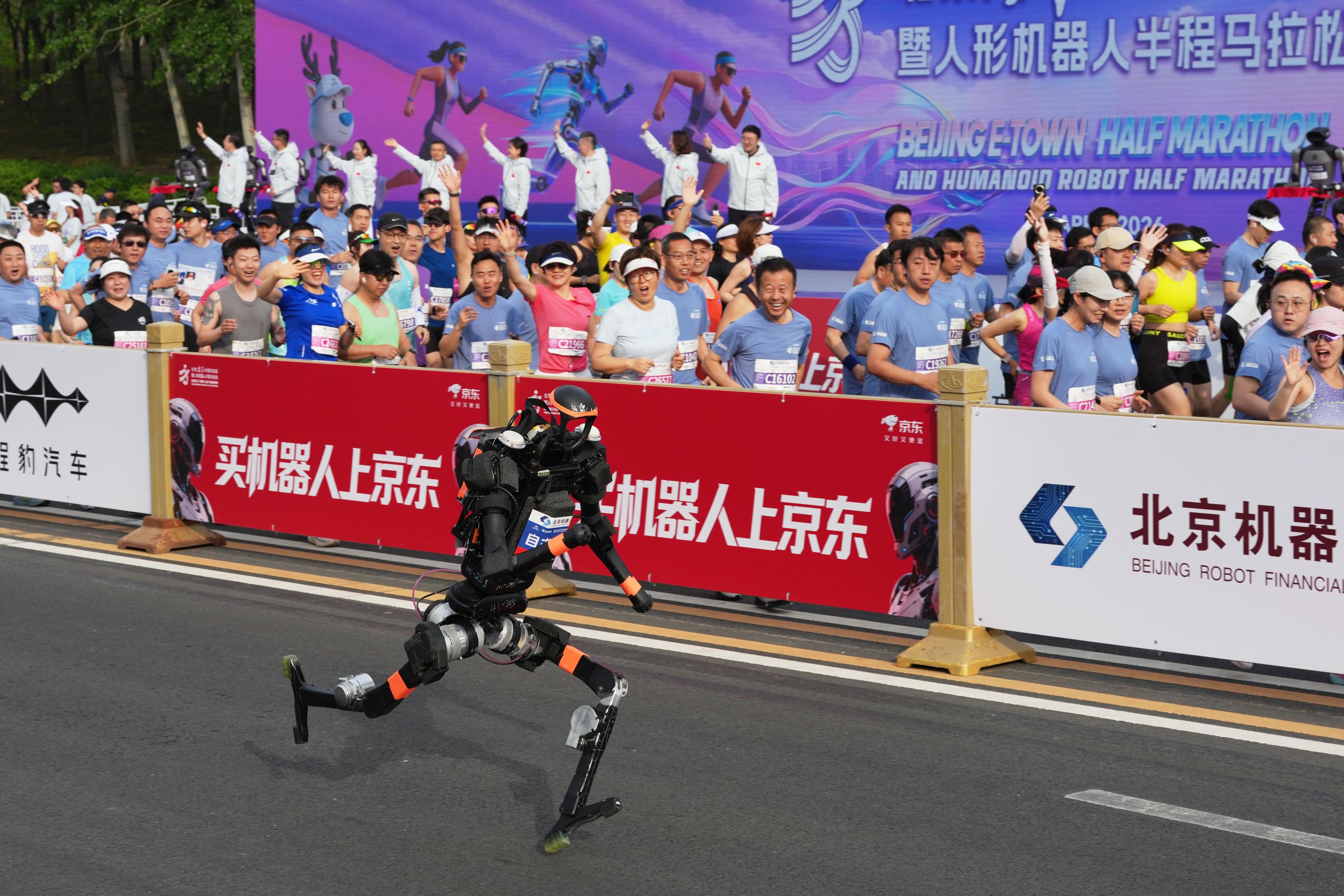
In the final stretch, as the asphalt narrowed between metal fences and volunteers with fluorescent vests, Lightning hesitated. The humanoid robot from Honor, better known for its mobile phones than for its forays into robotics, was just 100 meters away from completing the course when it lost balance and crashed into a railing. It fell with mechanical rigidity, as if someone had turned off a switch. But there was no drama: a technician ran over, repositioned it, and Lightning resumed its imperfect stride to cross the finish line in 50 minutes and 26 seconds.
A time faster than the half marathon record set last year by Ugandan athlete Jacob Kiplimo, who clocked 57 minutes and 20 seconds in a race in Lisbon (though not comparable due to clear differences in race conditions). Lightning, remotely controlled by a Honor team, was the winner of the second humanoid robot half marathon held on Sunday in Beijing.
Over 300 robots took part in this unique competition, almost triple the number from the previous year, representing around thirty companies, mostly Chinese. To avoid accidents, humans (around 12,000 runners) and machines ran on parallel circuits, as if belonging to two different dimensions of the same race. Nevertheless, the comparison was inevitable: the best robotic runner doubled the speed of the flesh-and-blood winner over 21 kilometers.
The scene contrasts with that of 2025, when the event bordered on the absurd. Back then, the winner, Tiangong Ultra, took 2 hours, 40 minutes, and 42 seconds to complete the distance, and the viral moments were the chain falls of robots unable to maintain their verticality for more than a few kilometers. A year later, the landscape has changed: fewer stumbles and greater stability and speed.
Most of the humanoids on the Beijing track today have come from the factories of Unitree Robotics, the leading Chinese manufacturer. This company, now a flagship in the sector in China, leads a market that the Asian country dominates clearly. In 2025, almost 90% of humanoid robots sold worldwide were Chinese, with Unitree at the forefront, and six of the top revenue-generating companies in this niche were based in the country.
The figures illustrate the speed of the takeoff: from just 3,000 units shipped in 2024 to over 14,500 in 2025. And it's not just about volume, but also about price. Basic platforms have dropped to just over 5,000 euros, a figure unthinkable just a few years ago, forcing international competitors to rethink their strategies. For now, these robots are mainly used in laboratories, stores, or factories, but the still unclear horizon points towards homes and services.
China's advantage is not limited to final manufacturing. The country controls a large part of the supply chain: batteries, sensors, electric motors, control chips. This vertical integration reduces costs and speeds up development times. It is essentially the same recipe applied in the electric vehicle industry: generous subsidies, fierce competition among local players, and economies of scale that end up crushing prices.
Earlier this year, the world got a preview of what's to come. Unitree's G1 robots went viral during the Chinese New Year gala, performing somersaults, trampoline jumps, and running at speeds close to 14 kilometers per hour. Its founder, Wang Xingxing, has stated that the company plans to ship between 10,000 and 20,000 units this year, a number that is beginning to place humanoids in the realm of mass production.
According to the consultancy Omdia, Unitree already outsells several American competitors such as Tesla, Figure AI, or Agility Robotics. And forecasts point even higher: Morgan Stanley estimates that the global market could reach $38 billion by 2035.