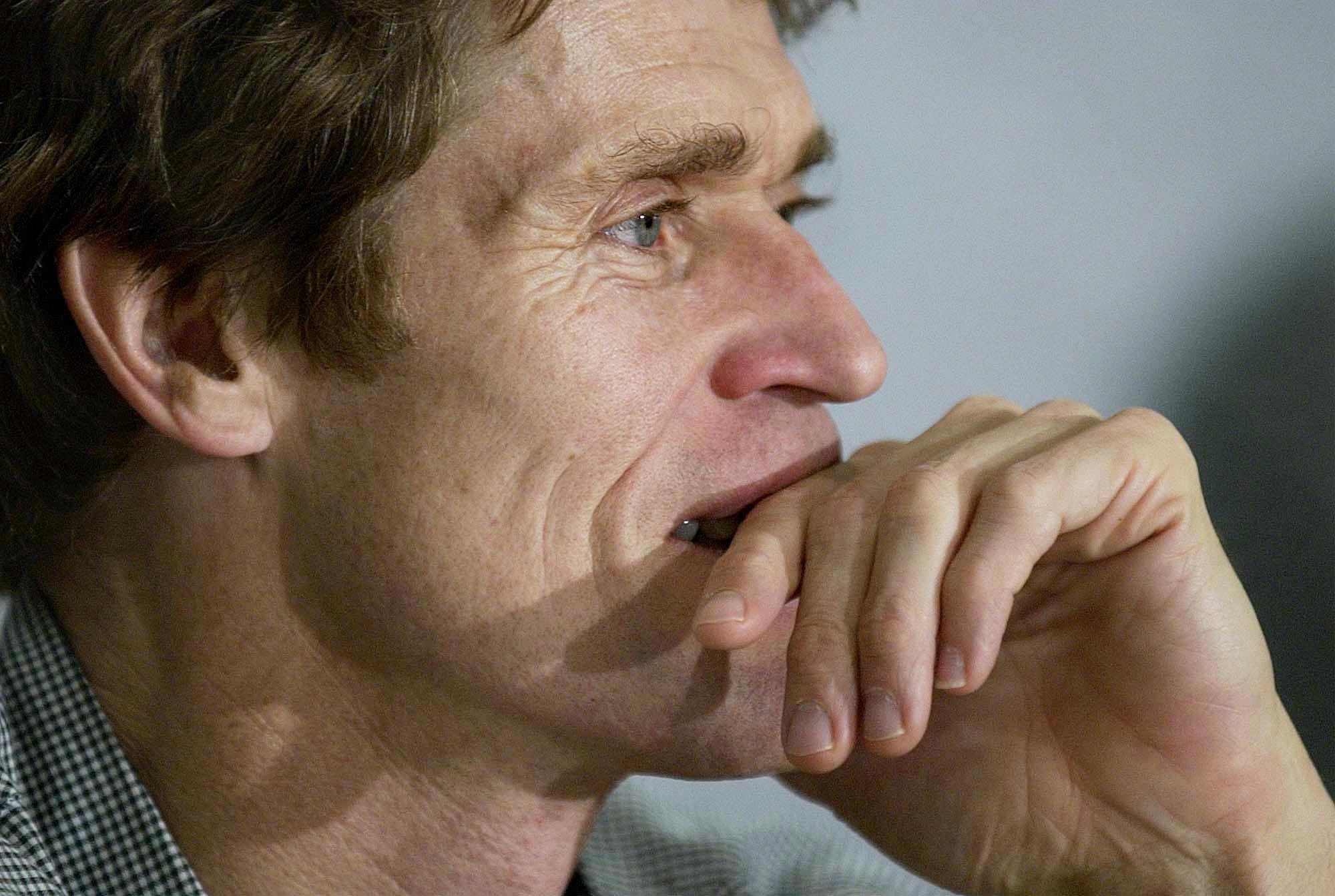
He remembers having been in Barcelona before. "Once or twice," he says, straightens up in his chair, and continues: "But I find it hard to recognize the city. I have the impression that the Barcelona I knew is now different." Tourism? "It must be," he responds simply. Unlike the city, Willem Dafoe (Appleton, United States, 1955) seems unchanged, always the same. His slightly hoarse voice, wide smile, and rebellious hair remain in exactly the same place since long before he was first credited in a film in 1980. And it wasn't just any film. Few can boast of having debuted in the production that marked the end of an era and almost everything: Heaven's Gate, by Michael Cimino. If you remind him of the fact, he laughs. Now, in the changing Barcelona of today, the actor presents The Host, the film by Miguel Ángel Jiménez based on the novel by Panos Karnezis in which he plays a rich, powerful, manipulative man sick with his own omnipotence. It's a film that speaks of the most toxic and outdated masculinities, of the obsession with legacy, of the vices of patriarchy, and many other things that cause harm. However, everything unfolds in Greece, in the eternal Greece with the same Willem Dafoe as always.
How much does an actor with almost 50 years of career, who brings to life a character obsessed with his legacy and inheritance, worry about his own legacy?
Before being an actor, I consider myself a spectator. I constantly watch movies, classic movies, and the first thing I think as soon as I sit down is: "All these guys are dead." Honestly, and it's not false modesty, it's something that doesn't concern me in the slightest. Really. I am too busy doing what I do, and, oddly enough, maybe that's why I do what I do. Also, if you start thinking about those things, it's like celebrating your own funeral in advance. Who is the legacy for? What's the point of leaving anything to anyone? I prefer not to have that responsibility. I don't have time to waste in that way.
One striking aspect of the legacy he prefers not to think about is that he started in the film industry with a movie that marked the end of an era.
Heaven's Gate ended the New Hollywood era. Would you say that the film industry is currently experiencing another era's end? Well, and to avoid taking all the responsibility, I did other small things before. But yes, it's clear that the film industry as we have known it is undergoing a process of change. The experience of movie theaters is disappearing in favor of streaming, placing us in a different world. Movies no longer have the impact on people they once had. But, on the other hand, it would be unfair to generalize without further thought. There is a type of more author-driven cinema -- perhaps much smaller in scale -- but it is still very much alive. In any case, with this issue, it's a bit like with the legacy: since I don't have the power to change anything, I prefer not to dwell on it. I can only do what I do.
Do you resist pessimism then?
Yes, I'm not completely pessimistic. I am, but to some extent. I still find very interesting people to work with and interesting things to do. I am a bit like the old captains willing to go down with the ship. But then you see things done with AI and you can't believe it. Just today they showed me an image of myself aged, even more than I already am, and it was incredible. It looked like I was about to die... Everything is too overwhelming, and right now it's impossible to think about the future. It's already quite difficult to think about how people perceive things in the present.
"My legacy? Every time I watch a movie, I think: All these are already dead."
In The Card Counter, you portray a man obsessed with power reminiscent of old and very toxic archetypes from the past; archetypes that, despite everything, seem very present in international politics. How long do we still have to wait to witness the disappearance of these people?
It's hard for me to answer that question. Time goes by, and they are still there. In defense of my character, I must say that the movie is set in the 1970s. The idea of a self-made man was relevant back then. It's the idea of a man who boldly, imaginatively, and courageously creates an empire. That doesn't happen with the men we might have in mind right now. In Trump, for example, the self-made man figure doesn't work. He is just the opposite. What we see now is a group of interconnected businessmen who share the same goals and business practices to oppress the rest of the people. That's what the ultra-rich who support Trump do. It seems like nations have disappeared, and only mega-corporations matter. Logically, one would think that they would use their privilege and power to do good, to help others, to oppose Trump, but they only have one agenda: to get even richer. The strange thing is that, with all that we are seeing, people don't realize that these people are their enemies. We should go after them, not admire them. I imagine it's because we tend to admire those who have more than us. I don't know, I don't know if I've answered.
I understand that you are concerned about the direction of what is happening in Iran and in the world... Of course, it's a real disaster... It is assumed that art should help us understand things and progress, and yet it seems that we are always in the same place. Are you discouraged?
I wouldn't say we are in the same position. It's like a cycle that makes us fall into the same mistakes over and over again. The truth is, I can't think of anything intelligent to contribute. And I really don't feel comfortable talking about politics because actors may be tempted to talk about things that people don't want to hear from them. The reality is that I do notice that we all, in one way or another, seek explanations, answers... We seek a real experience, and that, it's true, is provided by anything that facilitates a collective experience. In a world where everything is virtual, true art has to serve to reconnect with reality, to promote empathy, connection, a sense of common purpose... It's important to create a free space to consider other ways of approaching the world.
What does Dafoe have that other actors don't? It's rare for a director you work with not to work with you again. Julian Schnabel, Yorgos Lanthimos, Abel Ferrara, Wes Anderson, Robert Eggers... You are on the list of all of them.
There is a code that we all share. If I like a director's work, all I want is to be at their service to be part of their universe. I have a certain vocation of service. Zero protagonism, no selfishness. I don't mind the feeling of working for someone. I'm fine with disappearing, and I care more about the work itself than my work in particular.
You live most of the year in Rome, and we see that there are hardly any American films in the new edition of a festival like Cannes. Are we experiencing another end of a cycle?
Probably. But there is something much more obvious, and that is that the major studios fear Cannes. If they see that a film smells of art or has a chance of winning an award, they prefer to release it in the fall. It's difficult to monetize a success at Cannes. They save it for the awards season.
Do you consider yourself an exception among your colleagues?
I don't consider myself different from other actors, although, due to my background and interests, maybe I am. My origins are different. I don't know many actors who have worked in avant-garde theater for 50 years and make movies. So that's particular. Also, when I hear other actors talk about how they approach their work, I don't always identify with it. But it makes me a little embarrassed because I don't want to think that I'm special. On the other hand, I have very eclectic tastes and have always lived all over the world. Also, from a very young age, I have sought international productions. And I don't think that's typical. But, be careful, I don't want to think that I'm an atypical actor.
We started talking about Heaven's Gate. Recently, there has been a wave of reclamation of one of your forgotten films...
Yes, I know which one you're referring to, The Boondock Saints by Troy Duffy from 1999...
Are you surprised?
What surprises me is that it has become a cult film for younger people who haven't seen any of my previous works. It is said to be a poor version of Tarantino's cinema, but I disagree. It has something, and my character is incredible.