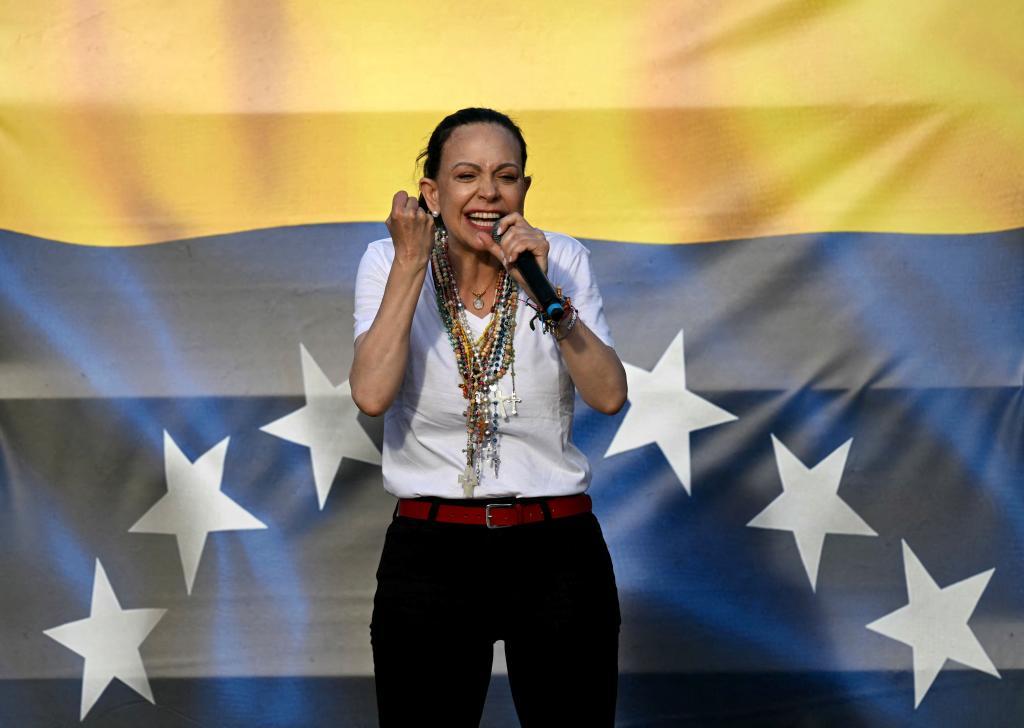
QUESTION. It is an honor to have you in EL MUNDO. Congratulations, yesterday was a very intense and emotional day. What did you feel when you looked out from the balcony of Puerta del Sol and heard tens of thousands of Venezuelans shouting "freedom"? What does this moment politically and emotionally say about Venezuela?
ANSWER. I felt immense pride. I felt in Venezuela. It was very, very impactful for me because I know what Venezuelans feel, and I knew what I would find here in Madrid: that emotion, that passion, that energy. I must say that what surprised me the most is the number of Spaniards who feel part of our cause, and that is something I carry back to Venezuela in my soul.
Q. Several times during your speech yesterday, you referred to your return. "That's where we're going, to pack our bags." After what happened yesterday in Madrid, when will you be able to return to Caracas and with what mandate from the Venezuelans do you feel legitimized?
A. The mandate remains the same. As you well know, those who have closely followed the Venezuelan cause, on October 22, 2023, Venezuelans decided to choose, through a process organized by the people, not only a leadership but also a strategy to follow. I would say some principles by which we are governed. These were, of course, the primaries. The regime became terrified after that success, and, well, we know what happened: they did not let me participate. What we saw here in Madrid yesterday is the ratification of what all of Venezuela is feeling, inside and out. I will return as soon as I finish a series of activities and objectives that I set before coming.
Q. But do you believe that the regime will be able to allow you to return to Venezuela?
A. The point here is that an irreversible process has begun. It is, as I said, a huge dam that has had a channel opened. Nothing and no one can stop this. In the end, what will happen depends on the people, on the Venezuelans. And we have a great responsibility; I assume mine and will be where I am most useful to our cause.
Q. What are the next steps? In other words, what would be your political priorities at this time? Are you in a position to demand a specific electoral calendar from Delcy Rodríguez?
A. The point is not me; the point is the country. And you saw it yesterday in a monumental gathering, even by Spanish standards. Everyone demanding the same thing. What could be more democratic than asking for an election? And I say it daily and I repeat it again because it is unheard of, or maybe not so much. But those who in the past said we had to go to elections no matter what, even knowing there was fraud, after we exposed the fraud and are going to elections without fraud, now they don't want to go. Get it together. Obviously, there is a sector that is trying to give oxygen, to postpone a tyranny that is on its way out. The timeline depends on the people and the force that is channeled around that popular desire. More than 80% of Venezuelans demand the ability to express themselves freely.
Q. You know, you have said, that time is important, that the regime will try to consolidate itself, to extend the times as much as possible. When do you think it would be fair to hold that electoral process? With what institutions? Because a good part of them are occupied by Chavismo.
A. All of them. All of them are occupied by the regime. No one is fooling anyone here. They are the same. Did Delcy Rodríguez arrive on January 3rd? She, as the vice president appointed by Maduro, was responsible for the entire structure of civil repression. She was in charge of the links with Russia, with Iran. No one is fooling themselves. The first step to take is the appointment of a new National Electoral Council, which complies with what our Constitution establishes, which says they must be individuals with no political affiliation and who generate credibility and trust among Venezuelans. There is nothing more democratic than an election, even for a democratic force that we won and that would have every right to say: it is that result, the one that is respected, the one that is imposed, and accepted in the interest of a peaceful process to ratify that expression of popular will. So, who can oppose that?
Q. Yes, this is relevant because there were elections on July 28, 2024, and you and Edmundo González won. What role does that legitimacy reserve for you in Venezuela's democratic transition?
A. Enormous. I must say that if I owe anything to life and to God, it is to have found a man of the moral stature, courage, kindness, and generosity of Edmundo González and his family. They have made an immense sacrifice for the freedom of Venezuela and have enormous legitimacy to accompany, participate, and together contribute to moving forward with this transition process as quickly as possible because, in the end, this is a matter of lives. We are talking about a country that is starving, with an inflation rate of 600% year-on-year in February, with wages of one dollar a day. So, understand the urgency and the tragedy of what Venezuela is experiencing today because there is this anxiety and these growing expectations within our country. And, in addition to all that, there is still persecution and political prisoners, despite the removal of Nicolás Maduro. At what exact point is Venezuela now? We have started a process in which, due to the intervention of the United States, by bringing Nicolás Maduro to justice because he was the head of this cartel, a process of dismantling the repressive structure, the corruption structure, and the criminal structure has begun. Have significant steps been taken? Of course, but not all that are required. Perhaps the most urgent issue, which has been one of the more than 1,000 political prisoners, there are still around 430 who remain in prison. Among them, all the military political prisoners: not one has been released. There is a particular vindictiveness against the military who have behaved institutionally and whom the regime uses as exemplary punishment to scare the entire military structure. The Amnesty Law is being applied in an absolutely discretionary manner. They grant amnesty to whomever they want, with absolutely arbitrary criteria. You have a case like that of Perkins Rocha, who was a judge of the first court, my lawyer, they release him, they release him, and they lock him up in his house with an electronic ankle bracelet; the case of the metropolitan police officers, who have been in prison for 23 years... They have destroyed the lives of those families. So, as a country, the first thing we demand is the release of all political prisoners. At this moment, the maintenance of the regime has a lot to do with the United States, it is the real power over Delcy Rodríguez.
Q. You, who have visited Donald Trump and speak with Marco Rubio, what guarantees do you have that Washington will not settle for a more or less effective arrangement for its interests in the short term and will return sovereignty to the Venezuelans over their country?
A. The current status quo is anything but effective. It is obviously unsatisfactory from any point of view. From the perspective of migration, which is a concern for the United States, people will not return to a country where the same criminals who destroyed your life and forced you to flee are present. From a security standpoint, they are the ones who maintain deep ties with Russia, Iran, Hezbollah, Hamas, the guerrillas, and drug cartels. They will never dismantle these structures unless forced, and as soon as they have less pressure, they will reinstall them. From the perspective of energy security, Venezuela is producing, at most, one million barrels per day. To produce 5 or 6 million barrels per day, which is our potential, between 150 and 190 million dollars are required. Tell me, what board of directors of a serious company would accept making investments of billions of dollars in a country that ranks last in the Rule of Law and has the same person who participated in thefts, expropriations, and confiscations at the helm. So, from any point of view you look at it, for the United States, for the countries of the region, and obviously for Venezuelans, what is beneficial is an orderly transition. And that involves establishing an electoral calendar.
Q. You knew that when you awarded the Nobel medal to Donald Trump, many people around the world would not understand it, that they would see your cause shift from being universal to being an ideological cause. What do you have to say to those who see things that way? Why did you decide to do it?
A: It is very regrettable that there are people who can distort or hate a leader more than they embrace, love, or support the higher causes or values. Our cause is for freedom, and it is a universal cause. Our cause is for human dignity, and it is universal because of justice, because it saves lives. And the truth is that Donald Trump, as President of the United States, has been the only head of state who has put the lives of any of his citizens at risk for the freedom of Venezuela. And that is something that no one can question and that we will never forget.
Q: Would the United States' military intervention have been imaginable without July 28th?
A: I don't think so. But ultimately, the United States will have to confirm or deny that. I believe that July 28th gave it enormous moral force and legitimacy because it made it clear to the world—and this was recognized—that Nicolás Maduro was not the president of Venezuela, but rather the head of a criminal organization.
Q. When you met with U.S. senators at the Capitol, you emphasized all the values of classical liberalism, speaking of the rule of law, democracy, and the free market. How do you envision the first phase of a legitimate government under María Colina Machado in Venezuela? What would be her first fundamental decisions?
A. I believe in the potential of human beings to autonomously build their own destiny. I believe we are free and equal. And, to that end, I believe we must have transparent, inclusive, and democratic institutions that allow us to establish our own rules and that these rules endure beyond the political shifts and preferences of certain authorities or officials, because they also undoubtedly create alternation of power. And for me, the key is always putting people at the center. People must have individual responsibility, in addition to assuming their part in this process. Our challenge is to extend the trust we have built among citizens to the institutions that must be rebuilt from scratch. From scratch. Because there isn't a single institution left standing in Venezuela. It's a great challenge, yes, but it's exciting because how many societies in history have the opportunity to build, like a blank page, institutions that should last for generations or centuries?
Q. I don't know how many, but Spain was certainly one of them; we did it in the late 1970s. What guarantees of reconciliation and stability do you think should be offered to that part of the repressive apparatus that remains within the regime today to prevent them from blocking this transition process?
A. First of all, I want to emphasize, when we talk about reconciliation, that this effort to confront and polarize the country and divide us along all lines—that is, white and black, rich and poor, left and right, those inside, those who had left, rural and urban—we managed to overthrow and dismantle everything that Chavismo did. I assure you that there is no society today, at least in Latin America, with the level of cohesion that Venezuelan society has. You have 80, 85% of the country that wants the same thing, that shares the same values. Do you see what happened yesterday? So, to those citizens who may be afraid during this transition process, what we offer is that we will apply justice, we will ensure their rights are respected, contrary to what the leadership of that structure did to us. If we truly want change in Venezuela, there must be a different approach. Of course, it's not about revenge, it's not about retribution. There has to be justice so that we can move forward, and eventually, there may even be forgiveness for the monstrous crimes that have been committed in Venezuela.
Q. Let's talk about this European tour in which you have met with very different leaders: you have met with Emmanuel Macron, you have met with Giorgia Meloni, you have met with Rob Jetten in the Netherlands. What are you asking of Europe at this moment? What are you asking of the West?
R. Very clearly, the same thing I ask of all Venezuelans: that everyone assume their responsibility. There cannot be double standards; there cannot be some actors who think that certain societies can have a certain level of democratic autonomy while others are not prepared for it. On the contrary, I believe that Venezuelan society has demonstrated, in a wonderful and moving way, not only its yearning for democracy, but also its ability to be organized and exercise it, to defend it under the most extreme conditions. So what we are asking for is a clear and firm stance toward the full exercise of popular sovereignty, toward those values that define liberal democracies, toward the restoration of constitutional order in Venezuela, and toward respect for international agreements in order to have a society and a world that can move forward in terms of prosperity and peace. What is clear is that there is no peace in Venezuela. Delcy Rodríguez represents chaos, she represents violence, and she represents the past.
Q: Do you believe that your return and the change in Caracas could alter the political and moral balance of all of Latin America, beyond what happens in Venezuela?
A: I would never attribute such a significant impact to a single person. I am convinced that the movement that has emerged in Venezuela, which is social and cultural in nature, transcends us all. And I am convinced that just as Venezuela has been, so to speak, the tumor of that cancer that spread throughout the hemisphere, using Venezuela's resources to undermine those liberal democracies, we are going to dismantle it and build, from Venezuela, with all that we have experienced and learned, a nation that projects respect, democracy, exchange, prosperity, and freedom. This will have a monumental effect. And I have no doubt that the liberation of Venezuela will also bring about the liberation of Cuba and Nicaragua.
Q: Things happened yesterday in Madrid, and things also happened in Barcelona. Pedro Sánchez, the President of the Spanish Government, brought together a number of progressive leaders, many of them Latin American, to discuss democracy, while you were mobilizing the entire Venezuelan diaspora here in Madrid. What does this contrast reveal about two ways of understanding Latin America?
A. I think you only have to look at the images to understand what one thing is about and what the other is about. Ours is about the people, about respect for human dignity, about the decision to be free, to cling to the truth, to transparency, to justice, and to the rule of law.
Q. Mr. Lula da Silva and Mr. Gustavo Petro received you with hostility on Friday. Why do you think that happened?
A. The only conclusion I can draw is that there are those who oppose the truth being revealed. There are those who would like to prolong the status quo in Venezuela for reasons I won't speculate on. And in the end, it's very clear to me that those who argued we had to participate in any election, even an illegal or untimely one, called by the regime when there was fraud, are now refusing to participate since there isn't any because we've dismantled it. We have to ask them: what explains this change of heart?
Q. Is this what you meant when you said that the Barcelona summit demonstrates that meeting with Pedro Sánchez wasn't advisable? What would the Spanish Prime Minister have had to do to deserve that meeting?
A. I don't think the term is "deserve." What I do is filter everything I do: whether or not it contributes to accelerating a transition in Venezuela. And there are events that contribute and events that are detrimental, because they create confusion or send inappropriate messages.
Q. And do you think that meeting with the Spanish Prime Minister would have sent an inappropriate message?
A. At this moment, without a doubt.
Q. The Spanish government, on the contrary, argues that it has facilitated visas for many Venezuelans, including many opposition leaders, and yet you refuse to meet with them. The fact that the President of Spain wants to meet with you is, in itself, a recognition of your legitimacy.
A. First of all, I have always acknowledged and thanked all Spanish governments, even to this day, for the way they have welcomed so many Venezuelans and facilitated their integration into Spanish society. It is something I recognize and appreciate, and it is something we in Venezuela will always recognize and remember.
Q. Spain often seems, however, complicit, with Zapatero always playing a significant role. To what extent do you believe Mr. Rodríguez Zapatero has participated as an accomplice of the Chavista regime?
A. I don't have all the information, and I believe that part of the concern about a transition in Venezuela, in some cases and certainly in this one, is that they fear the truth will be exposed. In any case, I can say that his intervention at times when there has been an inappropriate handling of the situation of political prisoners has not favored a democratic transition in the country.
Q. But if you govern, will the truth be revealed?
A. In any government where justice exists, the truth will be revealed.
Q. When I heard your daughter Ana Corina read the Nobel Prize acceptance speech, I was struck by the fact that the only country you mentioned by name was Spain, specifically in the second paragraph, at the beginning of the speech. Why? What does Spain represent for you at this time for Venezuela? Conversely, what did you expect from Spain during these years that you didn't find?
R. I chose my words very carefully in my speech that referred to Spain. It was an act of justice, because if Chavismo has tried to do anything, it's to rewrite history and deny our roots. The contribution of Spanish culture, language, religion, and blood to Venezuela is monumental, just as we obviously recognize our roots from other regions as well. So, what unites us with Spain is very powerful, and considering the Ibero-American market, not only because of its size and wealth, is monumental. I believe it's a real opportunity today, because I'm also deeply optimistic about the future of Latin America. So I think it's time for Spain and Latin America to rethink our relationship. I believe it should be much richer, more dynamic, and more synergistic, but that's only possible if there is democracy and freedom. And we certainly expected much more from the Spanish government in the fight for democracy and freedom.
Having said that, I cannot leave without thanking the authorities of this city, both the Community of Madrid, represented by Isabel Díaz Ayuso, and the Mayor of Madrid, José Luis Martínez-Almeida. I have no words to adequately express my gratitude for what this has meant for Venezuelans. It is a recognition of a remarkable achievement, and Edmundo and I have embraced it as such. And my thanks also go to the media: when few believed this was possible, you were there. Now everyone believes it and sees it as imminent, but there were times when we insisted and few dared to affirm it and give us that opportunity. Of course, I also thank the city's chroniclers, the artists, the academics, and the passersby who stop me in the street and tell me how much they care about our cause. So, thank you to Madrid and thank you to Spain. It will be our turn to welcome you.