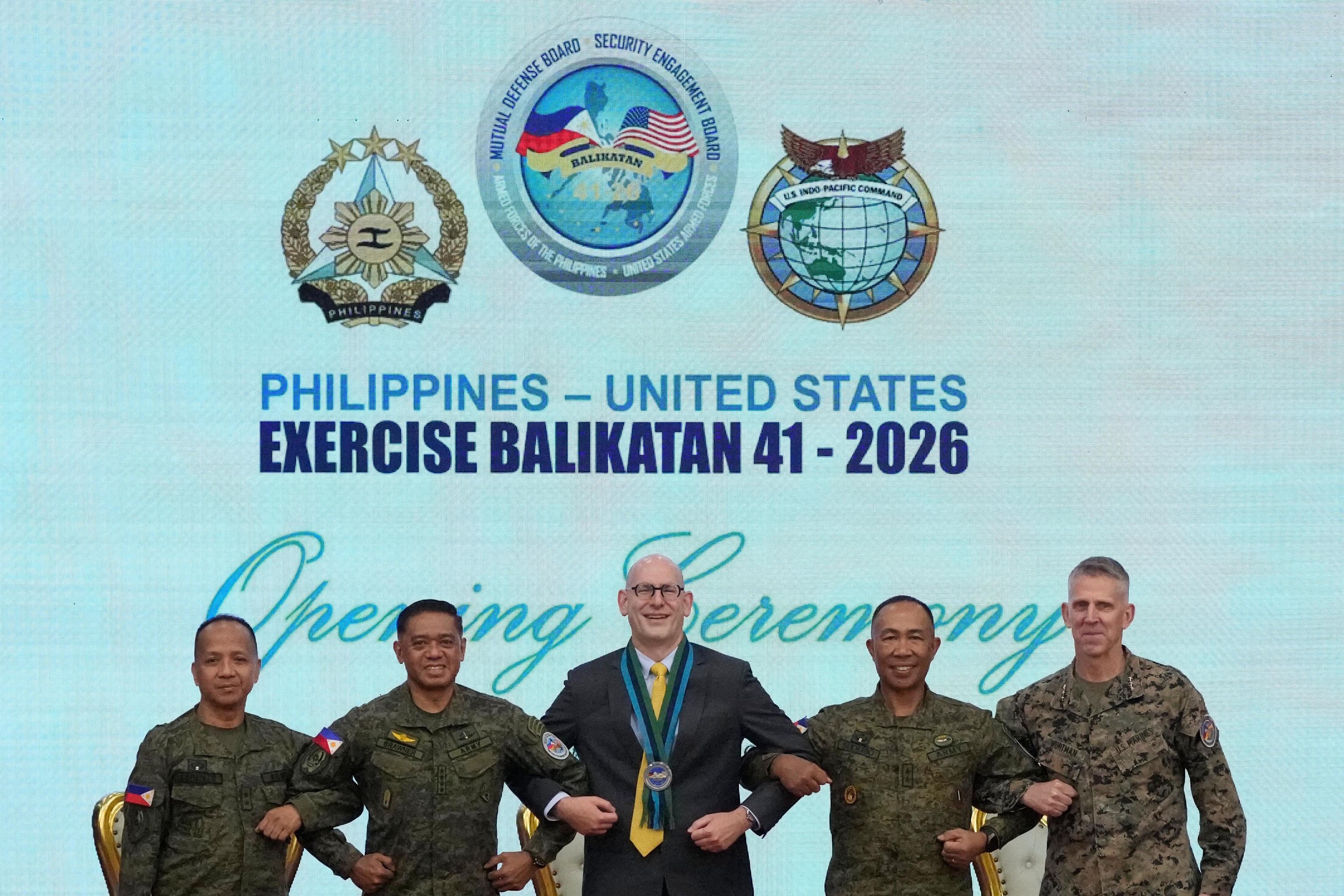
While the United States and some of its key allies stage this week in the Philippines their largest joint military deployment in the Asia-Pacific region, Beijing responds with a familiar choreography: also displaying naval strength.
On Monday, the same day Japan joined for the first time with combat troops in the Balikatan exercises (which the US and the Philippines have been conducting since 1991), China announced the dispatch of a group of destroyers - led by one of its most advanced warships, the Type 052D destroyer Baotou - to the western Pacific, passing through the Yokoate channel, a route close to Japanese territory.
"This is a mission to test the operational capabilities at sea of the armed forces," communicated the People's Liberation Army (PLA).
In recent months, the PLA has intensified its naval and air activities around Japan and Taiwan, in parallel with Tokyo's increasingly assertive stance and the clear break of the conservative government of Sanae Takaichi with the traditional pacifist Constitution inherited from the post-war period.
Last Friday, Japan's Maritime Self-Defense Force destroyer Ikazuchi made an uncommon transit through the Taiwan Strait, a move that Beijing described as Tokyo's attempt to "deliberately provoke problems."
Japan's new more militaristic stance now aligns with the Balikatan maneuvers, which have evolved from being a bilateral exercise between Washington and Manila to becoming a multinational platform with over 17,000 personnel and the participation of other countries such as France, Australia, Canada, and New Zealand. This year's novelty is that amid growing tensions with China, around 1,400 Japanese soldiers are taking part in these exercises, along with ships, aircraft, and Type 88 anti-ship missiles deployed from the Asian country.
The exercises last 19 days and will include live-fire drills in northern Philippines, facing the Taiwan Strait, as well as in a province near the disputed South China Sea, the scene of recent clashes between Manila and Beijing over several disputed islands, reefs, and sandbanks. So far, the confrontations have not escalated beyond water cannon fights or minor ship collisions that have occasionally left some sailors injured.
The Trump Administration often reminds that Washington and Manila are signatories of a 1951 Mutual Defense Treaty, which obligates the US to defend the Philippines if the Southeast Asian country's forces are attacked anywhere in the South China Sea. They also share the Enhanced Defense Cooperation Agreement (EDCA) of 2014, which allows for joint training, pre-positioning of equipment, and the construction of facilities such as airstrips, fuel storage, and military housing.
"Regardless of the challenges that arise elsewhere in the world, US focus in the Indo-Pacific and our steadfast commitment to the Philippines remain unwavering," declared US Lieutenant General Christian Wortman at the opening ceremony on Monday. Wortman later revealed that approximately 10,000 US personnel would participate in the "largest Balikatan in history," as described by the Philippine Army chief, General Romeo Brawner.
"Through integrated air defense and anti-missile systems, maritime security operations, live-fire exercises, and multinational joint readiness training, nations are building systems that think, move, and respond as one," said Brawner.
The military maneuvers in the Philippine archipelago focus on the so-called "first island chain": a strip of strategic islets connecting Japan, Taiwan, and the Philippines. Coastal defense drills will extend to less than 200 kilometers off the southern coast of Taiwan, the autonomous island that China claims as part of its territory.
At the end of last year, Philippine President Ferdinand Marcos warned that, given his country's proximity to the island democracy, "a war over Taiwan will drag the Philippines into the conflict."