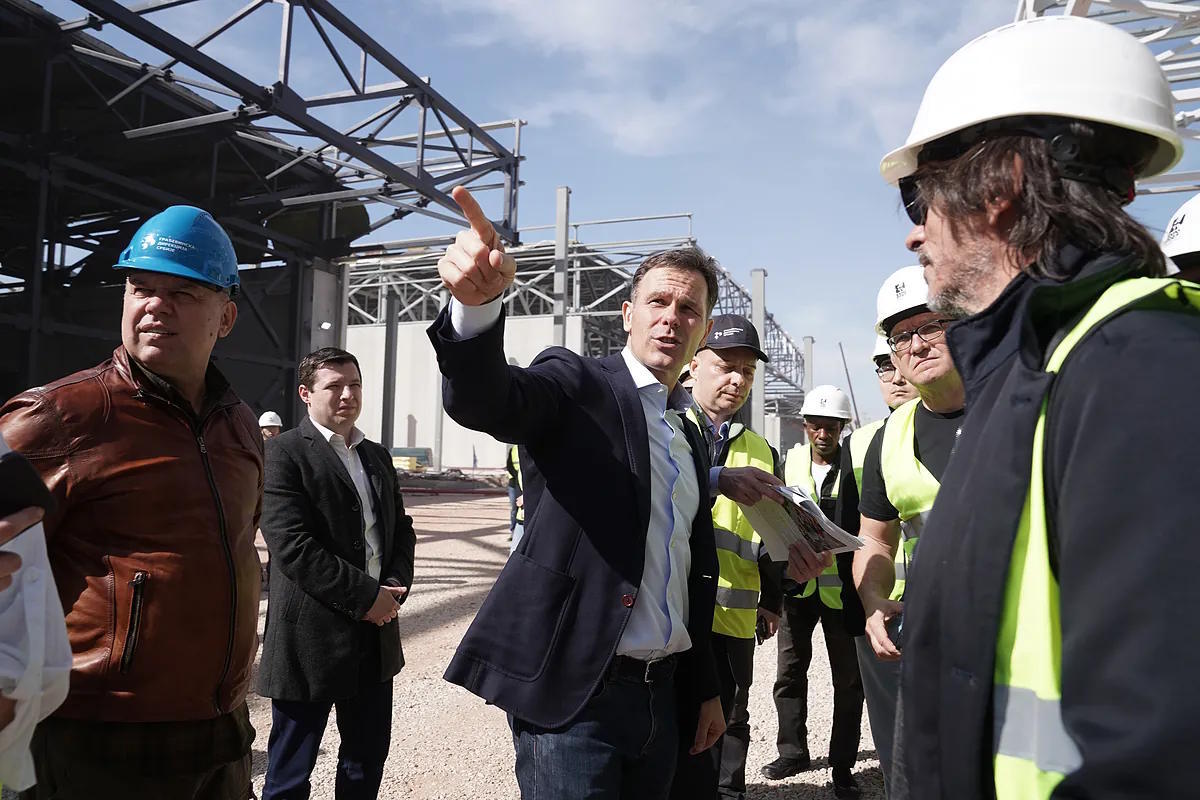
About 15 kilometers from the center of Belgrade, in the southeast of the city, cranes, a lot of dust, and gigantic building structures can be seen, with a futuristic-looking football stadium standing out, even though it is still covered in endless scaffolding. A huge team of 4,000 people works every day in an area of 25 hectares next to the Sava River with just enough time for the Expo 2027 inauguration on May 15 next year, the first to be held in the Balkans. The idea is to finish the construction this year, with only finishing touches remaining.
"We are six months behind schedule due to underground waters, but we have accelerated and will solve it", explains Sinisa Mali, Minister of Finance and Serbian Deputy Prime Minister, one of the names rumored to replace President Aleksandar Vucic next year. "My next plans are to retire," says the former mayor of the Serbian capital, who, amid questions about the immense project, is asked about his future and his favorite team ("Red Star, of course") with laughter.
Because, with no fixed date yet, Serbia will hold general elections in 2027, in which Vucic, who was first prime minister and, since 2017, president, will no longer be able to run due to having completed the maximum two terms allowed by the Constitution. Both the Expo and the electoral appointment coincide with a highly tense political climate for almost a year and a half due to mass protests and student strikes, which occupied the entire last academic year. The students accuse the government of corruption and plan to participate in the elections with a list kept secret until an official call is made, fearing reprisals against those on the list.
"Things have changed, now you don't see anyone around anymore", Mali assures about the students and their protests. "They tried, openly I would say, to seize power without elections. We talk about what matters to people. That is our policy, and we will continue like this," the Deputy Prime Minister concludes.
Mali prefers to explain the plan, focused on the Expo, which, according to his words, will reach the entire country. He specifies that out of the total budget of 17.8 billion euros, around 1,300 million are specifically for the Expo (the main contractor is the company Power China and the project is by the Spanish studio Fenwick Iribarren Architects), and the rest is dedicated to ambitious infrastructures involving the rest of the country: a high-speed railway line connecting Belgrade and Budapest, the first metro line, a power plant, several highways, and, of course, the new national stadium that will host their football team and major events, with a capacity for 52,000 spectators and an estimated cost of 460 million euros.
"The plan involves building a legacy from all this that will enhance the appeal and competitiveness of the entire country," Mali emphasizes. The Expo grounds will later become the new Belgrade Exhibition and Congress Center, and the 1,400 homes built to accommodate staff and participating countries during the event will be put up for sale. "Once the Expo is over, there will be an investment boom in this area, which was previously empty. It is a great opportunity and will make Belgrade more attractive," highlights the minister.
"The Government presents the Expo as a great success and as a lasting legacy in economic terms," points out Mira Milosevich, a researcher at the Real Instituto Elcano, an argument she believes "people are buying into." "Among other things, it is a distraction maneuver, but it is indeed important and represents a diplomatic projection, as we know in Spain from the experience in Seville in 1992," emphasizes this expert.
"There are many similarities between Expo 2027 and some previous emblematic projects launched by the Government, such as the development of Belgrade Waterfront -another million-dollar urban project-", explains analyst Sofija Popovic from the regional media European Western Balkans. This journalist highlights that "authorities present these initiatives at a national level as projects of vital importance for the economic development of the country, despite indicators and available evidence suggesting that sustainable economic growth cannot be realistically built this way."
Popovic also sees an attempt to "improve the international reputation after a year in which the repressive side of the Serbian regime became increasingly visible," referring to the student movement's complaints to silence them. However, she insists that "many people in Serbia believe that the main driving force remains the lucrative financial opportunities associated with the project."
Political analyst Aleksandar Djokic also points out that the Expo "is valuable for improving Vucic's regime image" and that the general feeling among "the dissenting part" is that it is "a major corruption scheme and that corruption is a crucial part of the loyalty system for the elites." Regarding the political climate and tensions in the streets, Djokic describes the discontent as "high," although the energy of the protests has decreased.
"The regime sought to delay as much as possible until the elections and thus gain time," and in his opinion, it has managed to "maintain its voter base." While the disunity between the student movement and the opposition "has reduced their capacity for organization and agitation against the regime, making the regime's victory seem increasingly likely."
"A major concern, regardless of when the elections are held, is the lack of trust in the electoral process itself," points out Sofija Popovic. "As national and international organizations have repeatedly pointed out, there are no conditions for free and fair elections in Serbia. Despite the EU's efforts to improve electoral conditions and increase press freedom in Serbia -as it is one of the candidate countries for integration-, very few advances have been made in practice," emphasizes this journalist.
"The country is very pleasant, but politically quite unbearable for the people living there," says Mila Milosevich, born in Belgrade but living in Spain for many years. "It is a hybrid regime that meets the formal demands of democracy, but in practice, a fairly narrow circle around Vucic makes the important decisions." "My feeling the last time I was there is that Serbians are fed up with Vucic, the opposition, and the students, but they have learned to cope with the situation."
Meanwhile, thousands of workers and the crane noises remain oblivious to these matters, focused on deadlines and the upcoming year. "The Expo is the greatest development opportunity we have ever had, just look at what happened in Lisbon, Vancouver, Shanghai, or Seville," enthuses Deputy Prime Minister Mali about what the event means for his country. "It is the largest event we have organized in our history and presents Serbia in different ways to all European Union members. Sooner or later, we will have full integration," he asserts confidently.