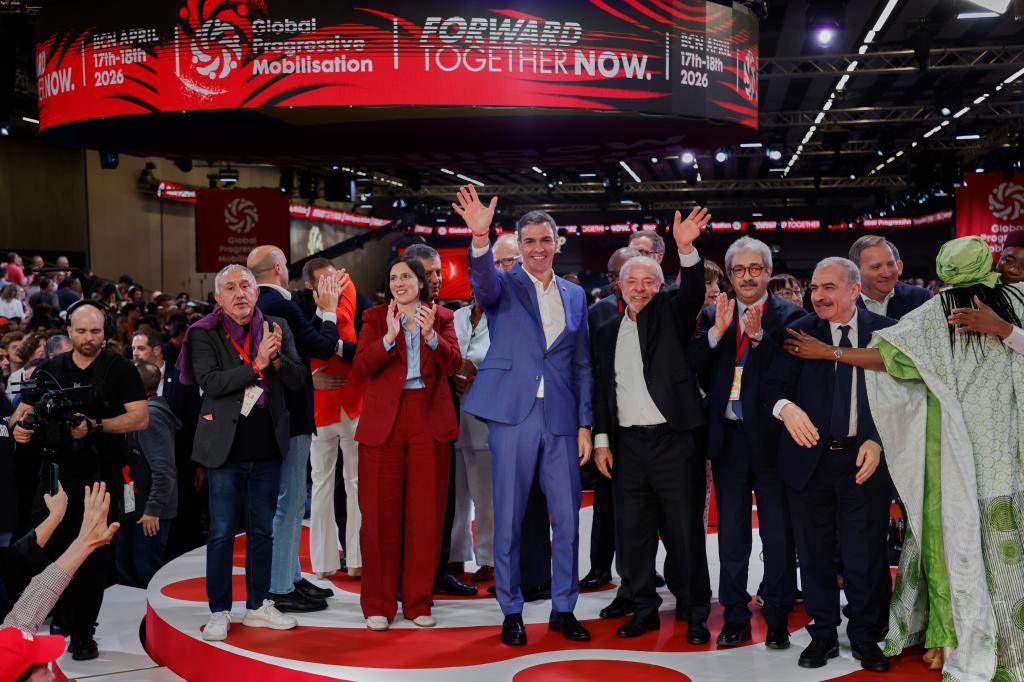
In the book where the current history is being written, where established rules blur, in the Government of Spain and the PSOE, there is a conviction that the far-right has learned to write and present reality before the left, with teamwork. "They are coordinated in an international mechanism that is working, they are clear about their objectives and the steps they must take to achieve them," say sources from Ferraz - the national headquarters of the PSOE. And they believe that the left must do the same. Coordinate and have an "action plan." Mobilize, ultimately. This is what the summits held this weekend in Barcelona aimed for (the Global Progressive Mobilization and the IV meeting In Defense of Democracy). "It is not a point of arrival, but the beginning of a new stage."
Spain acts as a channeling country for a visible and stronger "alternative," the construction of a "network" that serves as a mirror and counterbalance to the far-right and the right to "defend social democracy." This is what was intended to be showcased in Catalonia. A staging under the premise of the "need" for the "unity" of all progressives to counteract and halt the advance of the far-right worldwide.
Pedro Sánchez, socialist sources explain, has played a key role in building this "alternative" together with the President of the Party of European Socialists, Stefan Löfven. The meeting brought together international leaders such as the Brazilian Luiz Inácio Lula da Silva, the Mexican Claudia Sheinbaum, the South African Cyril Ramaphosa, the Colombian Gustavo Petro, and the Uruguayan Yamandú Orsi.
This progressive "mobilization" with Spain as the host serves Sánchez to continue stitching his role as a leading figure of the left in the world, as the antithesis of Donald Trump in shaping the new world order. The meeting in China with Xi Jinping and the international left's recognition of the Spanish president - including a sort of "transfer of power," believed by the Government, from Lula to Sánchez as a beacon of the global left - allow him to solidify the idea he has been working on for months, that Spanish social democracy is now the "reference point," a "compass" as in the past the Scandinavian or German social democracy could be. The Spanish Government is convinced that it is still possible to stop what they define as the "far-right wave" that has already reached Spain, with Vox very strong and gaining ground when votes are cast.
"Spain can offer and offers a different, progressive way of narrating and doing things to face global challenges," explain government sources. "This summit serves to ground narratives, strategies. We are arming ourselves against a far-right movement and have shown that we can loudly say that we are not alone." Because one of the purposes, in an international context of the advance of the right and the far-right, is to "raise our voice" and not let the far-right dominate not only in the media but also on social networks.
"It is time to move from the commitment we all have to concerted action, to strengthen this alliance," was the message that Sánchez, as the captain of the ship, delivered in one of his speeches. "Social democracy or barbarism" is the debate that La Moncloa poses for the upcoming elections in Spain and considers valid for any country.
And if that "network," that "mobilization," allows Sánchez to fasten buttons to his international profile while trying to leave more uncomfortable domestic issues in the closet - alleged corrupt schemes, the judicial investigation of his wife, parliamentary weakness... - it is also seized by Latin American leaders like Lula, Petro, or Sheinbaum as a showcase and podium to launch their messages. To blend in with more moderate and centrist left-wing movements that allow them to reposition themselves ideologically in the collective imagination. To appear in the picture outside the extremist label.
"What unites us is the commitment to the societal model that democracy represents in the face of attacks like the ones we see in numerous places," say sources from the Spanish Government. It happens that in a context where in Europe there is a dominance of right-wing and far-right leaders and the debate revolves around issues such as security, defense, and immigration, Sánchez finds a more empathetic space with left-wing Latin American leaders, with a more ideological and moral debate, focused on values, displaying a more social discourse where he feels more comfortable.