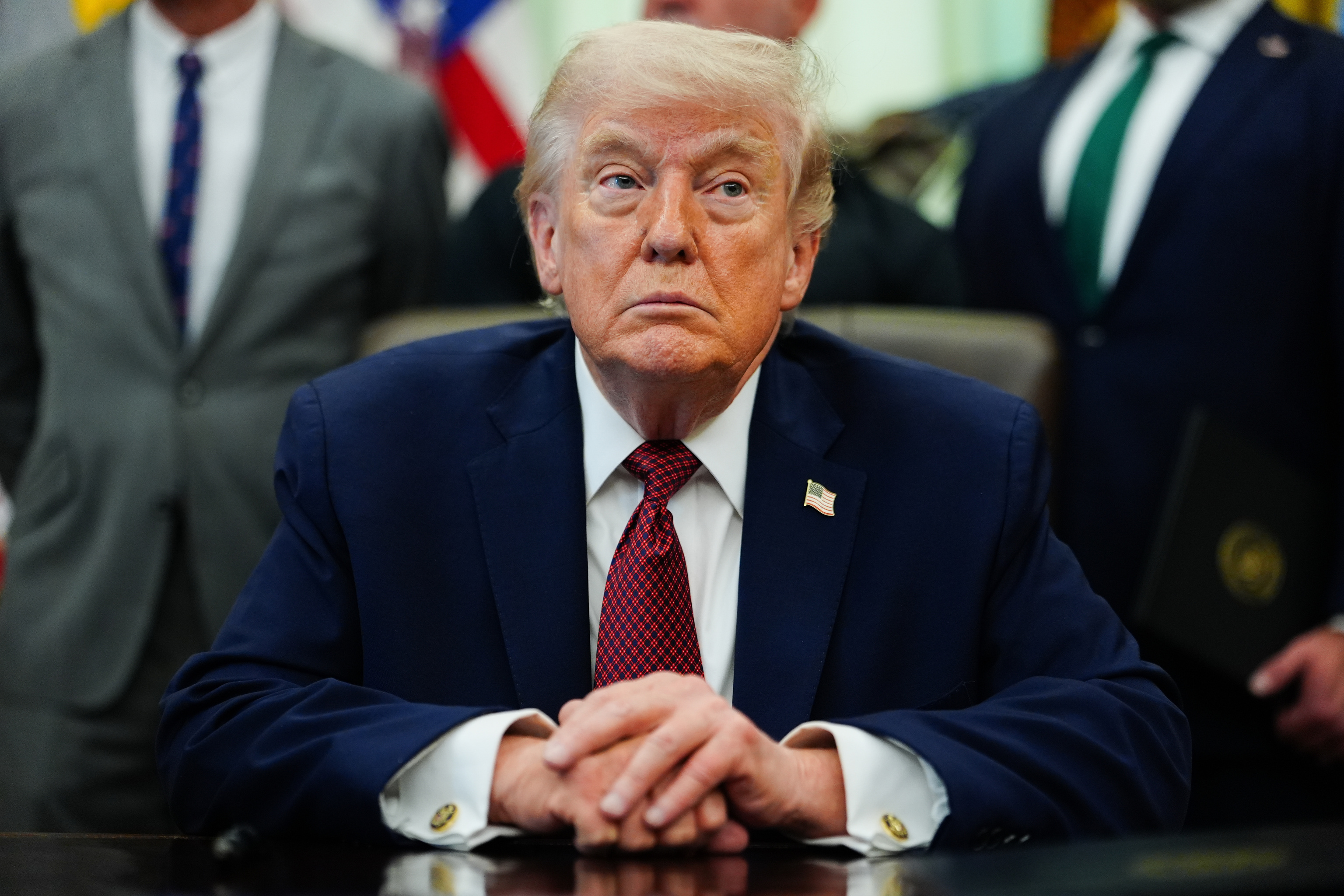
The President of the United States, Donald Trump, has once again extended the ceasefire with Iran at the last minute, which was theoretically expiring this Tuesday. After a long and tense day in Tehran, Islamabad, and Washington, where Pakistani mediation was not enough for both parties to commit to sending their delegations, Trump took to social media to announce an indefinite extension, citing alleged internal divisions among his enemies.
"Based on the fact that the Government of Iran is seriously fractured, not unexpectedly so and, upon the request of Field Marshal Asim Munir, and Prime Minister Shehbaz Sharif, of Pakistan, we have been asked to hold our Attack on the Country of Iran until such time as their leaders and representatives can come up with a unified proposal. I have therefore directed our Military to continue the Blockade and, in all other respects, remain ready and able, and will therefore extend the Ceasefire until such time as their proposal is submitted, and discussions are concluded, one way or the other. President DONALD J. TRUMP," the American President wrote.
Today's announcement is almost a replica of two weeks ago when, hours after announcing a possible civilizational eradication, he clung to Pakistani mediation to suspend bombings and force Israel to do the same, both on Iran and in Lebanon. Trump is very fatigued by the war, and all national press reports indicate that he wants to close this chapter. The problem is getting out of the mess he has gotten himself into. Right now, the Strait of Hormuz remains closed, navigation is very complicated, armies are mobilized, and the possibility of a major agreement including the nuclear issue is very difficult. Furthermore, Trump continues to set his own deadlines and ultimatums.
This morning, in a much more aggressive tone that no longer surprises or impresses his enemies, he had said that there would undoubtedly be a military attack if Iran did not comply with the demands of the United States. "I expect to bomb (...). We are ready to go. That is to say, the military is ready for it."
The first round of negotiations in Islamabad, with Vice President JD Vance, Jared Kushner (Trump's son-in-law), and Special Envoy Steve Witkoff, ended without sufficient progress, as expected given the magnitude of the task. Since then, there have been clashes, reproaches, and even shots fired, which under normal circumstances would have broken the truce. However, Washington is seeking a way out and is therefore willing to extend deadlines and relax its red lines.
It was expected that JD Vance would board a plane from the U.S. capital today, and Kushner and Witkoff, who were in Florida, would join in Europe. However, today these two were summoned to the White House, and Vance did not board. Meanwhile, the Iranians were paying close attention and stated that they would not send a delegation until the White House made a serious move. Tehran has made it clear that they do not trust Kushner and Witkoff, who are too close to both Israel and the Gulf countries.
"Blockading Iranian ports is an act of war and thus a violation of the ceasefire. Striking a commercial vessel and taking its crew hostage is an even greater violation. Iran knows how to neutralize restrictions, how to defend its interests, and how to resist bullying." wrote Iranian Foreign Minister Seyed Araghchi in the afternoon.
In an interview with CNBC, Trump had said hours earlier that the Revolutionary Guard was They are trying to move the missiles because we have obliterated most of their missiles and they are trying to move their missiles around even during the ceasefire. We have used this [ceasefire] to replenish, and they have probably replenished a bit too. We caught a ship yesterday that had some things on it, which wasn't very nice, a gift from China perhaps. I don't know, but I'm sort of surprised, but because I have a very good relationship, and I thought I had an understanding with President Xi, but that's all right. That's the way war goes, right?", said the president, suggesting that the interception of a ship in the hours prior was done to intercept arms shipments.
The chaos in the following hours had been immense, with contradictory messages in three capitals, unconfirmed reports in the press, and the feeling that everything could explode, reopening conflict and cross-border bombings in the region. The parties had not even been able to define exactly when the ceasefire was supposed to end, although this time Trump had been particularly open in his words, not specifying a date and time as he did the previous time.
The problems are not only about getting the parties in the same room, which is a huge challenge in itself. The first meeting, with Vance and the Iranian Parliament President, was the highest-level meeting between the two countries since 1979. It is not even about defining which countries the ceasefire affects or whether the temporary blockades in the Strait of Hormuz are maintained and under what terms. The most difficult part has always been and will always be the nuclear issue.
In recent days, Trump stated that Tehran would allow a joint mission to rescue the materials buried in the bombings of the summer of 2025, which Tehran denied. He also said that under no circumstances would he allow that uranium to go to the U.S., as the White House advocated. The Obama administration needed two full years to seal the most ambitious nuclear agreement to date, which Trump revoked upon taking office in his first term.
Defining the limits of civil use of nuclear energy, uranium enrichment, and the use of facilities is the red line for all parties. Trump justifies the war at all times by the need to prevent Iran from having nuclear weapons, and any agreement that does not resolve the issue, leaves uncertainty and loose ends, is doomed to fail. Or to have attacks again in the near future.
The balance is crucial on all fronts. Hezbollah confirmed in a statement on Tuesday that they have launched rockets and drones into northern Israel in response to what they consider Israeli violations of the 10-day ceasefire. Israel has maintained its attacks in southern Lebanon at all times, citing the right to legitimate defense with Washington's approval.