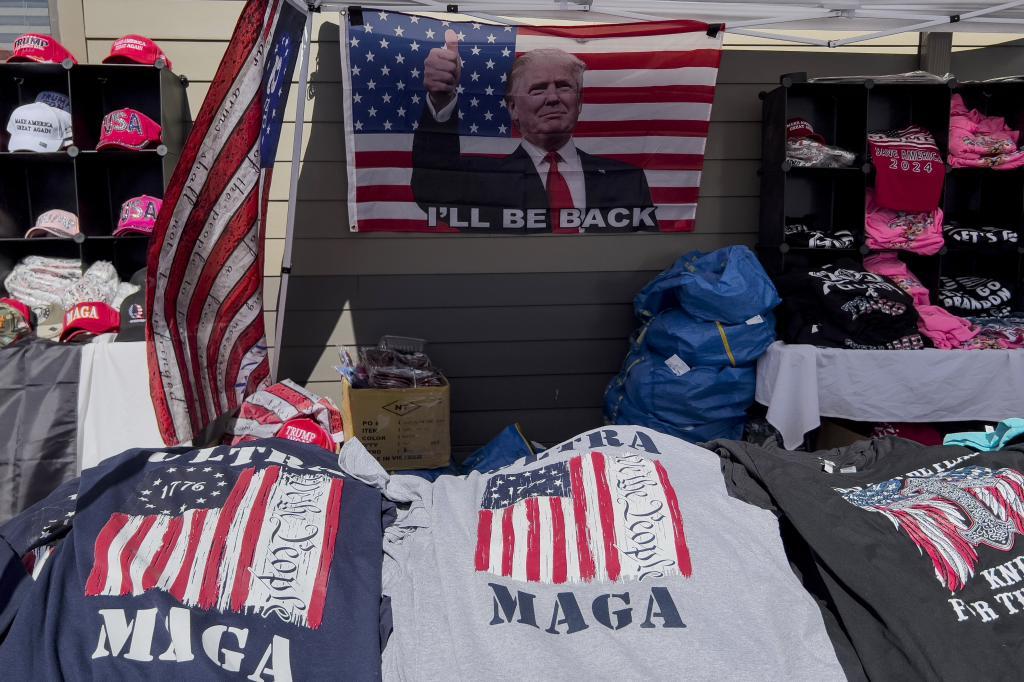
"Here it comes." Jeff Sharlet (New York, 1971) knew that the woman waiting beside him in a hangar in Youngstown, Ohio, was talking about Donald Trump. It was March 2016, and the then-presidential candidate was five hours late for a rally in front of about 3,000 supporters in a city that had been a Democratic stronghold for decades. While much was being written about the anger permeating those events, this American author - who has dedicated his career to dissecting Christian fundamentalism in books like The Family, now a famous Netflix series - believed he saw something different: jubilation, uninhibited behavior, an almost pornographic excitement towards violence, and a fervor where politics and religion were indistinguishable. What he witnessed that day led him to define the American far-right as a "fascist" movement.
"I was hesitant to call it that until I attended that rally," admits Sharlet in a conversation with EL MUNDO from New Hampshire, where he teaches Creative Writing at the prestigious Dartmouth College. He had traveled to Youngstown on assignment from The New York Times Magazine, which wanted a report on Trump's events as a religious phenomenon. "Now it's evident," he asserts. "But back then, almost no one in the political press wanted to see it."
Sharlet was no stranger to ultraconservative churches or the discourse of Christian nationalism; he has been researching and writing about religion for over two decades. Still, he admits that he had "never heard a preacher" like the fundamentalist who opened that rally, nor had he witnessed such delight in the imagined violence among the audience. He recalls how, near him, an endearing-looking elderly couple seemed to feel - he says - "a sexual excitement" at the prospect of a protester being hit by the crowd. "It was the pleasure of hitting, real or imagined". The husband then turned to Sharlet, who had not identified himself as press, and said, "[Trump] says what we all think. We all want to punch someone in the face, and he says it for us." "It was an intimate dialogue charged with sadism," the journalist and writer reflects today. "Trump had managed to eroticize violence against his opponents and, at the same time, turn it into a form of purification. To me, that was fascism."
That episode reappears in The Hangover: Scenes from a Slow Civil War (ed. Capitán Swing), the book in which Sharlet examines the faith rhetoric surrounding the MAGA movement and its links with conservative evangelism to portray a country that, in his view, has been sliding towards what he calls "a slow civil war" for years. To understand how it got to that point, the journalist travels through the United States in a sort of travelogue where he tries to trace the spiritual and political legacy of Ashli Babbitt, the insurgent - or martyr, depending on one's political sympathies - shot during the Capitol assault on January 6, 2021.
Sharlet claims that he slowly arrived at the expression that gives the book its title. "After January 6, I began to hear it from academics who had always been wary of alarmism," he explains. "They said we had never been as fragmented as a country." From there, he began to think about the conditions that would make a civil war possible and to focus on those who were already being targeted by that fracture: LGBTQ individuals, young Black people, or women seeking abortions following the Dobbs v. Jackson Women's Health Organization ruling, which overturned the constitutional right to abortion. "Then I understood that the question was not when it would start, but if it had actually already started, because it had already claimed its first victims."
Babbitt was one of them. The U.S. Air Force veteran died almost live on January 6, with the whole world as a spectator. "At first, it was unknown who had killed her, but you could see the hands of a Black man, an image reminiscent of foundational myths like The Birth of a Nation," Sharlet recalls.
"Her death was a turning point. To take the definitive step towards fascism, martyrs are needed," he points out. "First, Trump tried to elevate other citizens killed by undocumented immigrants, using a rhetoric of racial purity. But the public didn't know who those people were."
Babbitt, on the other hand, embodied all the attributes of a symbol: blonde, a veteran, a woman convinced that she had stormed the Capitol "for Christ and for Trump." The paradox, Sharlet notes, is that "she was a queer woman, not a churchgoer, who had supported Barack Obama in the past." "In the Republican world, getting involved in politics means getting involved in religion, even without any religious practice."
Trump's religiosity should not be underestimated. In his foray into politics, "he understood that he wasn't interested in strengthening another religious institution; he just needed to incorporate that rhetoric into his power base," explains the American. His background in the so-called Prosperity Gospel allowed him - and still allows him - to present wealth as proof of virtue, success as a sign of grace, and victory over the adversary as a form of public redemption.
"Trump comes from an old capitalist tradition that teaches that the richer you are, the more God loves you," Sharlet points out. "That's what he sold to his base: my wealth demonstrates blessing; vote for me and you will also partake in it." According to the author, that promise shaped the 2016 campaign and continues to be at the heart of the MAGA movement.
"MAGA is its own utopian project", he summarizes. "When they say 'Make America Great Again,' as with Italian fascism, they imagine a restoration of an idealized past fused with the technological dream of a future State. And right at the core of all that is the issue of white supremacy."
Trump and his followers, he adds, feed off each other. "If one observes his rallies, he follows the crowd as much as the crowd follows him." Sharlet recalls how at one event, Trump was talking about irregular immigration when he made a hyperbolic statement against transgender individuals. "The audience roared. He replied, 'Do you like that?'. And from that moment on, it became part of his manifesto. It's a deeply symbiotic relationship."
It is, for Sharlet, the "theater" of fascism. "Authoritarian movements do not formulate public policy proposals. They stage productions. They strike with sensitive images." As an example, he mentions Kristi Noem's visit, then Secretary of Homeland Security, to the CECOT in El Salvador, where she posed in tight sportswear and a Rolex in front of a row of half-naked and caged prisoners, supposedly deported from the United States. "It's pure theater. Very powerful. And it works".
Asked whether the recent escalation with Iran by the president and the criticisms arising within his own coalition - especially from Marjorie Taylor Greene and Tucker Carlson - have shaken Trumpism, Sharlet plays down the drama. "The history of fascist movements shows that they are always reinventing themselves, and many end up returning to the fold. Look at Carlson: it's not the first time - nor will it be the last - that he clashes with Trump." However, he does not share "the almost weekly proclaimed optimism" that the Trumpist coalition is crumbling. "We've been hearing it for 11 years. It has been on the brink of collapse countless times, and here we are".