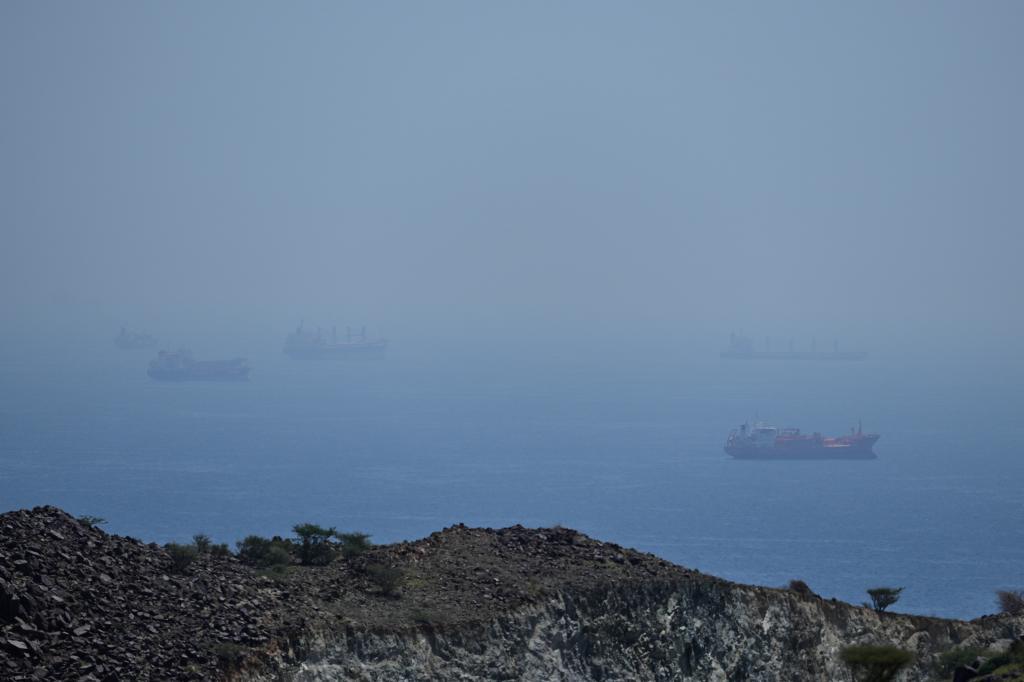
Despite the recent de-escalation of the conflict in the Middle East due to a recent truce agreed upon by the United States and Iran with Pakistan as the main mediator, the vulnerability of submarine telecommunication cables remains on the international security agenda.
This lull in fighting does not diminish the importance of an infrastructure that, beyond its consequences on the rise in oil and liquefied natural gas prices due to the conflict - which are already recovering - remains a strategic asset that threatens another economic consequence: the interruption of the data flow carrying global internet traffic from Europe to Asia. These cables pass through delicate areas such as the Bab el Mandeb strait, the entrance to the Red Sea dominated by the Houthis, a pro-Iranian force of the Resistance Axis.
From this strait to the Red Sea, with its corresponding exit through the Suez Canal in Egypt, a total of 16 cables are located. These cables carry between 15% and 20% of global internet traffic and constitute an essential route for telecommunications between Europe, Africa, and Asia.
Following the recent attacks between Iran and the United States on different targets and assets, submarine cables have once again come into focus. This is an element that, like hydrocarbons, if sabotaged or destroyed, could affect trading (i.e., financial trade: buying and selling of stocks, currencies, or cryptocurrencies), stock markets, and the flow of financial data, although without disastrous effects because the network is highly prepared .
In this regard, Carlos Dasi, director of operations, networks, and systems at Telxius - a company that provides and owns various cables running throughout the Atlantic Ocean - explains to EL MUNDO that "there would be an impact but it would not be a global disaster, as the networks have enough resilience to redirect traffic through other paths, either bypassing Africa or crossing the Pacific to the United States."
However, there are some clear consequences: "We are talking about a delay of 100 to 110 milliseconds that would have an impact especially on trading for financial and stock market matters," adds Dasi.
Currently, 16 cables run through the Red Sea connecting Europe (where Marseille is the main receiving center), Africa, and Asia. Among them, the most important are the cable called AAE-1 (Asia Africa Europe 1), connecting Europe with China in a network of 25,000 kilometers, and the ones known as SEA-ME-WE 4, 5, and 6, with over 20,000 kilometers in length involving companies like Microsoft, Google, Orange, and Meta.
In fact, Dasi explains that companies like Google or Meta, amid the geopolitical tensions in recent years, are trying to avoid these conflict zones: "They are effectively trying to avoid those conflict zones through diversity, meaning having three paths to reach a point."
"The same is being done in the Strait of Gibraltar. In the Strait, no more cables are laid, not because there is a war conflict or will be one, but it is a difficult operating area when repairing submarine cables due to heavy ship traffic, requiring permission and paying for part of the maritime traffic," adds the telecommunications engineer.
Regarding the Strait of Hormuz itself, near Bab el Mandeb, Dasi downplays a hypothetical cut in the infrastructure: "Those cables are local, not transit cables. When they affect telecommunications is when the cable is for transit. It would have a merely regional impact."
In late 2023, the rebel group controlling much of Yemen threatened to cut the submarine telecommunication cables running through the Red Sea. This threat was disseminated on a Telegram channel linked to the Iranian-allied insurgents, through a map and a message about Yemen's strategic relevance as a passage for internet lines connecting entire continents.
In response, Dasi plays down the threat, stating that "cutting submarine cables has little impact in the sense that the impact on the network is greatly mitigated, and on the other hand, you do not gain a geopolitical, geostrategic, or economic advantage by cutting a submarine cable."
"For something truly impactful to happen, you would have to cut, for example, all the submarine cables passing through the Red Sea and possibly all those leaving Europe for the United States, which is highly unlikely."
Despite being an isolated incident, the International Gulf Forum produced a report two years ago reminding that "a network of vital submarine communication cables could be the perfect soft target for their next attack, and this possibility should concern all nations depending on this critical infrastructure, both near and far." To date, no such incident has materialized.
AVERAGE ONE MONTH FOR REPAIR
The logistics required to repair a submarine cable depend on the depth and the sea conditions at that time. Dasi explains that "first, you have to see where there is a available ship to perform the repair, which are not always available, and then where your cable spare is located."
That is, if the available ship is at one point and the spare part is at another, the vessel must pick up the material before heading to the location of the fault. Therefore, "from the moment you have a problem with a cable until it is resolved, on average between 30 and 35 days pass, more or less."