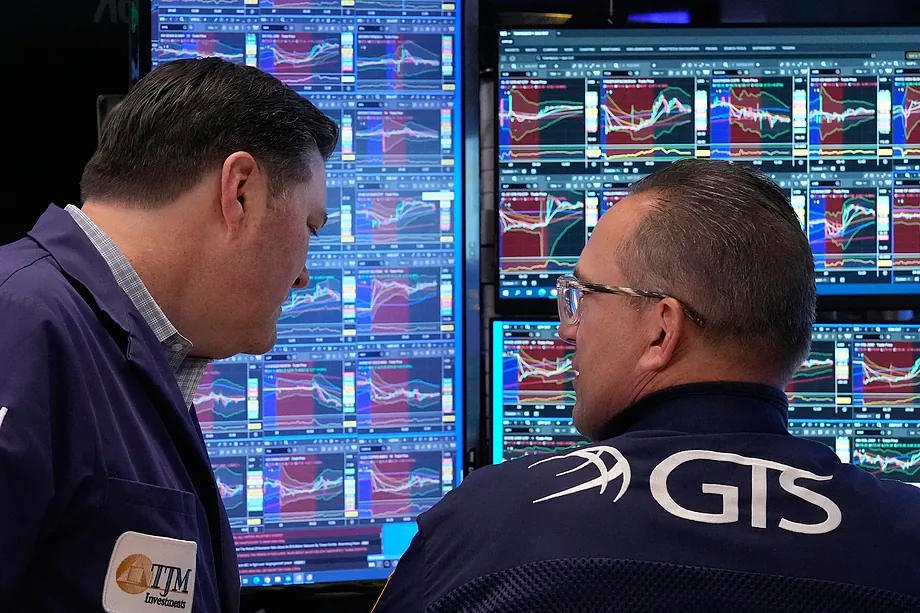
The largest investment banks in the US are filling their pockets thanks to the Iran war. Donald Trump's second term in the White House has created the perfect ecosystem for those who rely on trading and international markets to take advantage of a climate of uncertainty and volatility. Just during the first quarter of the year, the top five in the American market, JP Morgan, Goldman Sachs, Morgan Stanley, Bank of America, and Citi have reached $50.729 billion in revenues in their Markets-focused business. This is 19%, on average, more than last year, reaching unprecedented levels.
Investors, contrary to what may seem, have increased their activity in times of high tension, mainly since February 28 when the US president first attacked Iran with the aim of overthrowing the ayatollah regime. JP Morgan reported revenues of $11.6 billion from January to March, a 20% increase, thanks to "increased client activity", the bank stated in its results presentation last week. Goldman Sachs obtained another $12.738 billion in revenues; Morgan Stanley, on the other hand, exceeded $10.721 billion in its market intermediation business, 19.3% higher than the first quarter of 2025 "driven by strong client participation in a context of increased market volatility, and the strength of Investment Banking, led by advisory," the entity pointed out.
Citi and Bank of America are in the next tier, with a business that surpassed $7 billion from January to March. In the case of Citi, the entity highlights the growth in equity and currency during the first quarter of 2026. During this period, the dollar remains the main focus, having experienced sharp movements in recent months, exchanging at just over 1.20 against the euro, and lows of 1.14, after a year of significant declines against other major currencies when doubts about Donald Trump's tariff policy questioned the safe-haven status of the US currency.
The usual trend in listed markets is that volatility increases trading volumes, while it tends to retract investment in fund managers or ETFs. In fact, Citi analysts speak of "a sharp drop in flows" of money that entered European fund managers during last March precisely "due to increased risk aversion," as stated in a note sent to clients this Monday.
While the results of the first quarter of the year, which will begin to be revealed this week, are yet to be known, what is known is that Donald Trump's presidencies bode well for stockbrokers. The largest US broker, Charles Schwab, increased its revenues by 22% last year, reaching €23.921 billion. Interactive Brokers, one of the main brokers in Europe, earned 28% more in 2025 (with €4.357 billion) and sales valued at €6.205 billion, almost 20% higher. In commissions alone, it reached "582 million dollars, thanks to increased client trading volume," the company asserted in its annual results presentation.
In the same vein, actors like Robinhood are currently seeing a 52% increase coinciding with the first year of Donald Trump's 2.0 term. FlatexDeGiro increased its sales by 16.6%, reaching nearly €560 million. "Volatility creates more transactions, but it also increases uncertainty and liquidity, which has grown over the past year," stated Oliver Behrens, CEO of the broker during a visit to Madrid last week.
Today, April 22, is theoretically the day when the self-imposed truce between Washington and Tehran ends after two weeks to sit down and negotiate a definitive ceasefire in Islamabad, Pakistan. In the last seven weeks, fluctuations in the prices of commodities such as oil and gas have exceeded 100%, considering that the Strait of Hormuz is a critical area for the supply of both commodities worldwide, accounting for 20% of all trade. This has led to the European Brent trading 31% higher than at the start of the conflict, as well as the reference gas, the Dutch TTF, at around €42 per MW/hour.