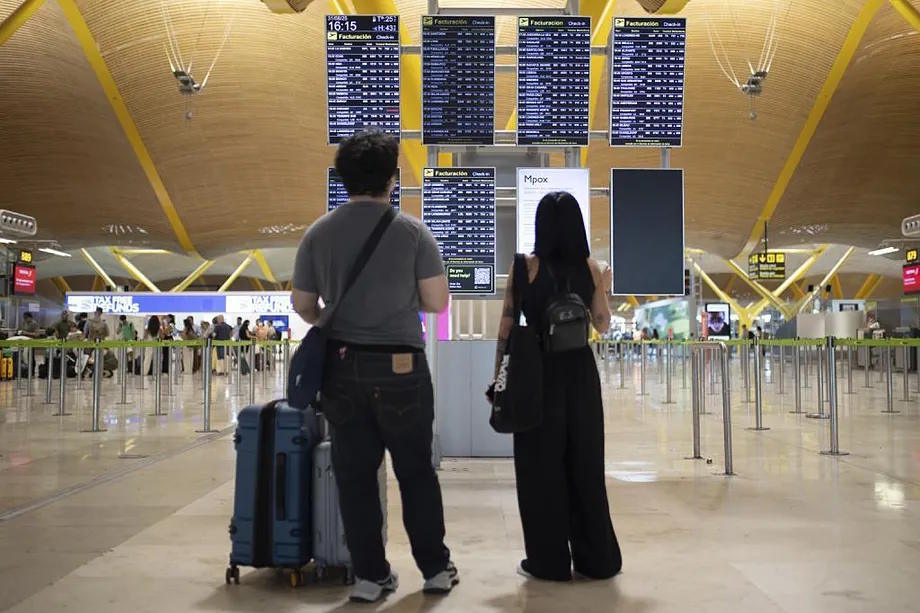
"We are on day 53 of this crisis, and Europe must move at reactor speed to relieve the pressure." The fuel shortage threatening European air connectivity within a month if kerosene supply issues are not resolved led the European Commission yesterday to announce extraordinary measures to alleviate an energy crisis that has increased energy import costs by 24 billion "without receiving an additional molecule of energy," as Brussels admitted yesterday.
"It is a pragmatic step forward", acknowledged airports and airlines, whose European associations act as intermediaries with the Commission. However, airlines warn, "this is not a time for lengthy processes: it is time to act quickly, now. Flexibilities already provided for in EU legislation on antitankering (taking advantage of the economic and supply benefits of some airports over others), passenger rights, and slots must be activated immediately. Airlines cannot wait, as the recovery of kerosene supply will take weeks," commented a spokesperson for A4E (Airlines For Europe), an association that includes Iberia, British Airways, Lufthansa, Air France, Ryanair, easyJet... among other major companies.
When airlines warn that "they cannot wait any longer", they mean it seriously and on the eve of summer, the busiest season. There is no need to wait for the six-week deadline estimated by the International Energy Agency last Thursday for EU reserves to reach the red line as a trigger for drastic solutions in companies that will involve raising prices to cope with the kerosene price surge (more than double since February 28), reducing frequencies to fill planes more, and ultimately canceling flights. European airports grouped in ACI, on the other hand, urge the Commission to urgently promote aviation taxes to cushion the impact of prices. Spain does not have these taxes that burden passengers in Germany, France, or Italy.
If the Dutch airline KLM already announced last week that it was canceling 160 flights on some of its most frequent routes to cope with price increases, last Tuesday it was Lufthansa that announced the cancellation of 20,000 flights scheduled for the summer to save fuel. Ryanair, on the other hand, has set a reevaluation of its prices for next May if the energy crisis triggered by the closure of Ormuz in the oil market is not resolved before then. Iberia and Air Europa, the two largest companies in Spain along with Ryanair, are evaluating the situation to make decisions in the coming weeks. Despite the fuel price hedging contracts that airlines use to protect against price surges like the current one working, the profitability of routes has changed in such a way that the less profitable ones are now on the chopping block. At IAG, the parent company of Iberia, British Airways, or Vueling, they point out that "there is no demand problem or fuel problem: the problem is the prices". Volotea has already cut 1% of scheduled flights due to "geopolitical instability" and has announced surcharges on already purchased flights due to fuel price hikes, a practice whose legality was questioned yesterday by Brussels.
The trickle to readjust the supply has already begun partly due to the 54 days of crisis and partly because the markets themselves give a higher probability to a "contained" conflict but with a duration that will last for months, as acknowledged by oil market operators in a scenario that, for example, the investment bank Inversis describes as "with partial blockages that come and go, slow, interrupted, and resumed negotiations," and a barrel price between 95 and 105 dollars.
Nevertheless, airlines in Spain remain optimistic about the summer season, planning a 5.7% growth in available seats, as announced by their association, ALA, up to 258 million with Madrid, Barcelona, Alicante, Málaga, and Sevilla as the airports that will grow the most this summer.
But this forecast is subject, above all, to the extraordinary measures that the European Commission plans to implement in the coming weeks, especially regarding slots and fuel distribution.
The first explains why there have not been massive cancellations yet and why the announced cancellations, including those of Lufthansa, are not final. Slots are usage rights that airports allocate to airlines and are essential for their competitiveness. However, if they are not used at least 80%, they are lost, so no company is interested in formally discarding routes before knowing to what extent they can do so without losing slots. The European Commission did not set a deadline yesterday to clarify this point, which would trigger route restructuring this summer.
The second is related to fuel availability. In 2025, national kerosene consumption stood at 7.7 million tons. Almost 30% was covered by imports, according to Cores. However, Spain would have room for self-sufficiency, as its refineries have the capacity to produce almost 9.9 million tons of kerosene per year, according to industry sources. With the current crisis, Brussels is considering auditing all fuel reserves in Europe. "This will quickly identify possible shortages and, in the event of emergency stock releases, provide specific measures to maintain a balanced fuel distribution," the Commission stated yesterday. This could alter fuel availability at Spanish airports and the actual flight offerings in the coming months. "First, we need to know the terms of the scheme," says Javier Gándara, president of ALA and head of easyJet in Southern Europe.