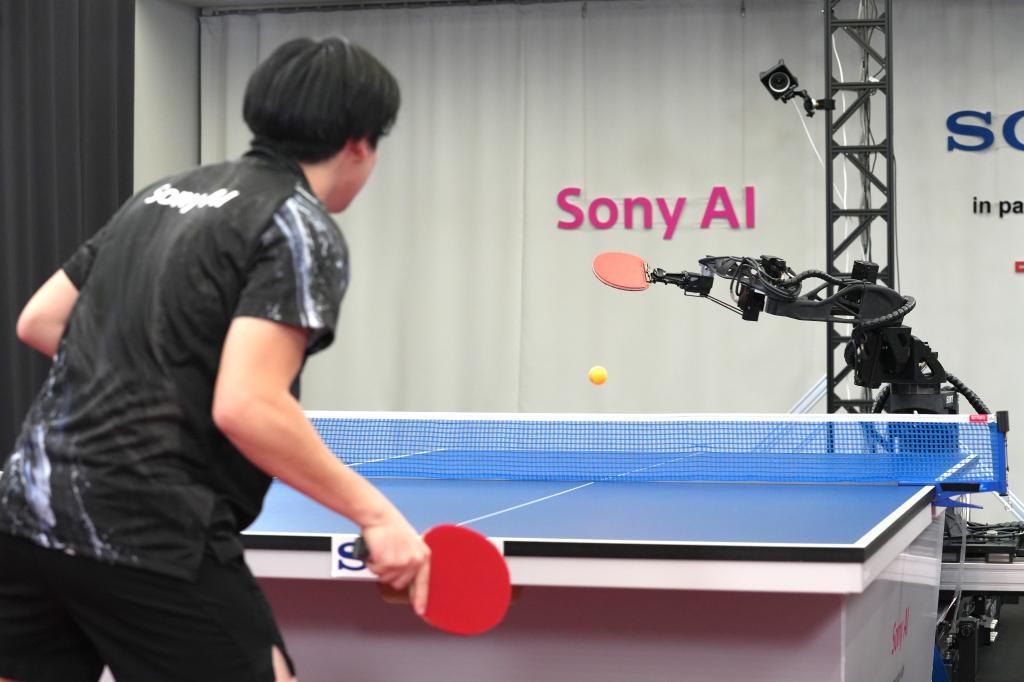
The company has introduced Project Ace, a robotic arm that is so skilled at playing table tennis that it poses a tough challenge for elite human players and sometimes beats them. This achievement marks a milestone in robotics, demonstrating that machines are reaching unprecedented levels of agility and perception in competitive physical environments.
To achieve this level of precision, Sony has equipped Ace with astonishing technical infrastructure. The robot has eight joints that control its movements, providing it with the necessary degrees of freedom to execute complex shots and respond quickly. According to Peter Dürr, an AI researcher at Sony, "the robot uses a camera system to understand what is happening.
It then makes decisions on how to move and then moves the racket to return the ball or to serve under the official rules of table tennis." One of the keys to its success lies in its "nine camera-eyes positioned around the court," which give it an "extraordinary ability to track the ball's trajectory and measure its spin." Unlike traditional systems, Ace was not programmed with rigid instructions. Instead, it used reinforcement learning, an AI method where the machine learns through constant practice. As Dürr points out, "there is no way to hand-program a robot to play table tennis.
You have to learn to play through experience." The showdown between Ace and professional athletes took place on an Olympic-sized court in Tokyo, designed to provide athletes with a "level playing field" with the machine. The results have been so astonishing that Sony describes this breakthrough as the "first time a robot has reached a human expert level of play in a commonly practiced competitive sport in the physical world, a historic milestone for AI and robotics research."
Michael Spranger, president of Sony AI, emphasizes that this project goes beyond mere sports entertainment. "So the significance of this breakthrough really lies in pushing the boundaries of AI. In the past, we have seen advances in AI in board games like Go. We have also seen them increasingly in video games, like our own work in Gran Turismo.
And now, for the first time, we are showcasing this capability in the real world in a highly competitive sport like table tennis," explains Spranger. The success of Project Ace demonstrates that technologies developed in virtual environments can be successfully transferred to the real world. Spranger believes that these kinds of systems, capable of being adaptive and quick in uncertain environments, will have crucial applications in manufacturing and other industries. However, he also warns about the ethical and security implications, pointing out that it is not difficult to imagine how such fast and perceptive hardware "could be used in warfare." For now, Ace remains the ultimate example of how AI has begun to master the speed and uncertainty of the physical world.