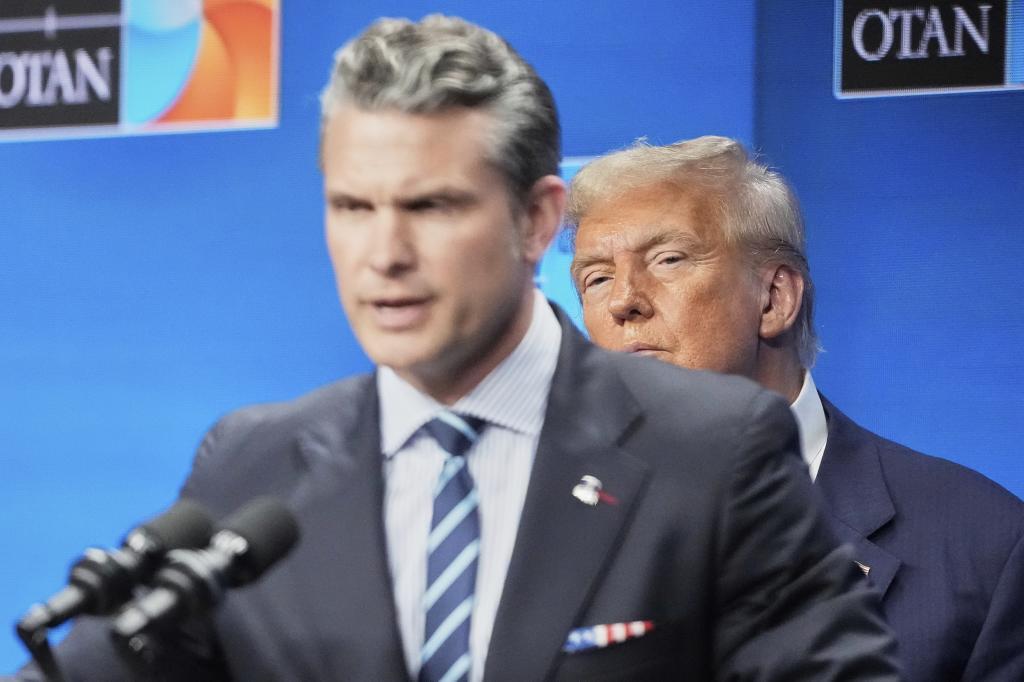
On Wednesday afternoon, the United States Secretary of Defense, Pete Hegseth, dismissed the Navy chief, John Phelan. The umpteenth dismissal at the Pentagon by one of the most controversial and questioned members of the Trump administration, a former television presenter turned religious fanatic immersed in a permanent purge.
Hegseth is one of the most questioned and criticized high-ranking officials from day one. He was nominated by the president and confirmed by the Senate not for his qualifications, as the impression left was that he was perhaps the least prepared and qualified Secretary of Defense in a century, but because Trump, furious because his own congressmen and senators had forced him to withdraw his first choice for Attorney General, dug in and increased the pressure, making it clear that he was not going to suffer a second defeat shortly after taking office. That's why Hegseth, a former military man accused of alcohol problems and abuse, with a record full of professional and personal scandals, with at least one out-of-court settlement where he paid a woman who had accused him of sexual assault, and with issues in the accounts of an organization he led, moved forward.
Since then, the situation has only worsened. As columnist Ross Douthat often recounts, the most conservative of The New York Times and ideologically close to a part of the administration, Hegseth's hiring is explained because the president, the politician who consumes the most television in the country's history, likes to have very telegenic and loyal people defending his positions, even if it means getting into trouble one after another.
Hegseth is a convinced Christian nationalist who believes that the country's problem, and the Army's, is that it abandoned its "warrior spirit" and softened by filling its ranks with women and minorities and by accepting all kinds of diversity regulations and policies. He believes that his "warriors" should be free to fight using everything at their disposal, and that constraints are a scourge, especially rules of engagement. In fact, he caught Trump's attention in his first term for his fiery defense of a soldier accused of war crimes. That's why Hegseth has undertaken the greatest revolution in modern military history, dismissing or relieving dozens of generals and admirals, especially blacks and women. But also by changing the rules of engagement or erasing historical measures to protect soldiers and civilians.
According to critics, he is completely out of control, driven by the feeling that he could be replaced at any moment if he does not satisfy the leader's desires. This week he announced that the flu vaccine will no longer be mandatory for troops, calling it "restoring freedom" to the military. Just as two weeks ago he lifted the ban on soldiers carrying their personal weapons inside military facilities.
When at the beginning of the month, two AH-64 Apache helicopters during a training mission near Nashville veered off course and made a very unorthodox pass over a demonstration against Trump first, and over Kid Rock's house, one of the favorite singers of Trumpism and the MAGA world (while Kid Rock came out, greeted happily, and recorded videos), the military commanders suspended the pilots. Hegseth immediately reacted to overturn that suspension and applaud their irresponsible actions.
In October, by the way, in a speech where he said there was no place for "fat, bearded, or long-haired" individuals among the troops and in their meetings, he stated that it was time to "bring back masculinity", because his is "the Department of War, not the Department of Wokes". And that's why he announced that he will eliminate anti-bullying practices, so that barracks return to what they were, restoring basic training guidelines to "what they should be: intimidating, rigorous, and disciplined," and authorizing drill sergeants to "physically engage with recruits."
In his early months, Hegseth got rid of Charles Q. Brown Jr., Chairman of the Joint Chiefs of Staff; Lisa Franchetti, Chief of Naval Operations; James Slife, Air Force Vice Chief of Staff; and Jeffrey Kruse, Defense Intelligence Agency Director. In October, General James J. Mingus, Army Deputy Chief of Staff, was forced to resign a year earlier than planned and without honors. Randy George, Army Chief of Staff, was abruptly removed three weeks ago in the midst of the Iran war and without any clear reason, after protesting the blocking of the promotion of several highly qualified candidates (two African Americans and two women).
Similarly, David Hodne, who was promoted in October to lead the Army Training and Doctrine Command, a high-level position for Army modernization and doctrine, and General William Green Jr., Army Chief Chaplain, have been sidelined. Just as the top military lawyers (JAG) of the Army, Navy, and Air Force were before, in a very clear message that he does not believe in the rules of war or in punishing those who commit crimes in the midst of combat.
The forced departure of John Phelan a few hours ago is part of something deeper. In April 2025, barely less than three months after arriving at the Pentagon, Hegseth got rid of Joe Kasper, his chief of staff. His downfall was linked to an internal crisis caused by an investigation into leaks and coincided with the first embarrassing incident: the publication, in a Signal group that included a journalist, of plans to bomb Yemen. A violation of all accepted practices, security protocols, and confidentiality. But along with him, three senior Department advisors were dismissed: Dan Caldwell, Darin Selnick, and Colin Carroll.
Likewise, Hegseth has an ongoing battle with Army Secretary Dan Driscoll, a college friend of Vice President JD Vance, a showdown that analysts believe can only be settled by the departure of one of the two. Clashes have been constant: over Ukraine (in the fall, Driscoll, not Hegseth, was sent to Geneva for peace talks), over Iran, but also over senior appointments. Driscoll has submitted lists of names, and according to information published by various newspapers, Hegseth has vetoed minority candidates. The relationship between the two is marked by a mix of personal rivalry, authority struggles, and disagreements over Army leadership. Driscoll is in many speculations as a possible replacement for the Secretary, and some newspapers have described Hegseth's reaction and his environment as "paranoia."
The religious question, in someone who has the expression Deus Vult tattooed and often evokes the Crusades, has recently taken on special prominence, as the Secretary has brought religious language to all levels of the Pentagon. It's not just that he is celebrating mass within the Department, also excluding some confessions. Or the religious rhetoric linked to conflicts like Iran, where he compared, for example, the rescue of the downed pilot with the resurrection of Christ. But Hegseth is increasingly blending military mission and spiritual mission.
Much of the debate revolves around his affinity with Pastor Douglas Wilson and the CREC (Communion of Reformed Evangelical Churches). Wilson, a radical nationalist, is linked to Christian Reconstructionism, a movement that advocates for public life to be ordered according to biblical principles. Likewise, the Secretary has deep ties with Brooks Potteiger, described as his main spiritual advisor. A few weeks ago, Potteiger appeared on a podcast where the "death" of James Talarico, a Democratic candidate from Texas, a devout believer himself, was called for.
For Hegseth, it's all part of a culture war that his side must win, at any cost. In books like *The American Crusade*, besides arguing that women shouldn't be allowed to fight, he repeatedly insists on "crushing the left," framing domestic politics almost as a matter of civilizational warfare. This helps contextualize Trump's controversial speech at Fort Bragg on October 1st, when he unexpectedly summoned 800 generals and admirals to involve them in the fight against "domestic enemies," the "internal plague" in the US, and the "lunatic left."
"As president, I will never hesitate to defend our people from the threats of violence, from the horrific plague that is occurring from within. Last month, I signed an executive order to train a rapid reaction force that can quell civil unrest. And this will be very important for those of you here," he told the top officials of the three militaries, "because it is the enemy within, and we have to get it under control before it gets out of control." "The United States is being invaded from within. It's no different than a foreign enemy, but it's more difficult in many ways because they don't wear uniforms. At least when they wear uniforms, you can take them out," Trump asserted.
"The military is about killing and breaking things," Hegseth said. "We unleash crushing, punishing violence against the enemy, and we don't fight by absurd rules of engagement. We are going to unleash our combatants to intimidate, demoralize, hunt down, and kill the enemies of our country. Enough with politically correct, authoritarian rules of engagement."