In 1967, a year after gaining independence from the United Kingdom, Botswana discovered its first major diamond deposit. Just around that time, but 8,500 kilometers away, the Dutch disease was detected, an economic phenomenon that has now migrated to this southern African country almost half a century later. While for the Netherlands it was the exploitation of its large natural gas reserves that strengthened its currency and harmed other exports, for Botswana it is diamonds that are damaging the rest of its economy.
The statement may sound eccentric due to the aura surrounding these highly desired stones, but their synthetic counterparts have taken over. The great success of diamonds had prevented the country from diversifying its economy. Lab-grown diamonds are chemically identical to natural gems and much cheaper. Nevertheless, the Government of Gaborone remains captivated by the sparkle that turned this country of 2.8 million inhabitants into one of the most prosperous on the continent and a stable democracy.
The historic firm De Beers, the same one that monopolized the global diamond market for a century (now controlling approximately 30%), is up for sale. And Botswana wants to bid and increase its stake from the current 15%, as reported by The Economist in a recent article. Botswana currently represents 72% of De Beers' production (it was advertising copywriter Frances Gerety who wrote in 1947, "A diamond is forever") and its intention is to control 25% of the company. This percentage would give them the ability to veto decisions.
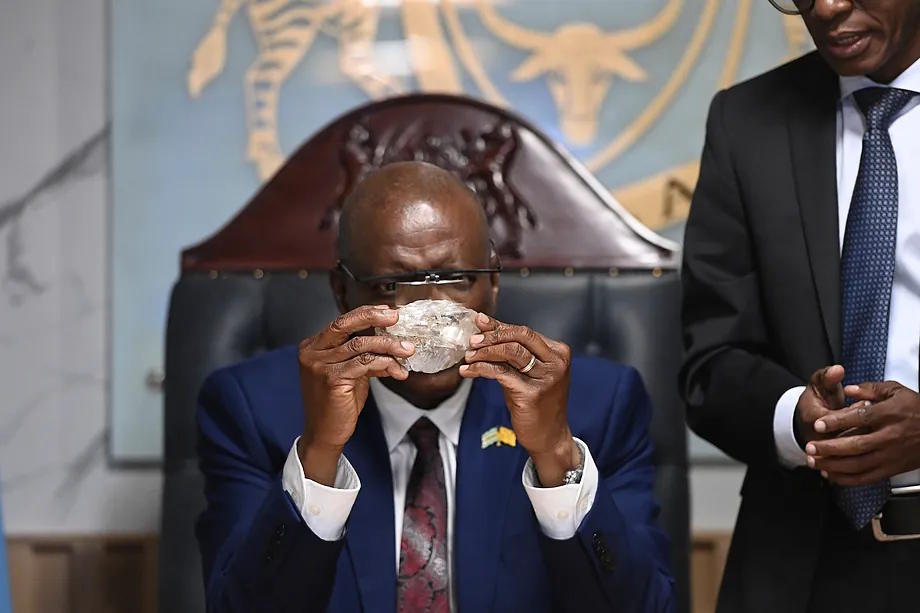
Because Angola, the competitor that displaced Botswana a couple of years ago as the world's largest producer, is also interested in buying shares. "We are not just custodians of the earth's wealth, we must become architects of its value," stated Botswana's President, Duma Boko.
Keith Jefferis, former Deputy Governor of the Bank of Botswana and current head of the firm Econsult Botswana, diagnoses that his country is undoubtedly suffering from the Dutch disease, of which he is an expert. His reports on how the decline in diamonds is affecting the national budget and other sectors of his country are the reference. Jefferis puts on his doctor's coat and explains to EL MUNDO in an email the symptoms of the ailment: how "sales and exports have decreased since 2023, and have fallen two-thirds compared to the 2022 level."
This decline "has had a significant impact on the State's fiscal revenues from diamonds, which have been the main source of government income." The main consequence? "It has caused large budget deficits, as well as deficits in the balance of payments."
"The days of diamonds as a thriving business are over", Jefferis concludes, as "the synthetic ones, being much cheaper, have gained an increasing market share in the jewelry sector." Will Botswana react and decide to diversify? "As long as it has the support of appropriate macroeconomic and microeconomic policies," responds the former Deputy Governor of the Bank of Botswana.
"These people want to increase their shares in the Titanic after it has already sunk", states Roman Grynberg, Economics professor at the University of Namibia and former researcher at the Botswana Institute for Development Policy Analysis (BIDPA). "Botswana knew about the risk of high-quality synthetic diamonds 10 years ago when I worked at BIDPA. They simply didn't want to listen," he points out. Someone who did pay a lot of attention was Nicky Oppenheimer, the South African billionaire, the last member of this dynasty to control De Beers: "He sold his 40% stake for about $11 billion to Anglo American in 2011. Now Anglo is selling its 85% for $2.3 billion."
His grandfather, Ernest Oppenheimer, founded Anglo American, which took control of De Beers in the 1920s. It had been created by the British Cecil Rhodes in 1888. The name De Beers comes from the owners' surname of the land in South Africa where the first diamond was found 20 years earlier, near the Orange River. Rhodes, who started by renting water pumps to miners, bought practically all the mines and created a distribution network with which he monopolized and set prices. He kept a large number of gems out of the market.
German Ernest Oppenheimer took control of De Beers in 1927 and brought the company to the top. Until, after the Great Depression, engagement ring sales plummeted. It was time to hire the New York advertising agency N. W. Ayer and the popular slogan "A diamond is forever." The idea that spending a fortune to seal eternal love was logical caught on. A ring that should be kept like the marriage... and thus not flood the second-hand diamond market. But neither diamonds nor marriages often live up to that maxim anymore.