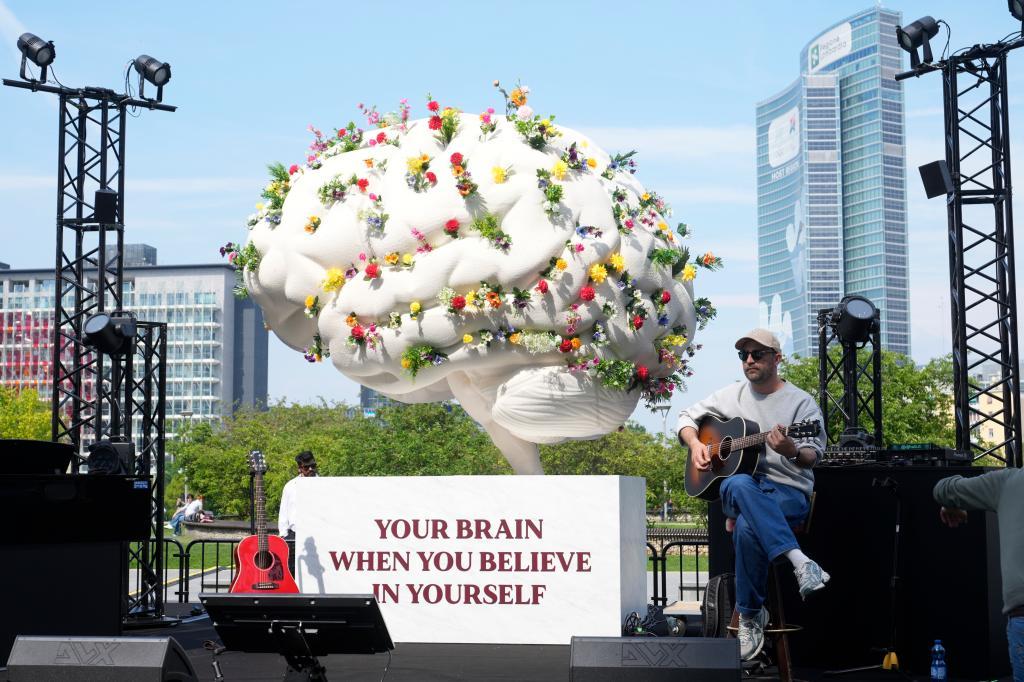
Juan Camilo Serna had a traumatic experience as an entrepreneur. One of his early business failures marked him so much that it took him over three years to recover and convince himself that he could try again. "The thought of reliving a similar situation paralyzed me," he explains today. The trauma left a mark on his brain as an emotional footprint. This is the somatic marker termed by neuroscientist Antonio Damasio, which triggers a past emotional experience that inevitably influences the brain in decision-making.
This explains why "poor emotional management can lead to business failure," in the words of David Juárez, director of the Master's in Marketing and Communication at the Polytechnic University of Valencia (UPV) and head of the world's first laboratory dedicated to studying entrepreneurs' brain performance. This is the Neuroentrepreneurship Lab UPV, located at StartUPV and integrated into the entrepreneurial ecosystem of the Valencian technological campus.
Camilo Serna is, in fact, the first Ph.D. in neuroentrepreneurship from UPV, a discipline that, as Juárez describes, helps "understand the brain processes that occur when making decisions at any stage of an entrepreneurial venture." And why is this relevant? Because when an entrepreneur has to decide whether to expand their company or seek financing, it's impossible to process all the information.
"This leads to any entrepreneur having to make a decision under conditions of uncertainty, which emotionally affects the brain," according to Juárez. The impact of uncertainty on the brain is significant, as it can trigger feelings of panic or fear: "Uncertainty affects us to the point of putting our brain into survival mode, meaning that emotional activation overrides the rational part." In other words, "we are not in a position to form a rational judgment."
Therefore, "the more tools an entrepreneur has to manage their emotions, the easier it will be to make a rational decision." Being driven by panic can cloud our judgment.
What Professor Juárez and his team do in the laboratory is monitor the brains of entrepreneurs when they operate under conditions of uncertainty. For example, a war outbreak and the subsequent rise in fuel prices may force an entrepreneur to decide whether to pass on this cost to their product prices, risking a drop in sales. How does their brain react to this stressful situation?
The first biometric they focus on at the UPV laboratory is "skin galvanic response," known as GSR. It's a technology that measures microsweating on the fingers, indicating the brain's response to an external stimulus or thought. As explained by researcher Paula Sabater, a Ph.D. student at UPV, this test actually measures "the variability within our microsweating, which indicates emotional intensity." "The level of emotional activation we have is crucial to discern what is happening to us," she adds.
This detects a peak of emotional activation, which is then interpreted with an electroencephalogram to determine if it's positive or negative. "Brain performance metrics determine stress levels, attention, emotional connection, and even relaxation, which is a return to your initial state," says Juárez.
The question then arises: do emotions help or hinder decision-making? "Under certain control, they are positive," responds the lab director. In fact, "we cannot make decisions without emotional activation. Emotions, therefore, help, and in the business world, it's called instinct."
The so-called business intuition is simply emotional activation when the brain senses that an option will be the best. However, "if we lose emotional control and panic sets in, there is what is called a limbic or amygdala hijack." This means, in Juárez's words, that "the prefrontal cortex, our rational brain part, is impaired or directly disabled." This is when we will not be able to act rationally. Hence, it's said that "an excess of emotional activation hinders decision-making."
David Palacios, an expert researcher in entrepreneurship and chief editor of the International Entrepreneurship and Management Journal, is clear in his warning to entrepreneurs: "Not mastering emotions leads to making poor decisions." Excessive optimism or exaggerated pessimism can confuse us when we need to take action. Relying solely on business intuition is not enough: "It can be a trap if you don't have enough data to make a decision."
"The traditional entrepreneur, who may have less formal education, usually relies solely on experience, on intuition. But nowadays, it's important to have more data to decide and know your emotional strengths and weaknesses because they will influence you," this expert insists.
At the UPV laboratory, they talk about "training the brain", helping it manage emotions. "We have to provide tools to give the brain a massage when we are tired," says Juárez, referring to the importance of meditation. "Through meditation, we have shown that it works well to improve attention and interest levels and reduce stress. Just as when your neck hurts, you go to a physiotherapist for a neck massage, meditation is important when we detect certain symptoms in the brain. Massaging the brain through meditation allows us to be more focused and rational."
Hence, emotional management is considered crucial, as entrepreneurship can lead to emotional exhaustion that no entrepreneur will be immune to. Therefore, efforts are made towards a resilient mindset, with tools like the so-called Eisenhower matrix to learn to prioritize important tasks. "You have to identify what causes you stress but you can't control, set it aside, and focus on what is truly important and manageable," they emphasize.
Differences between senior and junior
The research work at the neuroentrepreneurship laboratory has also led to the conclusion that there are differences in the brain performance of a junior entrepreneur - with less than six months of experience - and a senior one - with a track record of at least three or four years. This is one of the first lines of research confirming experience as a "normalizer of emotions," as described by Camilo Serna.
"Experience gives us confidence and security, but we realized that senior entrepreneurs find it very challenging to start over from scratch," explains this researcher. "And they struggle precisely because they remember past experiences where they faced failures or very tough times." Therefore, junior entrepreneurs, who do not carry these "traumas" in their brains, tend to be more optimistic and confident from the start and are generally willing to take more risks.
Paula Sabater points out another difference in the brain, this time between men and women. "The male brain tends to take more risks," she says, while the female brain prefers safety. "Women are biologically designed to have offspring, that is, to ensure the continuation of our species. Hence, all decisions we make usually consider safety, which is not as prevalent in men because they do not have that instinct or need."
As David Palacios notes, the brain remains the "most mysterious" organ for us, with unanswered questions. "Therefore, influencing its functioning will become increasingly interesting." Especially when success or failure depends on it.