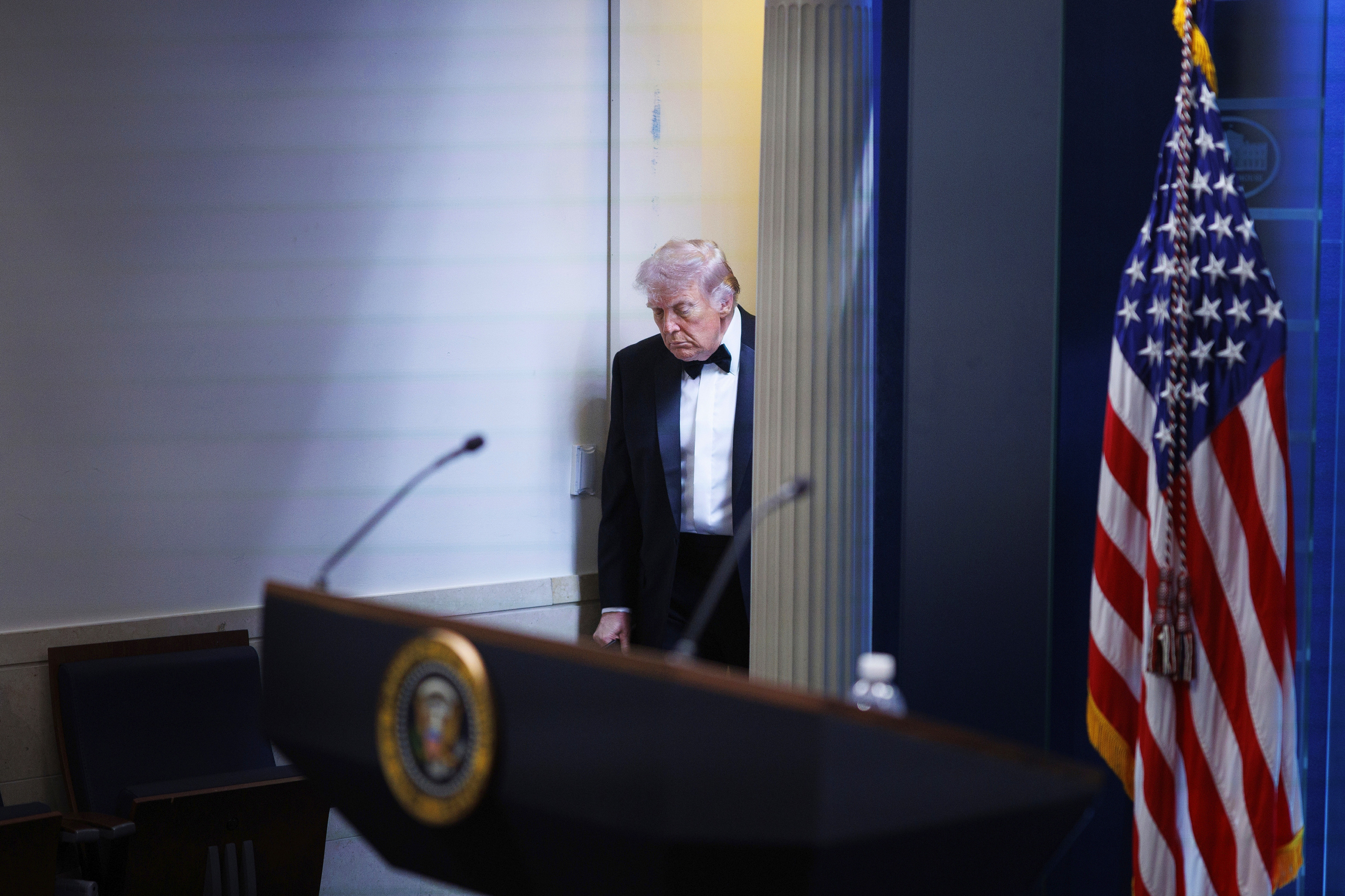
At 8:35 p.m. on Saturday, when the first course of the evening, a pea and burrata salad, had just been served, five or six sharp sounds interrupted the most anticipated and controversial event in Washington, the White House Correspondents' Dinner at the Hilton Hotel. For a moment, time stood still, amidst total confusion and incipient panic at what could have been a dropped tray, but turned out to be gunshots. Part of the room reacted nervously, seeking an exit or simply diving under tables, to the surprise of foreigners, still and unaware of the protocols that many Americans learn from a young age in case of an active shooter situation.
Within seconds, many more than what the Secret Service protocols probably require, dozens of agents surrounded President Donald Trump, the First Lady, Vice President JD Vance, and the top government officials, escorting them out of the room with their guns drawn. "Get down, get down!" shouted the security forces, equally or more bewildered than the attendees, while hundreds of guests, including congressmen, senators, military personnel, diplomats, and high-ranking officials, tried to understand where the threat was and how to move away from it.
By then, the Secret Service had already managed to subdue Cole Tomas Allen, a 31-year-old man, a guest at the same hotel, who had managed to breach the security perimeter with a shotgun, a pistol, and several knives, but had not reached the ballroom. The issue was that no one knew this, and for several endless minutes, the initial reactions pointed to a possible deceased shooter or the presence of more attackers. That was not the case.
Allen, after traveling by train from California to the capital, over 4,000 kilometers to transport his weapons, attempted to enter the lobby, located one floor above the party room, in a chaotic sprint firing shots, before being tackled, subdued, and handcuffed. There was an exchange of gunfire, and except for a non-consequential impact on an agent's vest, no one was injured. The system worked, but because it was only one person. If it had been a group or if he had carried a different type of weaponry, the outcome could have been very different.
The President himself, after unsuccessfully trying to return to the ballroom to continue the event, improvised a press conference at the White House an hour later to explain what had happened and to show that both he and his colleagues and family were safe. "I have studied assassinations, and I must tell you that the most influential people, those who have the most impact, are the ones who suffer the most. Look at Abraham Lincoln. If you review the people who have gone through this, the most influential, those with the greatest impact, are the ones they pursue. They don't pursue those who don't do much. I regret to say that I feel honored by that, but I have done a lot. We have done a lot," explained the President when asked why he believed "this keeps happening to him," referring to the attempted attacks against him.
It was the first time the President attended the White House Correspondents' Dinner, an institutional event that has been held since 1921, but one he had avoided precisely due to his poor relationship with the media. Trump needs them, but he hates them. In fact, there has been a strong internal debate in the world of journalism in recent days because many consider it senseless for someone who insults, disrespects, threatens, and even forces the dismissal of reporters, analysts, and presenters to be the guest of honor, and for the correspondents to laugh at his jokes. Some very important media outlets, in fact, did not participate. In the shooter's "manifesto" of about 1,000 words, there seems to be a reference to how there could be victims among the press if he achieved his goals, but he believes it is worth the risk, as he accuses them of being "accomplices" for attending an event with "a pedophile, rapist, and traitor."
Washington is once again in shock. The country is divided, polarization is at its peak, and the rhetoric, in an election year, continues to escalate. It is the third time since July 2024 that Trump has been the target of an attack or has been close to being attacked, following the shot he received at a rally during the electoral campaign and the discovery by his security detail of a man with a rifle lurking on a golf course, waiting for him to approach. Trump is one of the most threatened individuals on the planet, if not the most, in a moment of immense tension and political violence in the US. This has led to an increase in criticism and questions. About possible security failures, but also about the exact reasons to explain Allen's motivations, a California professor who left a "manifesto" in his room and sent his family, with expressions like "I am not a school child victim of an explosion, nor a child dying of hunger, nor a teenager abused by the many criminals of this administration. Turning the other cheek when another person is oppressed is not Christian behavior; it is complicity in the oppressor's crimes," according to The New York Post.
Acting Attorney General Todd Blanche, temporarily replacing the dismissed Pam Bondi, explained on Sunday in a series of television interviews that everything indicates that the detainee "probably targeted people working in the administration, including the President." Blanche stated that Allen is not "cooperating", but that investigators had managed to obtain some information from the suspect's electronic devices, from the search of his home in California and the hotel room, and from "interviews with several people who know him," which has started to shed some light.
The Acting Attorney General also confirmed an important detail to explain how he managed to get so close to the President with his weapons: Allen was a guest at the Hilton, which allowed him to arrive "a day or two before" at the premises. Surprisingly, the security perimeter around the dinner venue was theoretically very strict, but in reality, it only required passing through metal detectors to enter the ballroom where there were about 2,000 guests. To reach the red carpet, just a meter away from the most important ministers, or to enter private parties on different floors of the same building, all that was needed was to show a simple paper ticket or a screenshot of it. In fact, several anti-war protesters had managed to show up an hour earlier, with banners, right there, dressed up but without an invitation.
A White House Correspondents' Dinner volunteer told the Post that the alleged attacker seemed to assemble his shotgun in a poorly monitored area near the entrance, on the terrace level, before opening fire and running towards the ballroom. The government has boasted that the security perimeter and controls worked since Allen barely managed to penetrate a few meters. However, the same suspect, in the manifesto cited by the local press, mocks their incompetence.
In July 2024, Kimberly Cheatle, the Secret Service Director, resigned due to the significant security failures that allowed a shooter to almost kill Trump in Butler, a town in Pennsylvania, during an election rally. Cheatle, who in the days following the attack took "ultimate responsibility," acknowledged in a congressional hearing that it was "the biggest failure in decades." This time, the agents managed to stop the threat before it was too late, but the hundreds of journalists present immediately questioned whether the measures had been sufficient or appropriate.
"I was expecting security cameras on every corner, hotel rooms with hidden microphones, armed agents every three meters, metal detectors everywhere. What I found (who knows, maybe they are playing a joke on me!) is nothing. Not a damn bit of security. Not in transportation. Not in the hotel. Not at the event (...) It's crazy, any Iranian agent could have brought a heavy machine gun and no one would have noticed," Allen wrote on those pages. "I could enter with multiple weapons and not a single person there considers the possibility that I could be a threat. Security at the event is all outside, focused on the protesters and those arriving, because apparently no one thought about what happens if someone checks in the day before," Allen concludes his reflection.
The video of the moment Trump is evacuated is perhaps one of the most striking moments of the night. The president is sitting at the main table, on a stage, accompanied by his wife and a mentalist who was performing a trick for both of them in a relaxed manner. At that moment, something has happened in the room, with sounds resembling detonations in the background, and a significant part of the room reacts. However, no bodyguard immediately rushes to surround the president. It takes several seconds and even when the first and second agents arrive, what they do is cover angles by standing in front of him, not throwing him to the ground (as what happened in Pennsylvania) or shielding him with their bodies. It takes a few more seconds for that to happen, and even the president, who leaves the room later than the vice president, stumbles.
"Many security questions about tonight, including: why was there no identification control at all beyond a quick glance at an entrance or why were there no metal detectors until we reached the Hilton basement?" wrote X Meridith McGraw from the Wall Street Journal. And all this precisely at the same hotel where in 1981 they shot and seriously wounded Ronald Reagan. Security protocols require that in situations like last night's party, federal agencies check the names of those staying at the hotel, but Allen had no record and was not on anyone's radar, so it didn't trigger any alarms. Secret Service Deputy Director Matthew Quinn has stated that the attacker was trying to perpetrate a "national tragedy" while all eyes were on the White House Correspondents' Dinner.
Exactly because of all this, Trump believes that the idea of building a grand ballroom inside the White House is more justified than ever, one of his most desired projects, with a cost of 400 million dollars and is now mired in legal battles. The hotel, he stated in several interviews after the incident, did not provide the necessary security guarantees. While his longed-for project will include a large bunker.