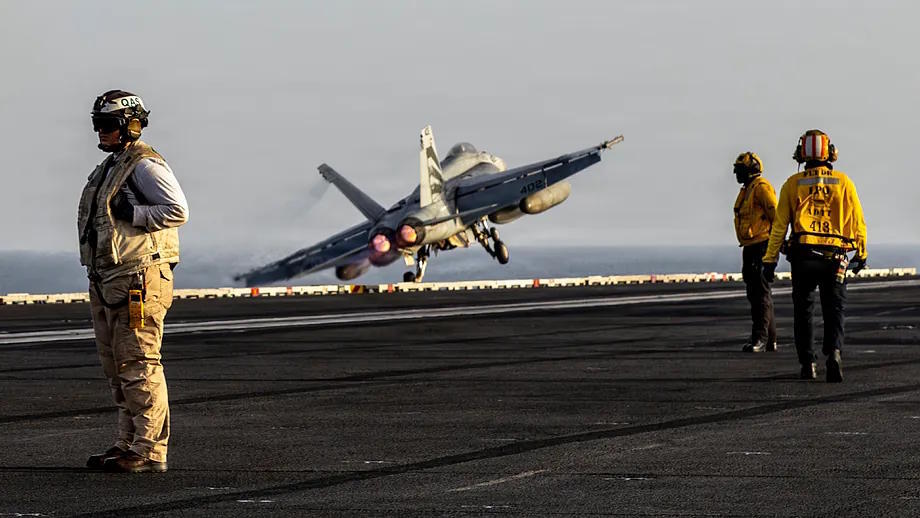
While Donald Trump talks about imminent peace agreements, Washington has already concentrated up to three aircraft carriers in the Middle East, an unprecedented show of force since the Iraq war in 2003. These are the USS Abraham Lincoln in the Arabian Sea, the USS Gerald R. Ford in the Suez Canal area, and the latest arrival, the USS George H. W. Bush, which has circumnavigated Africa via the Cape of Good Hope to take positions off the Gulf of Aden.
With this new aircraft carrier, the United States aims to soften the maximalist stances of Iranian leaders, who are only willing to negotiate on Tehran's terms. Tens of thousands of military personnel, perhaps over 60,000, including soldiers, pilots, mechanics, and sailors, are now stationed in the Middle East with dozens of destroyers and escort vessels, a complete amphibious group with 2,500 marines soon to be joined by another, and over 200 embarked aircraft in addition to hundreds more at US allied bases in the region.
Furthermore, the US has deployed part of a paratrooper division, the 82nd Airborne, and various special forces units such as Navy Seals, Rangers, and Delta Force.
Is this number sufficient for use in a large-scale ground operation in Iran? It is still far off. The US deployment for the invasion of Iraq in 2003 combined a massive and rapid concentration of forces with a shock strategy aimed at toppling the regime in a few weeks. Washington mobilized between 150,000 and 170,000 soldiers —with allied support totaling close to 300,000—, mainly prepositioned in Kuwait and backed by several aircraft carrier groups in the Gulf. The offensive began on March 20 with an air campaign designed to paralyze the Iraqi command through precision bombings and cruise missiles, while ground forces advanced from the south on two axes —the Army towards Baghdad and the Marines from the east—.
Meanwhile, Iran is also escalating in its own way: Tehran sources claim that they have recently mined the Strait of Hormuz for the second time, making the passage of vessels through its central zone even more difficult, precisely where commercial ships navigated before the war, despite Donald Trump's threats to attack any boat laying mines in the sea. In the event of the Strait's reopening, experts say it would take more than six months to clear the entire area of mines. Additionally, the Iranians continue their evasive maneuvers to manage to export their crude oil from the Persian Gulf to the outside through ship-to-ship transfers or by hugging their coast.
For now, Trump is reluctant to attack Tehran again after an air campaign alongside Israel that did not achieve the expected results of toppling the regime but did wear down its military capabilities. Currently, the US maintains a blockade in the Gulf of Oman to prevent Iran from continuing to move its oil outward. With this economic pressure, Washington hopes to soften and convince the Iranians to accept US conditions. In this regard, the Tehran regime stated yesterday that the Strait "will never return to its pre-war state", meaning they intend to consolidate their customs alongside the coast and continue charging each tanker for navigation rights.
Pakistan's top political and military leaders were working against the clock to revive talks between the United States and Iran after President Donald Trump told his envoys not to travel to Islamabad for negotiations this weekend, two Pakistani officials told AP on Sunday. After increased tensions torpedoed a second round of talks, Iranian Foreign Minister Abbas Araghchi spent most of Sunday in Oman, which borders the Strait of Hormuz. The minister is expected to return to Islamabad before heading to Moscow, Iranian state media reported.