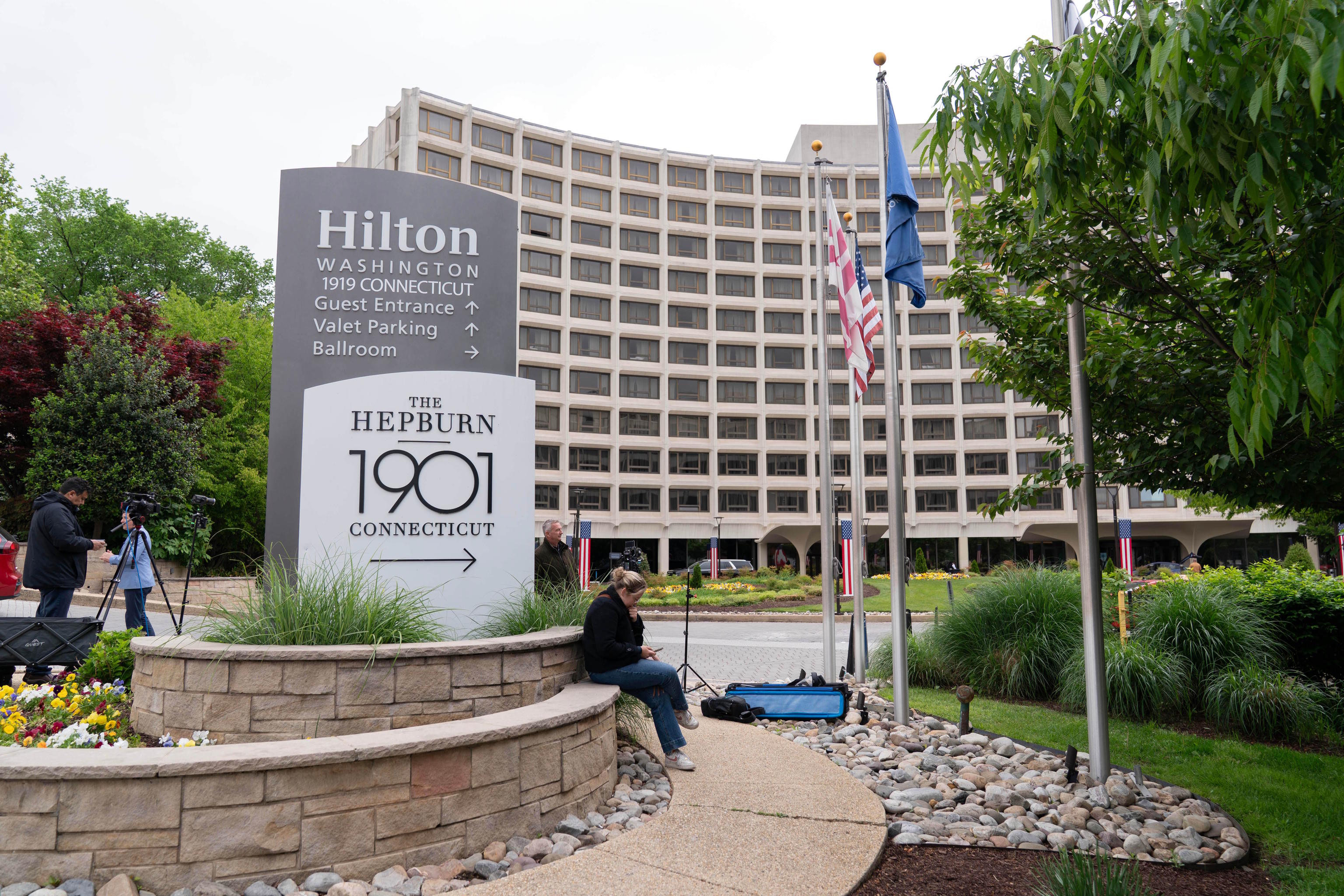
Cole Tomas Allen, the 31-year-old man arrested last night by the Secret Service after a shooting, did not reach the ballroom of the Hilton Hotel in Washington DC, where the top officials of the US government and Congress were, but he came very close. The images released by President Donald Trump, shortly after being evacuated by agents, show Allen running at full speed through one of the security checkpoints before half a dozen security personnel start shooting and manage to subdue, restrain, and arrest him.
What happened at the White House Correspondents' Association dinner will dominate the news in Washington in the coming days, sparking many debates and reopening uncomfortable discussions, starting with polarization and political violence. If Trump was the target, the most likely scenario for investigators right now would be the third assassination attempt since July 2024. This incident follows the murder of activist Charlie Kirk or the shootings of politicians in Minnesota, which resulted in the death of the former Speaker of the State House of Representatives.
In July 2024, Kimberly Cheatle, the Director of the Secret Service, resigned due to the significant security failures that almost allowed a shooter to kill Trump in Butler, a town in Pennsylvania, during an election rally. Cheatle, who later took "ultimate responsibility" in the days following the attack, admitted in a congressional hearing that it was "the biggest failure in decades." This time, the agents managed to stop the threat before it was too late, but the hundreds of journalists invited to the party, who had to lie on the ballroom floor after hearing the shots, wondered if the security measures had been sufficient or appropriate.
The video of the moment when Trump is evacuated is striking. The president is seated at the main table, on a stage, accompanied by his wife and a mentalist who was performing a trick for both of them in a relaxed manner. At that moment, something happens, and a significant portion of the room reacts with panic, standing up or starting to leave, as if shots were fired. However, no bodyguard immediately surrounds the president. It takes several seconds for the first and second agents to arrive, and when they do, they position themselves in front of the president to cover angles, not throwing him to the ground (as in Pennsylvania) or shielding him with their bodies. This takes a few more seconds.
"Many security questions about tonight, including: why was there no identification check at all beyond a glance at a ticket or why were there no metal detectors until we reached the Hilton basement?" wrote X Meredith McGraw from the Wall Street Journal on social media.
The first issue is related to the security perimeter. In the Butler rally, inexplicably, an armed young man managed to climb to the only elevated position in an almost deserted area and open fire before being shot down. At the Hilton, the police had closed off the area, but the metal detector checkpoint was very close to the building entrance and the ballroom.
In reality, the perimeter only fully protected the area where the ballroom is located, but not the more exposed areas, such as the red carpet where many Executive members walked. Access there could be gained with a ticket or a screenshot, but without passing through metal detectors. The same applied to access many private parties organized by media or companies on different floors of the hotel.
In other major events, such as the NATO summit or party conventions, those checkpoints are at least hundreds of meters away from the main event area. To reach the authorities, all security checks must be cleared. Precisely to prevent something like this.
The ballroom is on the lower floor of the hotel, so the shooter would have had to pass the checkpoint where he was apprehended, descend a flight of stairs, enter the room where dozens of agents were present, and approach the presidential table if that was his target. However, it was demonstrated that someone on foot, running, could cause significant harm. If it had not been a "lone wolf," as Trump stated, but a commando, the outcome could have been different.
Additionally, a White House Correspondents' Dinner volunteer told The New York Post that the alleged attacker seemed to assemble his shotgun in a poorly monitored area near the entrance, on the terrace level, before opening fire and running towards the ballroom. The witness, Helen Mabus, mentioned an improvised room near the entrance where bar carts were stored and where, at that moment, there was no security. "He was in that room [...] he took it out of a bag or something," Mabus said, adding that the weapon was long and did not appear to be a standard pistol.
At the Hilton, the president and the first lady, Melania Trump, were present. Also, Vice President JD Vance. The Secretaries of the Treasury, Defense, State, Energy, and Interior were there. The Speaker of the House, congressmen, and senators were in attendance. However, the only requirement for entry was a paper ticket or even a photo of it, according to attendees. No ID, QR code, or press credentials were necessary.
Shortly before the incident, some members of Codepink, a feminist group that regularly protests in Congress and opposes wars in Iran or Gaza, as well as events in Venezuela or Cuba, had been expelled after managing to reach the hotel premises dressed in evening gowns and carrying banners but without tickets.
The big question on everyone's mind in the capital last night was precisely whether the shooter might have been a hotel guest, which would have allowed him to bypass some security checks. While the surrounding streets had been closed to traffic throughout Saturday morning, guests at the Hilton (or residents in the area) could still enter without metal detectors, showing an ID but without pat-downs or metal detector scans. This raised significant security concerns since it placed the entire government in a room with over 2,000 people, knowing that unscreened guests were in the vicinity.
This issue will spark an initial debate. President Trump, in his address last night at the White House, hinted at it by stating that the controversial ballroom he is constructing, costing over $400 million funded by private donors, was vindicated by the security flaws at the hotel where the party was held, the same hotel where Ronald Reagan was shot and seriously injured in 1981.
"We have seen all the conditions that occurred tonight. It is not a particularly secure building. And I didn't want to say this, but that's why we need to have all the features of what we are planning at the White House. It will be a larger room and much safer. It has drone protection. It has bulletproof glass. We need the ballroom. That's why the Secret Service and the military are demanding it. They have wanted the ballroom for 150 years for many different reasons, but today is a bit different because today we need security levels that probably no one has seen before," Trump stated.
The second debate on national policy revolves around the funding of the Department of Homeland Security (DHS), which has been stalled since the anti-immigration operations in Minnesota that resulted in the deaths of two American citizens shot by ICE and the Border Patrol. Since then, Democrats have managed to block funding for the department, whose head, Kristi Noem, was dismissed a few weeks ago.
Conservative commentators on major networks last night already linked what happened at the hotel, where a Secret Service agent was shot, to the lack of resources and workers showing up for duty without guaranteed pay while Congress resolves disputes. The attack by the detained man, who was armed with a shotgun, a pistol, and several knives, will increase pressure on the opposition.
And the third, most delicate, debate will be about polarization. "Why do you think these things keep happening?" a journalist sympathetic to President Trump asked, who last night appeared much more conciliatory than usual, appealing to national unity instead of attacking the left and "antifascist groups," whom he systematically blames for political violence in the US. Given the precedents, this position is unlikely to last long.