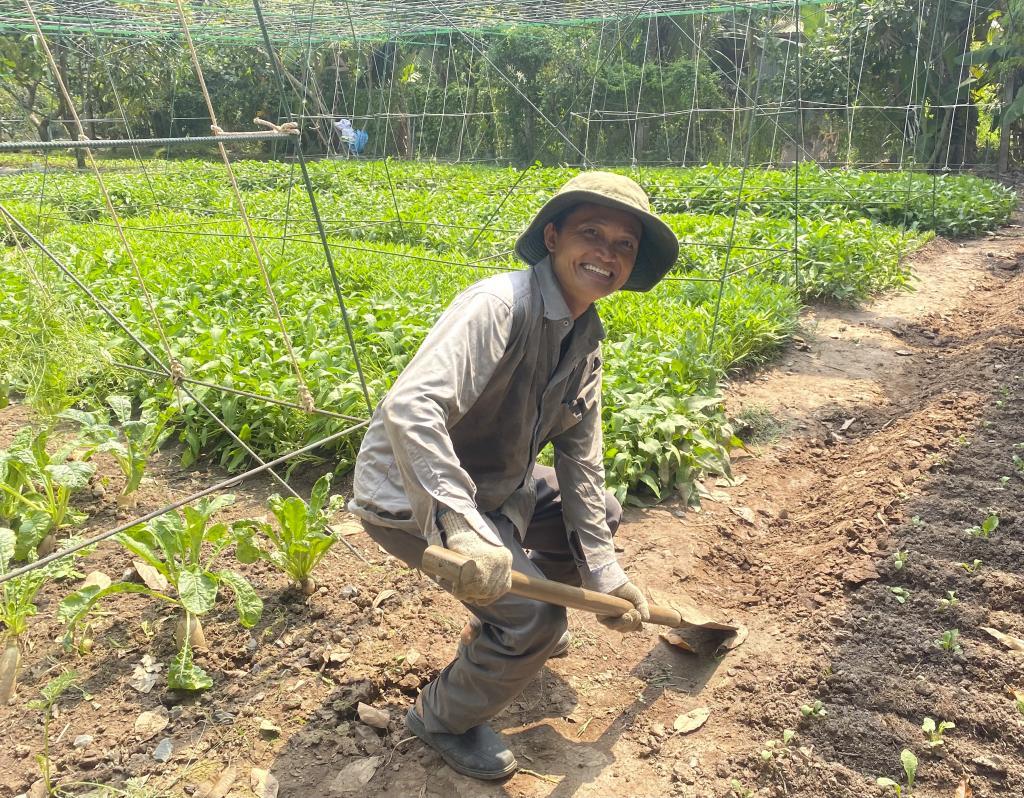
Tran Minh Khoa gazes at his rice field from the banks of the Mekong, with his pants rolled up and feet sunk in the warm mud. The numbers don't add up for him. "I used to know how much I was going to earn. Now I only know how much I'm going to lose", he says. Behind him, the green plots extend as far as the eye can see, but many have not been planted. Khoa complains that the diesel fuel powering the irrigation pumps has skyrocketed and that fertilizers, besides being much more expensive, are starting to become scarce. Every decision —to water, plant, fertilize— is now a risk calculation due to a war that is very distant for this Vietnamese farmer.
"Without the fertilizer that used to come from the Middle East, there is no rice. It's as simple as that. The land here yields a lot, but because we feed it. If we don't receive urea (the most widely used nitrogen fertilizer on the planet), we don't plant. What's the point? We would only lose money." Khoa pauses and suddenly offers a deeper analysis. "If we don't plant, there is no harvest. If there is no harvest here, it's not just our problem. Vietnam sells rice to half the world. Many countries depend on our rice to eat every day. If the Mekong fails, many people will go hungry."
The flow of the Mekong is deceptively calm. The mist rises slowly in the early hours, revealing a landscape of coconut palms leaning over the water, rusted barges loaded to the brim, and nets stretched like scars on the surface. Here, in southern Vietnam, everything revolves around water. Locally known as the River of Nine Dragons, this waterway has so many tributaries that it's easy to get lost in its anatomy. It descends from Tibet, crosses five countries, and opens into a labyrinth of arteries that nourish one of the most fertile deltas on the planet.
As the prolonged blockade of the Strait of Hormuz threatens to trigger a global food security crisis, EL MUNDO travels to the Mekong Delta, the granary of Southeast Asia, to explain how this energy bottleneck translates here, in Vietnam, the world's second-largest rice exporter, into unaffordable fuel, inaccessible fertilizers, and farmers who, for the first time in decades, are considering not planting. The long-term consequences are devastating: if the crops do not arrive in spring, exports plummet, animal feed runs out; prices will soar in supermarkets, and millions of people, both in and out of Asia, will be exposed to a new wave of hunger. The World Food Programme estimates that 45 million people could fall into famine if the Hormuz blockade continues.
Two hours from Ho Chi Minh, Vietnam's economic capital, lies Ben Tre, an agricultural province made up of islands and plains crossed by the arms of the Mekong. "The rising cost of fuel is killing us", says farmer Le Quang Huy. "A few weeks ago, cultivating my radish plot cost me four million dongs (around 150 euros). Now it's over six million."
In the delta, which produces a third of Vietnam's food, around 18 million people live, mostly small farmers with plots of just over a hectare from which they obtain two or three harvests a year. Their margin of error is minimal. And now it's even narrower. Huy, without being an expert in geopolitics, is aware of the reason for his distress: the war in the Middle East and the bottleneck in Hormuz have driven up energy prices and disrupted a key route for fertilizer supply. The domino effect is immediate: less inputs, fewer crops. Across the region, tens of millions of small farmers are struggling to find affordable fertilizers and the fuel needed to operate tractors, irrigation pumps, and planters.
Among the floating villages of the Mekong are small Khmer villages, a Cambodian ethnic group. In one of them, a woman is cooking on a black brick stove on a wooden structure. "We used to use gas for cooking," she says, pointing to a half-empty gas cylinder. "But now it's too expensive. We've gone back to using firewood, like in the past," she says as she gathers a bunch of dry branches. It's not nostalgia. It's survival. According to local organizations, the price of domestic gas has almost doubled in weeks. Families are reducing their consumption to a minimum. "My husband works in a motorcycle taxi service in the big city. Fuel is very expensive, so he makes fewer trips, which means less money at home," she explains.
In bustling Ho Chi Minh, home to nine and a half million people, this equation is evident on every corner. Motorbikes continue buzzing everywhere like a nervous swarm. But Pham Anh Duc, a transport app driver, is quite pessimistic: "I work 12 hours and earn about 240,000 dongs (around eight euros). But I spend half of it on gasoline. Sometimes it's not even worth going out." In a café along a crowded avenue, another driver chimes in: "Many are logging off the app (Grab, equivalent to Uber) and going home. It's not worth it." The energy crisis has compressed the margin to almost invisible for workers who, for the most part, also support a key informal economy for the country.
Bui Thanh Son, a taxi driver, is indignant when asked about fuel: "Some colleagues have left the wheel. Others have reduced their hours. But that means less money coming into the household. Someone always loses."
From outside the streets, the scene is seen as a globally strained chain. Energy analysts in Southeast Asia are explaining these days without mincing words: Hormuz is not just an oil route, it's an artery for fertilizers. When it's blocked, the impact in Asia is immediate because it depends on imports to sustain its intensive agriculture. The region has built its food security on cheap energy, accessible fertilizers, and open markets. If one of these pillars fails, the whole system falters.
Máximo Torero, Chief Economist of the FAO, pointed out this week to a greater risk: faced with more expensive or scarce fertilizers, many farmers will choose to reduce their use, a rational short-term decision but devastating in terms of productivity. Less fertilization means lower yields in basic crops like wheat, rice, or corn. And here comes a second domino effect: exporting countries, fearing for their own supply, could activate export restrictions, as has happened in previous crises. The result would be a global food inflation storm.
Back in the Mekong Delta, the impact is imminent after the last shipments that left the Gulf before the war have already arrived. In another village, Phan Viet Long pumps water from the river to save his crop under an unforgiving sun. Each pump runs on diesel. "Each liter now costs me twice as much," he explains. The same calculation suffocates shrimp producers, one of the economic engines of the area, due to the rising feed prices. Vo Thanh Nam, who manages five ponds, doesn't beat around the bush: "Costs have increased by 30 to 40%".