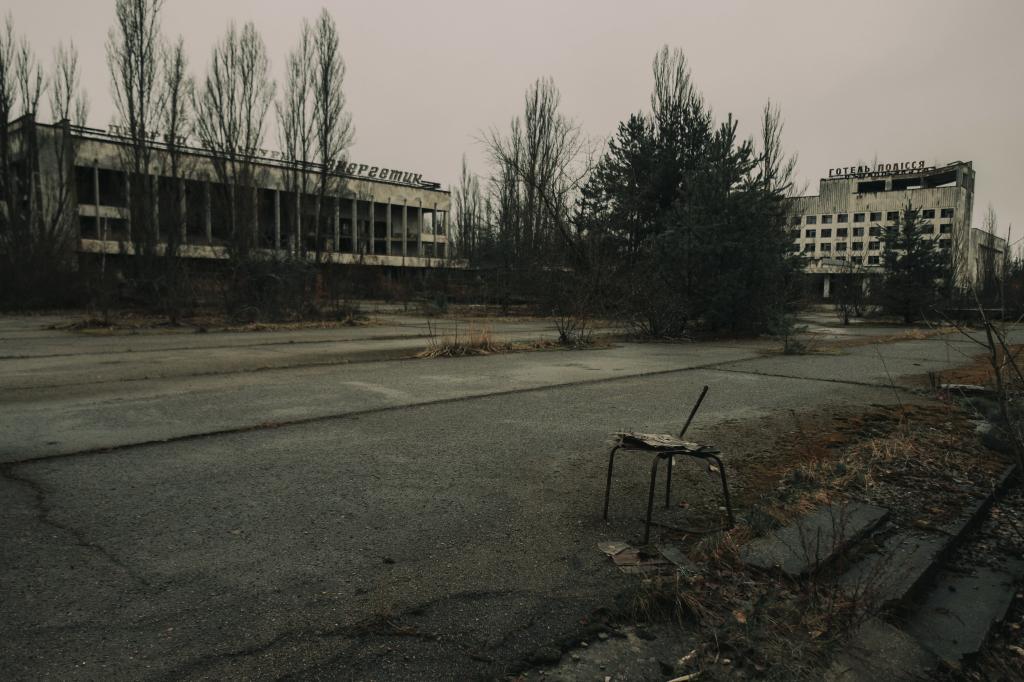
Aleksander Akimov was the shift supervisor of block 4 on the night of April 26, 1986. He was the one who, following the emergency protocol, ordered the reactor shutdown system to be activated and pressed the infamous AZ-5 button when the situation had become uncontrollable. He died weeks later from acute radiation syndrome, after spending hours trying to stabilize what he believed was still an intact reactor. Seconds after that action, intended to save the reactor and not detonate it, the worst atomic accident in history occurred. Today marks 40 years.
"I remember the day of the explosion. My family didn't hear anything that early morning, and the next day we went to school as usual and played in the street, already with the radioactive cloud above us. No one told us anything, nor distributed iodine pills. My parents wanted to take us by bus or boat down the river to Kyiv, but we couldn't. Finally, the authorities evacuated us the next day, Sunday," recalls translator Olga Tarnovska, who lived as a child in the ghost town of Pripyat.
During a poorly designed and executed safety test, the plant operators deactivated key protection systems and brought the reactor to an unstoppable chain reaction. A sudden power surge caused two explosions that destroyed the core, releasing large amounts of radioactive material into the atmosphere. The reactor's graphite burned for days, spreading contamination over vast areas of Ukraine, Belarus, and parts of Europe. Although the USSR tried to conceal the accident, engineers at a Swedish nuclear plant detected abnormal levels of radioactivity in their country and confirmed that it did not come from their plants but from Eastern Europe. Moscow then had to acknowledge it.
The immediate and lasting consequences were significant. Although the figures provided by the USSR were always questioned from the West, their reports state that two workers died that same night, and dozens of firefighters and workers died in the following weeks from acute radiation syndrome. More than 100,000 people were evacuated, including the entire city of Pripyat, with 56,000 residents linked to the plant, including Olga Tarnovska and her family, and a large exclusion zone was established.
In the long term, the accident resulted in an increase in cancers, especially thyroid cancer, and had a profound environmental, health, and political impact. It also exposed structural failures in the Soviet atomic system, from the design of the RBMK reactor to the initial opacity of the authorities, marking a turning point in the global perception of nuclear energy.
A BEFORE AND AFTER
The Chernobyl accident was not the sole factor, but it marked the moment when nuclear energy ceased to be a technical or energy debate and became a political and social issue of paramount importance in Europe. The radioactive cloud did not respect borders, and the opaque management of the USSR undermined public trust: suddenly, the risk no longer seemed abstract or distant. Since then, many European governments have tightened regulations, halted projects, or subjected nuclear development to much greater political scrutiny. Countries like Italy voted in a referendum to abandon nuclear energy in 1987, while others like Germany began a lengthy process of questioning that decades later would lead to the progressive closure of their plants.
However, the response was not uniform. France, for example, maintained and consolidated its nuclear commitment for reasons of energy sovereignty, while in other countries, the withdrawal was partial or reversible. Rather than causing a widespread immediate abandonment, Chernobyl increased the political cost of nuclear energy, strengthened anti-nuclear movements throughout Europe, and forced a reevaluation of safety and transparency standards. This shift was solidified years later with the impact of the Fukushima accident, which reinforced decisions already looming in Europe.
What is the current status of nuclear energy in Europe? Was its expansion halted following the Chernobyl disaster? Europe remains one of the major nuclear hubs in the world, although far from the momentum it had in the 1970s and 1980s. Including those in the EU and the rest of the continent, there are around 160-165 operational nuclear reactors. In the EU alone, there are about 98 reactors in 13 countries. If we add the UK, Ukraine, Switzerland, or Russia, Europe has over 160 reactors. In other words, our continent still has a significant but aging fleet, as many reactors were built in the 1970s and 1980s.
How many of them were built after Chernobyl? Very few compared to the period before. Before 1986, Europe was in full nuclear expansion. After Chernobyl, the pace plummeted. There was a sharp drop in new projects in Western Europe, with moratoriums, cancellations, and delays. In the decades that followed, only a few new units were built in Western Europe, such as Olkiluoto 3 (Finland, 2023) and Flamanville 3 (France, still ongoing but with delays).
In Eastern Europe, there was more activity, but in many cases, these were reactors initiated before 1986 and completed afterward, not entirely new projects. Overall, from Chernobyl to today, Europe has gone from building dozens of reactors per decade to just a handful in 30 years, with long periods of over a decade without new plants in several countries. Chernobyl did not end nuclear energy in Europe, but it did break its energy inertia. It maintains a broad fleet inherited from the past but has been unable to renew it with the same intensity.
Therefore, today's debate on "nuclear renaissance" is, in reality, an attempt to reverse three decades of stagnation rather than expansion.
SOVIET ERRORS
Was an accident like Chernobyl possible in a Western nuclear plant of that era? Strictly speaking, an accident exactly like Chernobyl was highly unlikely in Western plants even in the 1980s. The Soviet RBMK reactor combined two dangerous features: a positive reactivity coefficient that made the reactor more unstable as the temperature increased and the absence of a robust containment building to seal the leak instantly, a feature not present in Western reactors. Additionally, safety systems were deactivated during the test, and operations were conducted beyond established limits. In most Western reactors (light-water reactors like PWR or BWR), the physical behavior tends to be more stable, and the reaction slows down as the temperature rises. Operational norms and safety culture made it much more difficult to chain errors of that kind without the system automatically shutting down.
Nuclear engineer Kirsty Gogan emphasizes separating the accident from current technology: "We cannot allow an accident from decades ago to define the future of a technology that is much safer today." Physicist and climate advocate James Hansen openly supports nuclear energy despite the 1986 legacy: "Chernobyl is a tragedy, but nuclear energy has saved many more lives by preventing air pollution than it has cost."
That said, risks can take other forms. Serious accidents have occurred in technologically advanced systems, such as the Three Mile Island or Fukushima incidents, where the issue was not a reactivity explosion like in Chernobyl but a tsunami. In other words, the likelihood of a Chernobyl in the West was very low, but the nuclear risk has never been zero; what changes is the type of accident and the barriers designed to contain it.
THE IMPACT IN SPAIN
The Chernobyl accident had a primarily political and social impact on Spain. The radioactive cloud reached our country in a very attenuated form and without relevant health effects, but the accident reinforced an existing distrust in Spain towards this energy source. In the second half of the 1980s, a climate of public opposition crystallized, with mobilizations and a lively debate on risks, transparency, and energy dependence. This context solidified the "nuclear moratorium" approved in 1984 by the government of Felipe González, which halted new projects and redefined the Spanish nuclear program.
The best example is the Valdecaballeros nuclear power plant (Badajoz), which never became operational despite being in a very advanced stage of construction. The decision not to put it into operation was not a direct and immediate reaction to Chernobyl, but rather the result of a prior moratorium, motivated by economic (electrical overcapacity and costs), regulatory, and political factors. The 1986 accident reinforced that decision and made it much more difficult to reverse, but the plant was ultimately abandoned due to a combination of structural reasons already underway before the disaster. Chernobyl merely hammered the final nail in the coffin.
In the midst of the debate on energy security and decarbonization, several influential voices argue that Europe doesn't have much room for maneuver if it wants to meet its climate goals. Economic historian Adam Tooze connects the accident with the current difficulties in relaunching the nuclear sector: "Every attempt at a nuclear renaissance in Europe faces a memory problem: Chernobyl remains the benchmark."