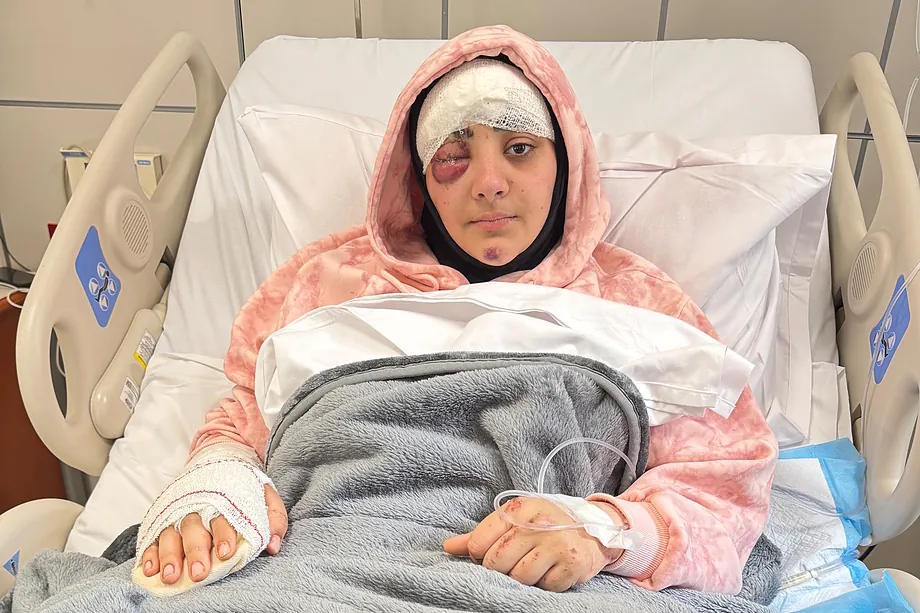
Zeinab Faraj remains hospitalized in a healthcare center in Beirut. Her father, Mohamed, 51, explains that she will still have to undergo "about four surgeries." "She was saved only by God. She was buried under the rubble," he adds. Her body was rescued by the hand, marked with a ring, sticking out among the debris. The 22-year-old girl has her head and arm bandaged, and her right eye has disappeared under a huge hematoma.
"The worst injury was to her leg. It was crushed by a huge rock," Mohamed adds.
Her colleague, journalist Amal Khalil, 43, was not as lucky. The last Israeli rocket, the third attack she endured, finished her. Her body was crushed under the roof and walls of a garage on the 22nd.
Amal was the latest victim of an increasingly common occurrence: the killing of Lebanese journalists and media employees by the Israeli army, following the same pattern of behavior as those same armed forces applied during the brutal offensive on Gaza.
According to the Lebanese Press Editors Syndicate, Amal was the 27th on the list of fatal victims in this sector since October 2023.
But Amal's death was particularly chilling. The renowned reporter from the Al Akhbar newspaper and Zeinab - an intern working as a photographer and with whom she had been in a relationship since the beginning of the conflict - had moved to the south of the country to try to document the situation in that region, where the supposed ceasefire established on the 16th seems to be crumbling by the minute.
This Sunday, the Israeli army ended the lives of another 14 people.
The journalist couple traveled to the village of Al Tiri, near the city of Beint Jbeil, where the Israeli army and Hezbollah forces are still fighting for control.
Speaking with difficulty from her bed, Zeinab recalls that, while they were there, a missile hit the car of two friends of the journalists, two young men from Beint Jbeil. "It was right next to our vehicle," she points out.
The incident left them in shock. Zeinab could barely turn on the camera on her phone, which she had hanging around her neck, and start a phone call with her father. "I was very scared. You could see the car burning and the two bodies of those boys, burning alive. I was saying, 'Dad, help me! What do I do?'" Mohamed recalls.
Zeinab believes that the first missile exploded around 2:30 in the afternoon. She didn't know it, but she had hours of horror ahead until the devastating final outcome.
"There were two small drones and a larger one flying above our heads. We parked on the side of the street and hid next to a tree," she specifies.
Amal had time to inform her newspaper. She sent them a WhatsApp message where she wrote: "I'm okay. A car in front of me was attacked".
From that moment on, a frantic race began to try to organize the rescue of the duo. Zeinab mentions that Amal called the "Lebanese army, the United Nations, the Red Cross..." and that they, in turn, tried to coordinate with the Israeli army to organize the safe return of the reporters.
The tension surrounding the wait increased when Israeli UAVs launched a second rocket, shortly after 4:00 p.m., this time directly at the journalists' car.
"Amal was injured. She couldn't stand. She was crawling. She was bleeding from the head and arm," the photographer recalls.
Even injured, the journalist managed to force open the door to an adjacent garage where they took refuge.
"We were terrified. We spent over half an hour in that building. Amal kept calling on the phone. From time to time, we hugged each other and said: Please, don't leave me!," Zeinab comments.
"At one point, I shouted to her, 'Don't fall asleep, Amal!'" she adds.
Another journalist and friend of the deceased, Ibrahim Dawi, assures that the last phone contact with Amal was at 4:22, when the reporter confirmed that they were hiding in the garage. "She said she was okay and was waiting for the army to come get her. Then the phone went dead", he stated. According to his account, the Israeli aviation bombed the building at 4:27.
"The army, the Red Cross, and the Civil Defense had been trying all that time to rescue them, but the Israelis did not give permission," he indicated.
The rescue teams found Zeinab, but the ambulance transporting her to the hospital was also attacked by drones. This time, with sound bombs.
The girl didn't even notice. She was unconscious. "I dreamt I was with my father", she says.
The rescue groups had to retreat and did not obtain authorization from the Tel Aviv army to use machinery to recover Amal's remains until 7:30 p.m.
According to the former Lebanese Information Minister, Ziad Makari, in September 2024, Khalil received a call from an Israeli phone number, threatening her life due to her coverage of the conflict between Hezbollah and Israel, leading the department to request official "protection" from UNESCO.
Local media such as Al Modon published the full text of that intimidation. "Well, madam, you go from one village to another, but maybe you haven't attended enough funerals or been to enough hospitals. There is a lot of sadness and pain behind your smile, which you try to hide on Twitter. Let's see what response you give us. Is your house still standing, Miss Amal? We know where it is, and we will find it when the time comes. Although you may not worry, in the end, we will take care of everything. I suggest you escape to Qatar or somewhere else if you want to keep the connection between your head and your shoulders."
Days before Khalil's death, the Israeli army spokesperson, Avichay Adraee, shared a video on social media showing the deceased rescuing a cat from the ruins of a building. The Israeli military once again "marked" the journalist by identifying her newspaper, Al Akhbar, as a "terrorist [media] outlet speaking on behalf of Hezbollah, the devil."
The newspaper's director, Ibrahim al Amin, explained that the journalist had informed him about these incidents. "In the fall, during the war, she received a message from an unknown number, written in Arabic, but its content was very clear."
The newspaper's top official admits that it was "impossible" to convince her to limit her movements to risky areas.
After the death of their reporter, Al Akhbar interviewed journalists from other TV stations or newspapers still covering events in the southern part of the country. The headline was more than explicit: "Who will be next?".