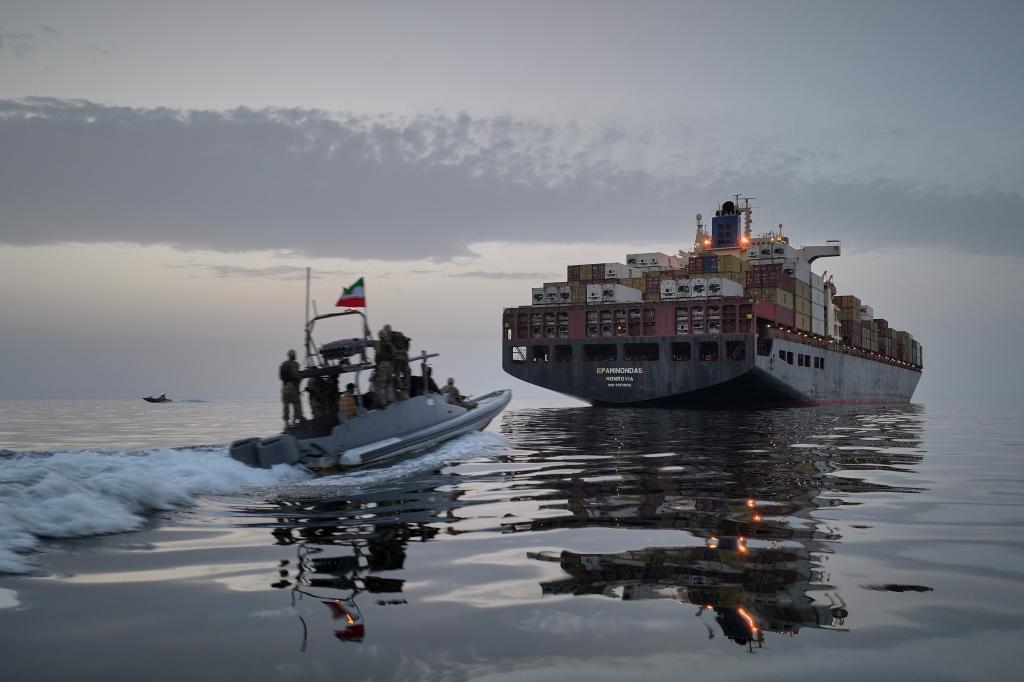
Iran maintains the lock on the Strait of Ormuz, which has been ongoing for two months, and Trump's blockade overlaps with it. Now, between the ayatollahs and the United States Navy, they are trying to see who will surrender first after strangling the world economy's aorta. In this clash of titans, no one is stepping back yet as the situation deteriorates every day.
What do each of the sides aim for? The U.S. President has imposed a siege policy to pressure Iran to negotiate under their preconditions, which include surrendering their enriched uranium, ceasing to support allied militias in the region like Hezbollah or Hamas, and halting their ballistic missile program. However, in this deadlock, Trump could choose to accept the opening of the Strait of Ormuz and spin it as a victory. The issue is that he would lose his leverage to end Tehran's atomic program. Moreover, no one in the United States would consider withdrawing in this manner as winning any war.
On the contrary, he could also act militarily using the significant force present in the region to force Iran to open the Strait of Ormuz, which could lead to a dangerous escalation, and even if some islands are taken, the offensive may not guarantee its opening.
What does Iran seek? Tehran continued to mine the Strait this weekend with its speedboats despite Trump's explicit threats, while some tankers linked to Tehran are still trying to break the U.S. blockade. It doesn't seem like they aim for a quick resolution of the conflict. Only a few tankers, hugging the Iranian coast, have managed to leave in the last few hours. Dozens of them, warned by the radios of American destroyers, have turned back.
The ayatollahs have no intention of reopening the Strait until Washington accepts, in turn, the draconian conditions that Tehran wants to impose, currently willing to make minor concessions. In the last hours, Iran has sent a new proposal to the United States: reopen Ormuz, but only if Washington signs the end of the war with guarantees that it will not resume. Any issues regarding ballistic missiles and the nuclear program would be negotiated later. These conditions would be a humiliation for the White House.
Trump desires a quick agreement and to get out of the chaotic Iran maze as soon as possible. This is precisely what Tehran wants to deny him. That's why the timelines are extended while the price of oil rises a bit more each day, and analysts' mood becomes more catastrophic. This puts more pressure on the White House, while the Revolutionary Guard is content with just surviving.
Therefore, the situation in the Strait remains highly tense. U.S. planes and drones patrol the skies while Iranian speedboats do the same at sea. U.S. forces yesterday turned back six tankers carrying approximately 10.5 million barrels of Iranian oil, while another four million barrels still managed to pass the blockade by sailing very close to the Iranian coast.
Furthermore, the GPS position of ships in international waters off the United Arab Emirates and Oman is suddenly appearing inside the Strait or even in Omani territory, while data shows vessels in the port of Fujairah as if they were on land, giving an idea of the electronic warfare chaos in one of the world's most critical energy corridors.
Nico Lange, a German Defense analyst, states that in the current phase of the conflict, "the United States and Iran are testing each other's patience. Washington is now betting that the blockade of Iranian ports will eventually lead to financial difficulties, storage problems for produced oil, and ultimately a threat of halting oil production. Iran negotiates with stoicism and tenacity, hoping that global pressure, the oil and petroleum products price spiral, and the debate on high living costs in the United States can push Trump to soften his positions."
Raz Zimmit, director of the Institute for National Security Studies (INSS), asserts that "each party believes - not necessarily with reason - that their resilience exceeds that of the other side; and both parties estimate that they still have effective additional escalation steps [U.S. attacks on infrastructures and power plants; closure of the Bab el Mandeb Strait and Iranian attacks on energy infrastructures in the Gulf]."