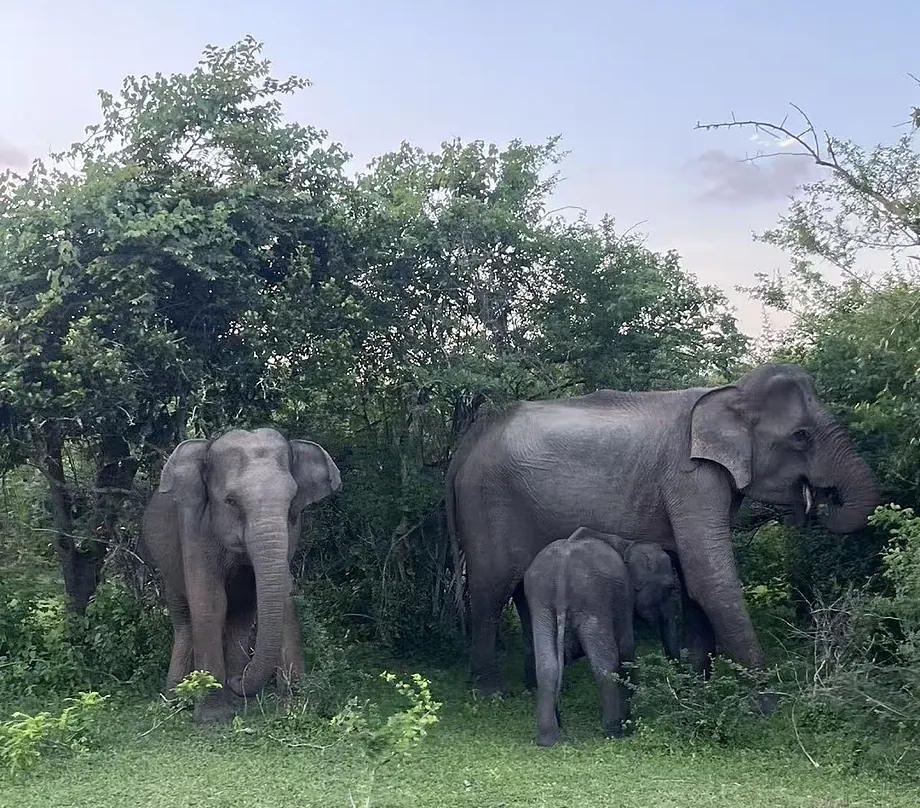
The Jeep slowly advances along a dusty red track as the dawn light filters through the thorny bushes. In the distance, an elephant emerges from the shrubbery. It chews leisurely, oblivious to the camera clicks and the subdued murmur of tourists. In Yala National Park, the most visited sanctuary in Sri Lanka, elephants remain part of the promised scenery in brochures. But outside of that showcase, the coexistence between humans and pachyderms is crumbling every day in fields and villages.
"Two weeks ago, an elephant killed a 12-year-old girl on her way back from school. It charged at her on the dirt road that connects her house to the village," says Kumar, one of the Yala safari drivers in the southeast of the island.
"And it's not an isolated case. In this same area, a farmer was crushed to death while trying to drive away another elephant to prevent it from destroying his crops." Kumar explains that within the park, there are about 300 wild elephants. "Throughout the country, there are over 7,000. But their territory is no longer theirs. Human settlements have encroached on their habitat, leading to conflict," he concludes.
This war intensifies towards the dry north of the island, where the boundary between cultivation and jungle has become porous. In January, in the Anuradhapura district, a male elephant was burned with torches by several neighbors trying to drive it out of a settlement. The police arrested three men.
A video recorded on a mobile phone - flames approaching the gray skin, screams, running - went viral on social media and sparked outrage. "We didn't want to kill it, just make it leave," one of the detainees told a local media outlet. "But when these animals come at night, they destroy everything."
Incidents accumulate in the daily chronicle. Last November, a bus driver died after losing control of the vehicle when it collided with an elephant crossing a secondary road near the city of Habarana. A few months earlier, a forest guard was gored while patrolling a wooded area. Earlier this year, a Hungarian tourist couple was attacked on the Pidurangala-Sigiriya route, one of the country's most popular: the 64-year-old man died on the spot. "The elephant came out of nowhere. There was no time to react," his companion recounted.
Just between January 1 and February 20 this year, the Department of Wildlife Conservation recorded 44 dead elephants and 10 deceased individuals. In 2025, according to estimates reported by local media, over 400 elephants and around 100 humans lost their lives in these encounters. Since 2015, the official balance presented in Parliament speaks of 3,477 dead elephants versus 1,190 people. It is a war without a defined front, but with constant victims.
In this Indian Ocean island nation, elephants hold an almost sacred place. For the majority Buddhist population, they symbolize wisdom and strength; domestic elephants parade in religious processions and are an emblem of national tourism, starring in campaigns to attract foreign visitors. Killing one is a serious crime that, according to the World Wildlife Fund (WWF), can even carry the death penalty. However, cultural veneration coexists with a much harsher reality on the ground.
For many farmers, an elephant is not a sacred symbol but an immediate threat to their livelihood. "When an elephant enters your plot, you don't see a sacred animal, you see ruin," summarizes Sunil, a farmer from Yala. "In one night, they can destroy what you've cultivated for months". Hence the resort to illegal and lethal methods: shootings, electric traps, runovers, and so-called "jaw bombs," an explosive disguised in food that detonates when bitten.
"Many nights we don't sleep. We take turns to watch over the fields," says Nimal, another farmer. "If you hear branches breaking, you know they are close. Sometimes we throw firecrackers, other times we shout or bang cans," he continues. "They tell us not to harm them, that they are the country's heritage," complains Lakmal, a resident of villages near the park. "But who protects our heritage? If I lose the harvest, I lose everything".
On the other side, some workers in the tourism sector try to qualify the narrative. "The problem is not the elephants, it's the lack of planning", argues Ramesh, a local guide. "If natural corridors were respected, there would be fewer conflicts. But development is outpacing solutions." Ravi, a Jeep driver, understands why tourists get excited every time they see an elephant up close. "I did too at first," he admits. "But after hearing so many stories of deaths, I no longer see it the same way. You know that the same animal, outside the park, can be a threat."
After decades of civil war and rapid agricultural expansion, the natural habitat of elephants has fragmented. Roads, railways, human settlements, and rice or banana plantations intersect ancient migratory corridors. Elephants, with prodigious memory and ingrained habits, continue to use ancestral routes that now lead to villages and cultivated fields.
The government oscillates between protecting an emblematic species and the pressure from communities living on the front lines of the conflict. Electric fences, animal relocations, compensation programs have been tried. The results are mixed. "Moving an elephant doesn't solve the problem, it displaces it. And often exacerbates it," explained an official from the Wildlife Department.
As evening falls in Yala, tourists return satisfied after photographing elephants in the wild. A few kilometers away, in the dimness of a village without lights or cameras, farmers light bonfires and make noise with cans to scare off the animals. They say the night is the most dangerous time. There, far from the perfect frame, coexistence is far from being a postcard.