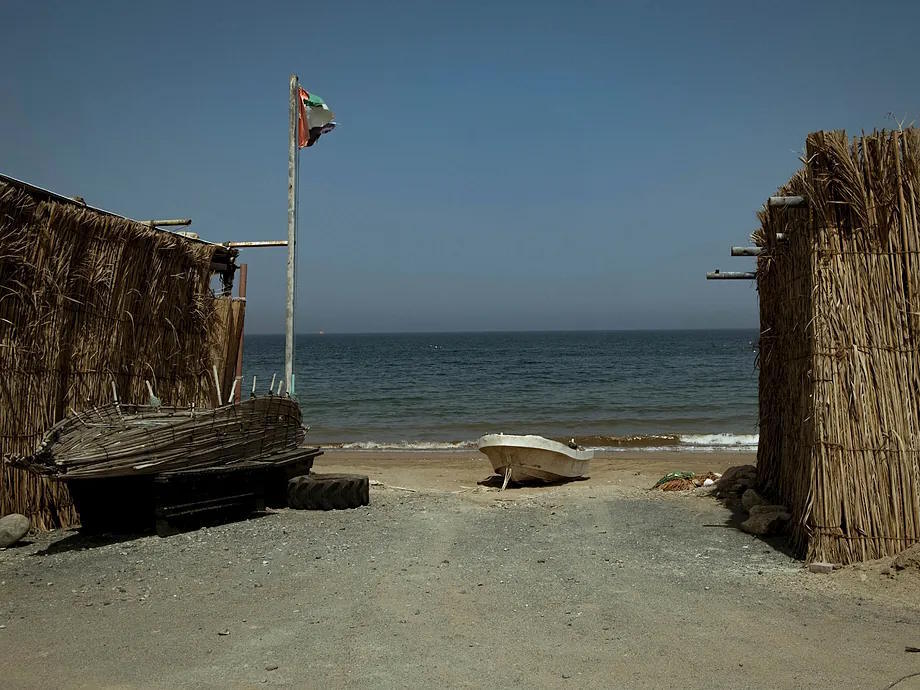
An hour away from the futuristic opulence of Dubai, Emirati Ahmed, a young fisherman, beautifies his modest wooden skiff in the shade by removing the old paint layer to repaint it. "We have fished alongside the Iranians for generations in these waters. None of us understand why they have attacked us like this," Ahmed says, referring to the missiles and drones from Iran that have visited this region in search of the huge oil deposits near the port of Fujairah. Now, everyone hopes that this unstable ceasefire will turn into lasting peace.
Once we move away from the main avenue of Murbah, where commercial activity is frantic, everything transforms into silence and calm, only interrupted by the call to prayer from the muezzin. The heat of the Middle East, which translates here to 37 degrees by the sea, causes the body to soak the clothes with sweat without any shade to help recover. Under the quiet palm tree forest before the beach, one cannot imagine being next to the most disputed geopolitical and strategic point in the world at the moment: the Strait of Hormuz and the Gulf of Oman.
At the modest Murbah, US warships have drawn an imaginary line. From this approximate point southward, Iranian oil tankers will be radio-warned not to continue their journey to the Arabian Sea. If they still disobey the advice, they will be approached by Marine helicopters. This has already happened with a handful of them. Several fishing boats lie on the bright sand. Under three wooden huts, local fishermen have set up meeting rooms with old armchairs, each in a different color. The breeze moves a flag of the UAE.
At Murbah Beach, which extends next to the Fujairah pipeline terminal and its naval base, there is not a soul, but a warship sails past us at full speed, and in the distance, a group of large oil tankers queue up off the coast. On one of those ship tracking websites, we can see that the two closest ones are the Kallista, under the Panamanian flag, and the Olympic Life, under the flag of Marshall Islands, both empty of oil but already being directed by two tugs towards the hose that fills the belly of the Emirati tanker Opta Divine. A few kilometers offshore, the concentration of large cargo ships is much higher.
For the United Arab Emirates, the Habshan-Fujairah pipeline has become a key strategic piece in the current context of tension in the Strait of Hormuz. This infrastructure allows diverting up to about 1.5 to 1.8 million barrels per day (almost a full oil tanker at maximum capacity every 24 hours) from the inland fields to the Indian Ocean coast, avoiding passage through the Persian Gulf and thus preventing it from being seized by Iran's closure.
In a situation of maritime blockade or traffic restriction like the current one, this pipeline does not completely replace the volume that normally transits through Hormuz, which used to handle up to 135 ships a day, but it does guarantee Abu Dhabi a minimum export route that reduces its exposure to geopolitical risk. More than a total alternative, it is a strategic insurance and relief: a pipeline that does not eliminate the threat but allows the UAE to continue pumping oil into the market even when the strait ceases to be a reliable highway.
This pipeline, along with Saudi Arabia's East-West pipeline, is the only oil relief available to the global economy today, held hostage by the war between the United States and Israel against Iran. It does not have an easy path from the inland oil fields because the landscape changes from sand dunes to a mountainous, arid, and rocky ocher-colored area where vegetation only grows in low-lying areas, where water accumulates, and where camel herds drink. All Gulf countries are now reviving old projects to build other pipelines like this one to avoid the possibility of Iran closing the nearby Strait of Hormuz whenever it wants.
Google Maps shows a café open in the middle of the palm tree forest when the sea breeze arrives as hot as a hairdryer motor. There we find a small air-conditioned refuge, quality Italian coffee, and French croissants. A group of foreigners, with sun-tanned skin, spend their time looking at their phones. People of the sea. The waiter asks the sweaty journalist who has just arrived while serving a classic espresso.
- Have you never been here before? Your face looks familiar to me.
- People from all over the world come here as part of the tanker crews. I must have mistaken you for someone else.
A man claiming to be a local businessman, seeking refuge from the heat in the air conditioning, reflects: "Here, tuna, mackerel, or grouper fishing supports thousands of families, but this tension has turned our world into a risky activity. We continue to go out to sea, but we do it with fear of mines or warships. That limits fishing grounds and increases the cost of each day."
Some avoid traditional areas for fear of incidents or being mistaken for suspicious vessels; others see how maritime traffic controls and diversions alter fishing patterns. In this new scenario, the Gulf ceases to be just an economic space and becomes a strategic board where even small fishing boats navigate through the cracks of a global crisis of still unknown proportions.