"A story of victory, the martyrs of Majdal Zoun." An anonymous hand painted that slogan in yellow on a wall in the small Lebanese village.
A slogan that hardly seemed compatible with the devastation suffered by the village, located just over 10 kilometers from the border with Israel. The image dominating the coastal road from the southern city of Tyre, through Mansouri, to Majdal Zoun, is a successive accumulation of ruins. And portraits of Hezbollah militants fallen in clashes with Israel. They are dozens. Both at the entrances of Mansouri and Majdal Zoun. Their number rivals that of the buildings destroyed or reduced to pure piles of rubble.
"It looks like Gaza. They have razed everything", admits Jaafar Zabad, one of the residents of Mansouri. "The infrastructure is destroyed, and around 80% of the houses have been demolished," echoes Abdel Ammar, a member of the municipality.
Majdal Zoun is the last village that can be accessed in southern Lebanon south of Tyre. The rest, the enclaves of the so-called first line of the border with Israel, are now under the direct or indirect control of the Tel Aviv forces. One of the new Israeli positions is visible on a nearby mountain.
Here the order is imperative. Any vehicle heading south of Tyre is a possible target for the neighboring country's soldiers. By the sea, on the road, several vehicles that decided to ignore that order days before are still stranded. Metal carcasses, charred by Israeli drone attacks.
The burial of the seven Hezbollah militants has brought together thousands of residents in Majdal Zoun, who have decided to defy the Israeli prohibition. A crowd dominated by black - in a sign of mourning - walks through the desolation shouting "Death to Israel! Death to America [USA]!".
Fueled by anger, some of the deceased's comrades welcome the arrival of the coffins with bursts of gunfire in the air. Others fire their pistols until the elders urge them not to tempt fate any longer. The unmistakable buzz of the Israeli drone hovering over the area.
In this region, the theoretical extension of the ceasefire until May 17 does not go beyond a mere declaration. This is confirmed by tank shell shots exploding not far from the funeral. Also, news reports of the death of four people hit by Israeli projectiles further north, in Yohmor al Shafiq, an incident that occurred at the same time as the funeral.
The massive burial in Majdal Zoun was just one more on the long list of funerals taking place in the southern towns of Lebanon in recent days, taking advantage of the unstable truce agreed between Beirut and Tel Aviv on the 16th, which seemed to have reduced violence.
However, over the past weekend, the two rivals have intensified the military escalation, the number of fatalities, and the exchange of inflammatory rhetoric incompatible with the desire to maintain this hypothetical truce. In this regard, Israeli Defense Minister Israel Katz threatened Lebanon on Monday with a "fire that will ravage the entire country".
Most experts agree that the persistence of this interlude is directly linked to the resumption or not of the war between the United States and Israel against Iran, the main ideological and logistical support of the Lebanese group Hezbollah.
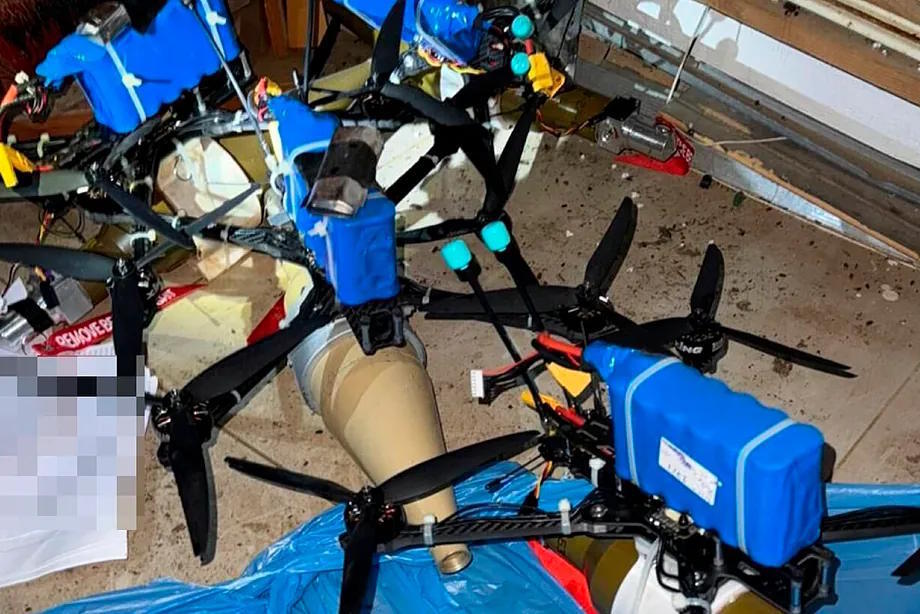
The conflict has experienced a significant shift in recent weeks due to the increased use by Hezbollah of the feared fiber optic drones, which were first seen in the war in Ukraine.
Since late March, the paramilitaries under Naim Qassem's command have started to release videos of these UAV actions against Israeli armored vehicles and all types of military vehicles, bringing back the warlike aesthetics that have defined the Ukrainian conflict since 2024.
Recordings like the one from March 26 showed the drone approaching through hills and slopes until identifying the Israeli Merkava tank, parked on the side of a dirt road. Completely exposed and without any protection against these devices. An image that would be almost impossible to find on the battlefields of Ukraine.
According to the Institute for the Study of War, this aerial assault was "the first action by the Lebanese armed group with a fiber optic FPV drone against an Israeli armored vehicle" in the ongoing conflict in the south of the country.
The proliferation of FPV use in Lebanon reflects the historic era change witnessed in the way wars are conducted, as dictated by the battlefields of Ukraine.
The emergence of fiber optic drones has caused a media shock in Israel. On the 20th, the military expert from the Israeli newspaper Maariv, Avi Ashkenazi, warned about this new phenomenon, stating that Hezbollah "has deployed hundreds, if not thousands, of fiber optic drones", a threat for which their country's soldiers still have to find a "response".
Although army spokespersons explained that so far "the damage caused by these" swarms of drones "is limited," the analyst recalled the troubled memory of the Israeli occupation of Lebanon between 1978 and 2000 - where nearly a thousand soldiers from that country died - and added: "The Israeli army is once again getting into the Lebanese mud."
The newspaper Haaretz noted that these devices "developed in Ukraine are reaching the region, offering Hezbollah a cheap and precise weapon that can bypass Israel's electronic defenses. Something has changed." "Fiber optic drones have become the biggest challenge" for the Israeli army, echoed the Walla website.
According to the military correspondent for the Israeli publication Mako, at least 38 soldiers from that country were injured by Hezbollah's new FPVs since March.
For analyst Nicholas Bradford, the appearance of fiber optic FPVs in the arsenal of the Lebanese armed group is a "significant element that confirms that Hezbollah has been taking note of the war in Ukraine".
"It is a cheap and easy-to-make weapon. But it is too early to say if it will change the way of war in this area. For now, it does not represent a radical change. Most of the casualties they are causing are injuries," he explained in a phone conversation.
However, on Sunday, Tel Aviv acknowledged the death of a first soldier under the action of these devices in an incident that left six other soldiers injured.
The video of the incident released by the Israelis showed another device exploding near the helicopter evacuating one of the casualties. The soldiers avoided a disaster by a matter of meters.
"Where are our defenses? We cannot engage in a war of attrition", questioned the newspaper The Jerusalem Post hours later.
The videos released by the Shiite militants have also sparked a flurry of analyses by military tactics experts who point out that the group's pilots do not seem very skilled yet, and the number of aircraft they deploy remains very limited. However, the images also highlight the almost complete lack of awareness in Ukraine about the risk posed by this new weaponry.
In one of the videos, a group of Israeli soldiers is seen taking a selfie in front of a tank, on a completely open road with no one watching for the approaching FPV that ends up exploding against the group.
The Israeli think tank Alma Center, specialized in studying Hezbollah, indicated on Monday that most of the actions by the paramilitaries since April 16 have been carried out with these UAVs.
In mid-April, the Israeli Ministry of Defense made a "public appeal" requesting "help to find solutions" to this monumental "challenge," as reported by Yediot Ahronot.