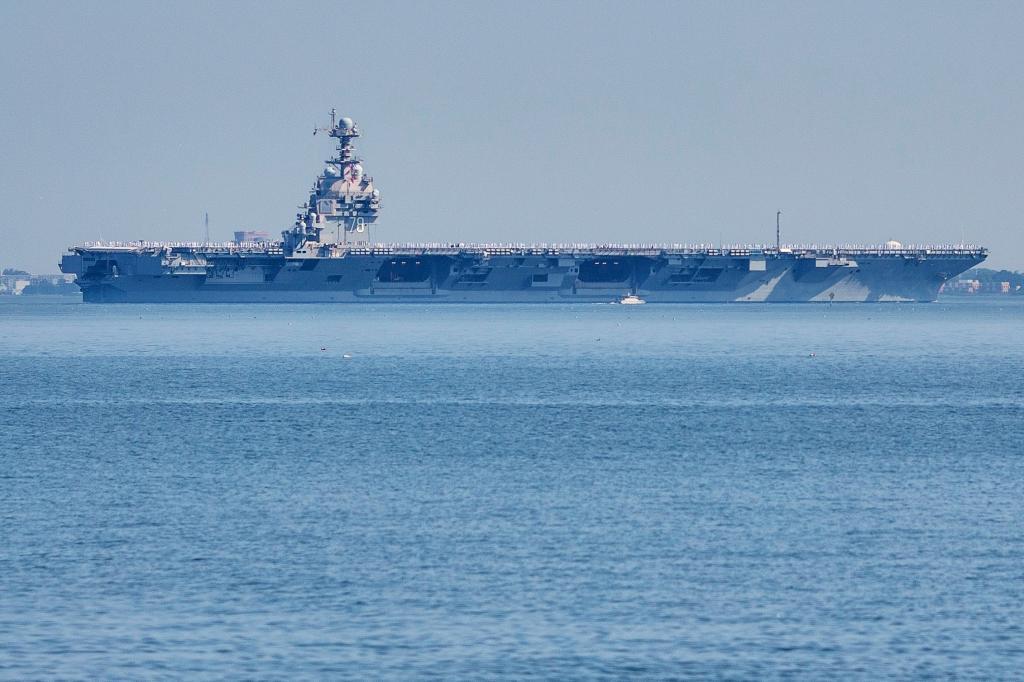
The United States has 11 nuclear-powered aircraft carriers. But it is only capable of deploying three in the war it has launched jointly with Israel against Iran. Doing so has taken two months because the latest of these vessels, the George H.W. Bush, has just arrived in the theater of operations. In the meantime, a tragedy was narrowly averted when the most modern aircraft carrier in the US fleet, the Gerald Ford, suffered a fire in the middle of the bombing campaign that took 30 hours to extinguish, burning the quarters of 600 soldiers, and forced the ship to be out of combat for two weeks while being repaired in Malta and Croatia.
Morale on the ship is also very low. This is the first mission of the Ford, which entered service last year, and whose crew has been away from their families for 10 months. It is the longest voyage of a US aircraft carrier since the end of the Cold War and, when it ends in mid-June, it will be among the longest of any ship of this kind in the history of the US Navy.
The Ford has had multiple operational problems; the most well-known being a massive toilet blockage in February, something particularly important on a ship with 4,500 people. Numerous unconfirmed reports suggest that this incident, or even the fire in March, could have been acts of sabotage by the crew itself, tired of seeing a six-month mission in the Eastern Mediterranean turn into a year-long one involving two conflicts: the capture of Nicolás Maduro in the Caribbean and the bombing of Iran from the Mediterranean and the Red Sea.
Thus, out of its 11 aircraft carriers, the United States can only deploy three against Iran, in a war in which the Pentagon acknowledges having already spent 25 billion dollars. If it takes action against Cuba, it will have to use forces based on its territory - which is simple since the island is 100 kilometers from Florida - or amphibious assault ships - actually, light aircraft carriers - from the Marines.
But if the United States has 11 nuclear-powered aircraft carriers - a number set by law - how is it possible that only three can be deployed, and after a considerable effort, in the biggest war it has launched since the Gulf War where it expelled Iraq from Kuwait, even though Tehran is now a much better armed and competent enemy than Baghdad was, and Washington only has the support of Israel instead of the 35 countries that supported it in 1991?
The answer lies in a combination of military and industrial realities. The military aspects are simple: typically, large US naval weapon systems operate on the three-thirds rule. That is, they spend one-third of their time in port, one-third on training missions, testing new weapons and tactics, and one-third deployed on missions. This implies that, under normal circumstances, only one-third are truly operational.
But now, a scheduling problem has been added. All US Navy aircraft carriers are nuclear-powered. This means they do not need to refuel in port, giving them virtually infinite autonomy. However, every 25 years, the ships must change their nuclear fuel. This literally involves dismantling part of the ship, accessing its two reactors - which means cutting steel plates of the ship in half - removing the used enriched uranium rods and replacing them with new ones.
The operation is combined with a complete restructuring of the entire ship. It is almost like dismantling the aircraft carrier and rebuilding it, making it practically new when it leaves the shipyard. And with a colossal bill, around 5 billion euros, in addition to the approximately 15,000 million it costs to build and equip an aircraft carrier and its Embarked Air Wing, consisting of about 70 planes and helicopters.
The only drawback is that the whole process, called RCOH (the English acronym for Refueling Complex Overhaul), takes between three and five years. During that period, the ship is in dry dock. And in the entire United States, there is only one shipyard capable of performing the RCOH. It is in Virginia and belongs to the company Huntington Ingalls.
The entire process is a machinery that must work perfectly greased. And this is where the system is failing. Covid-19 slowed down the RCOH of the George Washington, which took almost six years. Next came the John C. Stennis, which is also behind schedule and will not be completed, hopefully, until the end of the year. Huntington Ingalls will then take on the refurbishment of the Harry S. Truman, but at the same time, it will have to carry out a repair, which will likely last more than a year, of the Ford, just arrived from its odyssey in Venezuela, Iran, fire, clogged toilets... and, on top of that, with completely new technology, as this ship inaugurates a new class of aircraft carriers totally different from its predecessors. Meanwhile, the shipyard will have to continue building two other ships of the Ford class, the Enterprise and the William J. Clinton.
All of this results in an overwhelming bottleneck. Added to this is the US military doctrine, which requires having a carrier permanently active in the Atlantic and another in the Pacific, facing potential threats from Russia and China, respectively. The collapse is so significant that the US Navy has had to do something exceptional: extend the life of the venerable Nimitz, which entered service in 1975 and therefore reached its 50-year lifespan last year. Otherwise, it would have broken the rule of the 11 aircraft carriers, which, although flexible - as long as Congress temporarily authorizes it - is not open to many interpretations when China is building a fleet of large conventional aircraft carriers.