The girl smiles at her mother and waves a small red flag with the yellow five-pointed star: a symbol of national unity and the communist ideal that guides Vietnam. The warm light of the sunset beautifies the snapshot. The family, originally from the rural interior, is spending the weekend in Ho Chi Minh, the financial capital. "It had been eight years since I last came. The city has changed: skyscrapers, many luxury stores... it looks different," comments the mother while photographing her daughter next to the statue of "Uncle Ho," the hero of independence who gives the city its name. The scene takes place in front of the Communist Party Committee building, with its clock and restored colonial architecture.
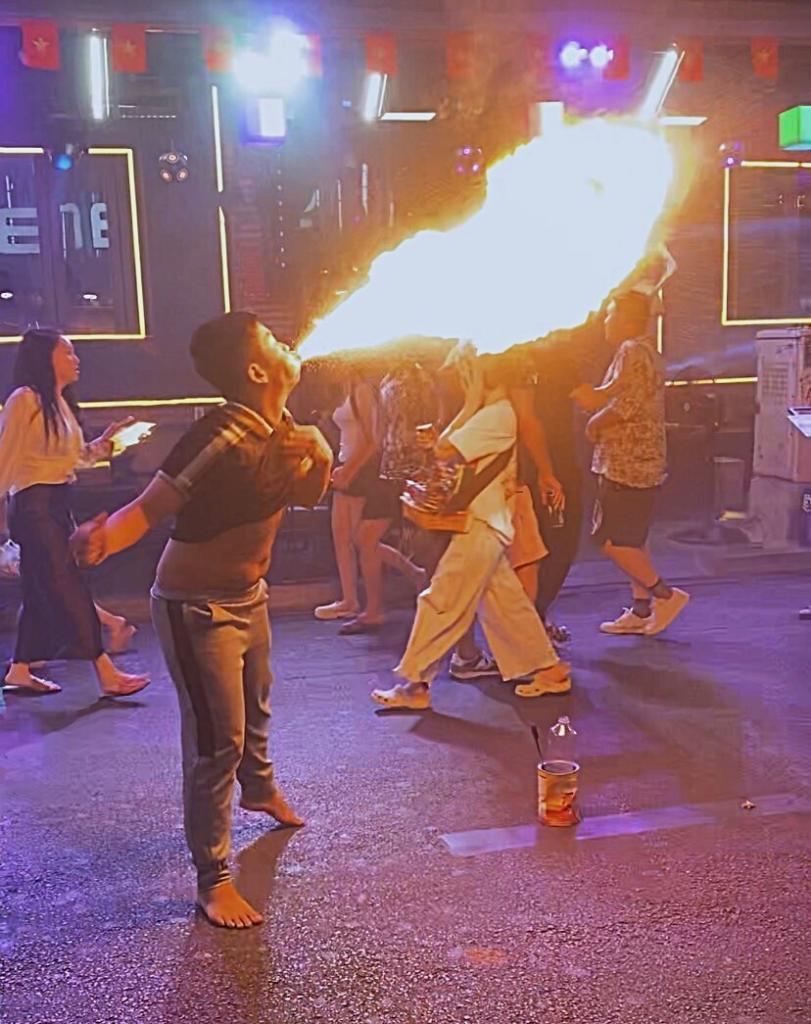
Touching the early morning hours, less than a kilometer from the statue, familiar images blur in front of a technicolor chaos: neon lights flicker to the rhythm of loud music, drunken tourists stagger, and local children breathe fire in exchange for a few bills. All of this converges on Bui Vien, an 800-meter street full of go-go clubs competing in their own decibel war, from electronic music reminiscent of a rave in Berlin to reggaeton. Food stalls and sexual massage parlors abound in the arteries.
On the outskirts of Ho Chi Minh, extensive industrial zones unfold with high-ceilinged factories showcasing the exporting muscle of a country whose economy grows at the pace of its assemblies and foreign trade. Logistic centers and manufacturing facilities of international electronics and textile companies are also located here. Trucks loaded with containers travel dusty roads, connecting workshops and ports.
Bui Vien Street, epicenter of the party scene in Ho Chi Minh.Lc
These are three of the faces that Vietnam presents today: a communist regime, home to over 100 million people, advancing as one of the most dynamic economies in the world, with growth rates hovering around 8% annually and a growing attraction of foreign investment in key sectors such as manufacturing and technology.
In the same month that the 68-year-old leader To Lam consolidated as the supreme leader (assuming the presidency of the State in addition to the position of general secretary of the Communist Party), EL MUNDO travels to Ho Chi Minh on the anniversary of the fall of Saigon, the city's former name, when the end of the famous war changed the country's destiny.
Inside the Independence Palace, former residence of the president of South Vietnam, now converted into a museum, it is remembered how on April 30, 1975, the city was engulfed in uncertainty. In front of the U.S. embassy, a desperate crowd gathered in front of the high walls, and shouts mixed with the noise of helicopters picking up the last evacuated officials and soldiers from the rooftop. On the radio, President Duong Van Minh's message announcing surrender to the communist troops from the North was repeated in a loop. The South, supported by the United States, had been defeated.
At noon, the first tank, with the number 843 painted in white, broke through the iron gate of the palace. As night fell, Saigon was renamed Ho Chi Minh. The official name change did not come until the following year when the country's reunification under the Socialist Republic of Vietnam was formally proclaimed.
Half a century later, most Vietnamese still refer to the city as Saigon. A bustling metropolis that, far from extreme poverty and the era of isolation during the post-war period, is bathed in capitalism. "On this same street, you can see communist propaganda signs in front of Louis Vuitton and Rolex stores," points out Tran Thi Lan, a resident strolling through a commercial area.
Commercial area of Ho Chi Minh.Lc
The scars of the past have been forgotten, and remnants of the war, such as the vast network of interconnected underground galleries that served as shelters, have been transformed into museums attracting millions of visitors each year. Vietnam now maintains a very close relationship with the U.S., which has been its largest investor and key to its current development boom. "In big cities, life has improved a lot, but political control and censorship are also tightening more and more," says Hieu, a university student.
The country is entering a new political phase marked by a more personalized drift of power. The latest congress of the Communist Party of Vietnam (CPV), held at the beginning of the year, not only set ambitious economic goals for the next five years but also consolidated To Lam as the most powerful leader by being reelected general secretary and shortly after assuming the presidency as well.
For decades, the CPV had maintained a power balance among the four pillars of the system - general secretary, president, prime minister, and president of the National Assembly - a design conceived precisely to avoid the concentration of authority in a single figure after the wars of the 20th century. That collegiate model has now been broken.
The decision of the National Assembly to appoint To Lam as president also brings Vietnam closer to China's political scheme, where the omnipresent Xi Jinping has accumulated control of the Party, the State, and the armed forces. In mid-April, a week after his rise, the Vietnamese leader's first trip was to Beijing. Lam, a former police officer and former head of intelligence services, has consolidated his internal power by relying on two pillars: economic growth and party discipline. His profile, according to many analysts, embodies a combination of political control and economic pragmatism.
Lam has promoted administrative reforms aimed at streamlining bureaucracy - including the elimination of tens of thousands of middle-level positions - and accelerated the approval of major infrastructure projects. At the same time, he has personally sponsored an intense anti-corruption campaign that, in addition to responding to a real social demand, has served to purge internal rivals and strengthen his control over the party apparatus.
Local tourists in front of the Independence Palace.Lc
The less friendly side of power remains a single-party regime that does not tolerate dissent. International human rights organizations denounce the increasingly frequent use of ambiguous provisions of the penal code, such as Article 331, which punishes "infringement of State interests." Under this provision, activists, journalists, and citizens have been convicted for activities ranging from social media posts to peaceful protests. Between 2018 and early 2025, at least 124 people are said to have been sentenced under this law, a figure that quadruples the previous period.
United Nations reports also point to a more difficult-to-measure phenomenon: the increase in self-censorship. "Our Constitution recognizes the right to freedom of expression and freedom of the press, but all media are under government supervision and demonstrations without prior authorization, which is almost never granted for political protests," explains a lawyer named Do Duy.
In this scenario, while Vietnam successfully integrates into the global economy and emerges as one of Asia's emerging engines, its political system evolves towards greater power concentration and stricter control of society.
The new appointment of To Lam signifies a transition from collective leadership to a more centralized model, with clear echoes coming from neighboring China. Although Vietnamese nightlife is much more uninhibited than in the major metropolises of the Asian giant.
In the heart of the party scene in Ho Chi Minh, frozen beer pitchers cost less than a euro. Go-go dancers perform on street-level platforms well into the early hours, and children breathing fire raise the temperature even more.