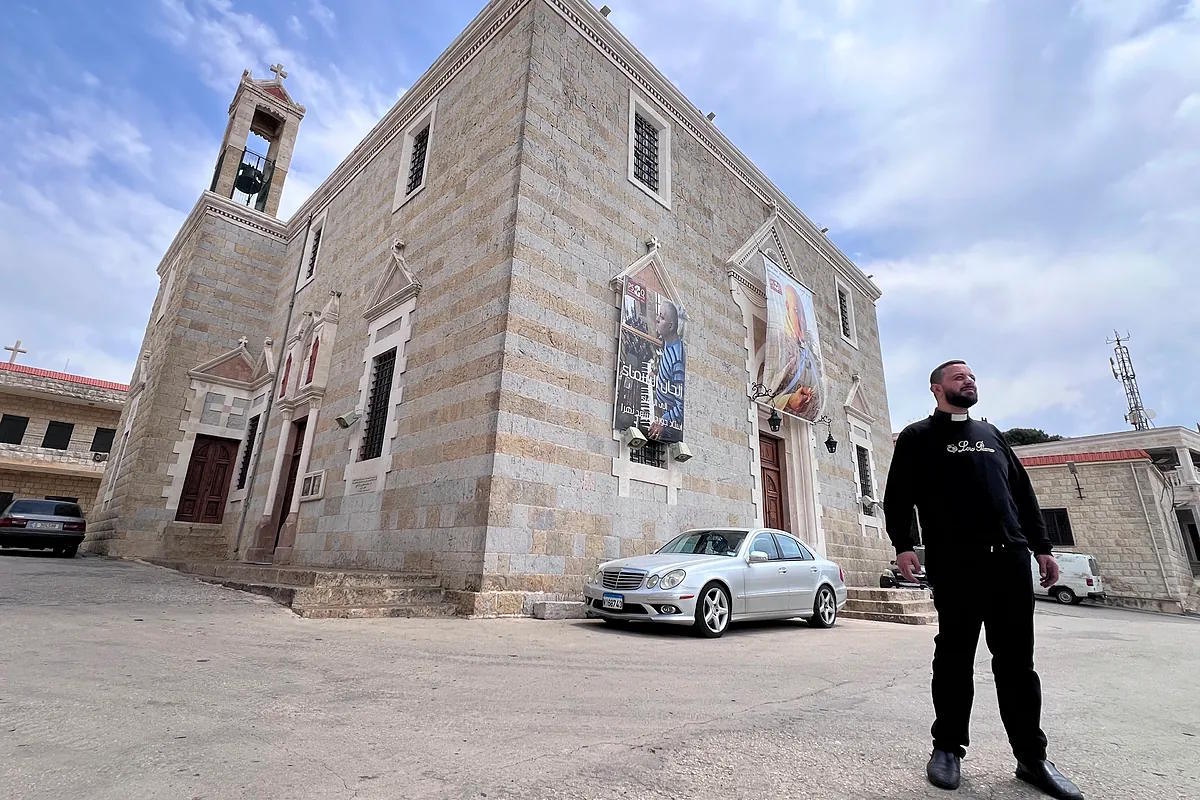
A huge image of the religious figure Pierre al-Rahi dominates the facade of the main church of Qlaaya. "There is no greater love than this: to give one's life for one's friends," reads the banner, quoting the Gospels.
Antonios Farah, who now serves as the parish priest of the predominantly Christian village, was present on March 9 at the scene. He arrived just as a second Israeli shell hit the house, where Al-Rahi was already located.
"I was opening the car door and the blast slammed it shut violently. When I came out again, I saw them evacuating Pierre. I asked him: 'Are you okay?' And he replied yes, with a smile and a thumbs up. He had blood on his leg, but it didn't seem serious," Farah recalls.
It was serious. A piece of shrapnel had severed his artery. Farah arrived at the hospital 20 minutes later, and the cleric had already lost consciousness. Shortly after, he died due to blood loss.
The death of the well-known Maronite church figure, under fire from the Tel Aviv army, shocked the Christian minority in Lebanon. No one, not even Farah, understands what the Israeli objective was. Qlaaya, a town of several thousand, is an enclave inhabited mostly by members of this religion, who have declared their neutrality in the current conflict.
During the Lebanese civil war, which ended in 1990, Israel maintained a close relationship with Lebanese Christian militias, a relationship that continued until 2000 with the so-called South Lebanon Army, led by another Christian, Antoine Lahad.
Israel used this force to control the so-called "security zone" it occupied before withdrawing that year.
Qlaaya is located five kilometers from Jiam, one of the main strongholds of Hezbollah militants. From the nearby city of Marjayoun - also with a Christian population - the urban environment of that enclave can be clearly seen. Or what's left of it. The standing residential blocks are a rarity. Most of the buildings are piles of ruins.
As confirmed by Antonios Farah, one of the neighborhoods that were "blown up" and completely destroyed by the Israeli military was the Christian one.
"The church of San Antonio has also disappeared. We had rehabilitated it (it was damaged in the 2024 war)," recounts the priest.
Unlike other occasions in the repeated invasions of Lebanon, this time the military fury of the neighboring country does not seem to have made the same distinctions when advancing.
The Israeli assault has not spared Christian religious temples, nor the symbols of that faith - nor those of other beliefs - and has ended the lives of at least seven Lebanese of that faith.
"Now they kill or expel Christians, Muslims, or Druze equally," says Adib Ajaka, a Christian sheriff from Yaroun, another southern town where the neighborhood occupied by this minority was razed by the Israeli military.
Excavators against the convent
Adib shares the video of the latest action of the excavators from Israel against the convent and the school of the Sisters of the Holy Savior. The footage clearly shows the machine demolishing the walls of the building.
For the priest Charbel Naddaf, responsible for the parish of Yaroun, the objective is clear: they want to "empty the region of its inhabitants and prevent their return."
The Israeli armed forces have admitted that they "damaged" the compound in Yaroun, but claim that it "did not have any external signs indicating it was a religious building." A statement they released with a photograph of the site, showing a statue of the Virgin Mary.
The attack on the religious dwelling has sparked yet another controversy following incidents such as the death of Father Pierre or the photograph showing an Israeli soldier attempting to decapitate a statue of Jesus Christ in the village of Debel.
"Israel changed after October 7. They no longer respect anything. We saw it in Gaza, where they also attacked Christians. Or with the attacks suffered by Christians in Jerusalem," adds Adib Ajaka, before showing another recording, capturing the moment an Israeli excavator crushes a statue of Saint George.
"That happened in the 2024 war," he points out.
Attacks on places of worship or Christian symbols have intensified since 2023, a phenomenon acknowledged by Israeli authorities and media, extending to Palestinian territories and Jerusalem.
Just a few days ago, this latter city witnessed the brutal assault on a French nun by a Jewish fundamentalist, who ended up kicking the nun before being arrested. The Israeli Foreign Minister described the incident as "shameful."
However, institutions like the Hebrew University of Jerusalem warned that this is not "an isolated incident" but part of a worrying pattern of growing hostility towards the Christian community and its symbols.
The Center for Religious Freedom Data, a network of Israeli volunteers, reported that they have documented up to 31 incidents of harassment against Christians in the first 3 months of the year.
Spitting and daily humiliations
There are numerous testimonies from devotees of this faith collected in Israeli media, denouncing the increasing harassment by radicals. "Spitting and humiliations are daily. People are afraid to walk in Jerusalem with Christian symbols," wrote the Yediot Aharonot newspaper recently.
Tel Aviv is aware of the damage these acts cause to its public image in the West, and Prime Minister Benjamin Netanyahu has made conciliatory statements towards the Christian community.
"Israel is the only country in the region where the Christian population and standard of living are growing. Israel is the only place in the Middle East that respects freedom of worship for all," stated the head of the government, following the scandal of the destruction of the Jesus Christ statue in Debel.
On the 26th of last month, the head of the government reiterated and appeared alongside Christian soldiers from the Israeli army. "Israel not only protects the rights of Christians in the Middle East, but also has Christian soldiers," he wrote on social media.
In Lebanon, on the ground, the military vehemence of the Israeli army does not seem to distinguish the religious confession of its victims. Thousands of Christians have been forced into the general exodus that the southern region has witnessed. The hypothetical ceasefire, in effect since the 17th, is merely a fable in this area, where fatal casualties are counted every day.
At least three predominantly Christian villages - Alma al Shaab, Al Qaouzah, and Sarada - have been completely emptied of their residents. The same has happened to those living in mixed localities like the aforementioned Yaroun or Khiam.
The residents of Alma al Shaab - which had a maximum of a thousand inhabitants - resisted being displaced.
"Israel had no reason to attack us. We did not participate in this war," says the mayor of the municipality, Chadi Sayah.
The Israeli Armed Forces ordered them otherwise. The first warning came on March 3. Two days later, the Lebanese army withdrew. Then, on the 7th, a drone attacked a local police car with two rockets.
"Many people had already left. There were less than a hundred of us left living in the church," says Sayah.
The final "message" was more bloody. On the 8th, another Israeli unmanned aerial vehicle killed Sami Ghafari, 70 years old.
"Sami was the brother of the priest. He was watering his garden. He died with the hose in his hand. Why was he killed? I don't know. A day later, the Lebanese army communicated the Israeli message to us again: the population of Alma al Shaab is in danger. We understood it was time to leave," he recounts.
"Christian presence is in danger"
Sayah says that although the village has been left empty, according to satellite photos they have obtained and information received from the UN peacekeepers passing through the area, the Israelis have respected the homes, unlike in other nearby towns that have been blown up.
The head of the municipality does believe that the Tel Aviv military has changed their attitude towards Christians. When reminded that Israeli soldiers used to show a certain respect towards members of this faith, he replies: "that statement is no longer valid. The Christian presence (in southern Lebanon) is in danger. We are abandoned and trapped in a sandwich (referring to Israel and Hezbollah)."
Lebanese Christians in the south of the country are grouped in two large clusters of villages in the area bordering Israel, where Shiite Muslims are the vast majority.
Three of these villages (Rmeich, Ain Ebel, and Debel) have been completely surrounded by Israeli troops in the west and can only receive assistance through humanitarian convoys.
In fact, the Papal Ambassador in Lebanon, Paulo Borgia, had to lead one of these convoys at the end of April to transport 40 tons of food to Debel.
The rest, those around Maryajoun, remain connected to the north of the country by a road that was bombed by the Israeli air force but repaired by Spanish UN peacekeepers.
"We don't have supply problems," confirms Antonios Farah.
But the road to Maryajoun and Qlaayah requires passing through the territory of Nabatiyeh, which is constantly punished by Israeli air and artillery attacks.
More airstrikes
Air raids have intensified in recent days in response to Hezbollah's fiber-optic drone attacks, which have left three soldiers dead and dozens injured during the same period.
Last Friday, Israeli soldiers admitted to launching fifty airstrikes in just 24 hours. Lebanese authorities have reported dozens of deaths and injuries just over the weekend.
Just moments before, Civil Defense members had finished placing one of the bodies in a bag. An employee at the facility is trying to clean up the blood on the floor.
The nearby explosions are constant, as are the Israeli planes flying overhead before launching missiles at nearby villages. The impacts raise huge columns of smoke just a few kilometers away.
In some cases, the actions of the paramilitaries have not been unrelated to Israeli retaliation against the Christian minority. This is denounced by the representative of Qouzah, Boulos Abu Karam, who has been displaced to northern Beirut.
Following the scorched-earth policy instituted by the so-called "Gaza doctrine," when Israeli troops occupied Qouzah days later, they began blowing up empty houses.
Karam Abu Karam, the brother of the former, shows a video in which his home and an adjacent one explode. "It's from April 16," he adds.
Forbidden to cross the 'yellow line'
The former Antelias Hospice, belonging to the Maronite Patriarchate of Lebanon, became a shelter for Christians displaced from the south during the 2023/24 war.
Adonis Rezeb, from Ain Ebel, has returned to the same place where he spent almost a year and a half during those times. In the same room with bunk beds where he gathers with his two children, wife, and parents.
The 41-year-old Lebanese man says they cannot return. "It is forbidden to cross the 'yellow line' (the de facto border marked by Israel in the south)."
The family lives with 35 others from the same border area with Israel, all Christians like Samar Samih Zaiz.
The shelter residents share videos showing homes in their villages looted by Israeli troops.
Samar, 43, is dressed in deep mourning. She struggles to express herself. Sometimes she breaks down in pain and bursts into tears.
She left her hometown, Debel, during the 2024 war. Her family stayed there. On October 2 of that year, the Israelis bombed the family home, killing her two parents and brother.
Before concluding the conversation, she asks the journalist, consumed by anguish, "My religion asks me to forgive. But how can I forgive them after they have killed my family?"