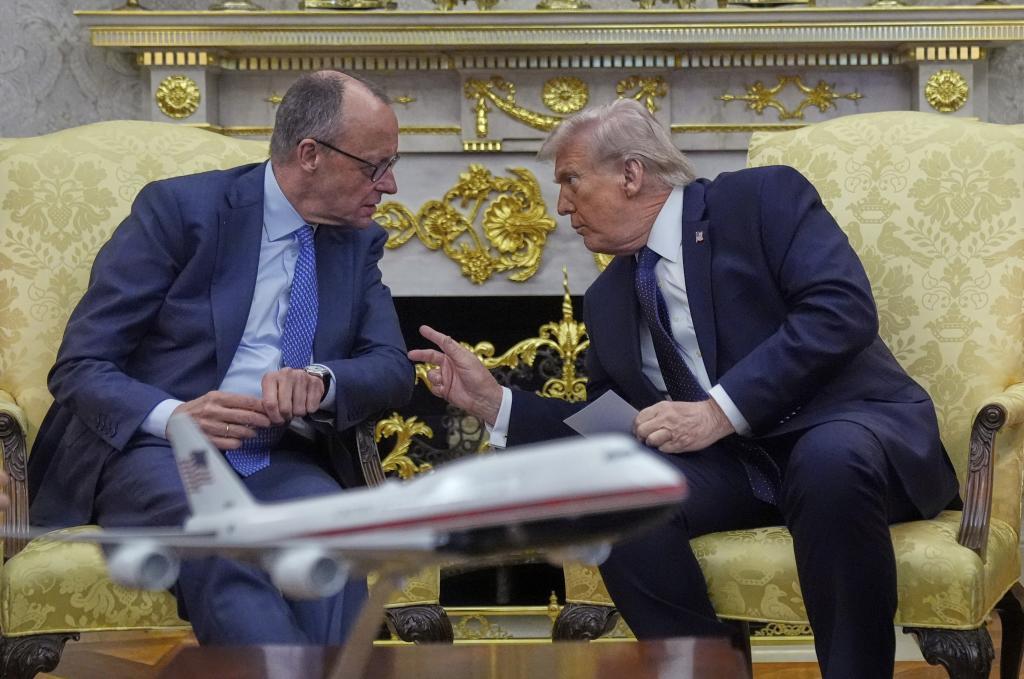
After several weeks of considering the idea, US President Donald Trump has given the order to reduce the number of US troops in Germany. In his first term, Trump already approved a redistribution of forces to focus efforts on the Chinese threat, which was to be achieved with 12,000 fewer troops in its main European hub. Recent documents such as the National Security Strategy or the National Defense Strategy made it clear that Europe was no longer a priority scenario for Washington. However, the decision now has a completely different, less strategic, and more punitive sense. A punishment to the largest country in the EU days after Chancellor Friedrich Merz openly criticized the US military operation in Iran, stating that it lacked a clear objective and underestimated the Iranian strength.
On Thursday, Trump took to social media to warn that a troop reduction seemed inevitable. This Friday, the president, in the same location, announced an increase in tariffs on vehicles and trucks manufactured in the EU, where German brands have the most at stake. Shortly after, the Pentagon provided the first figures.
"The Secretary of Defense has ordered the withdrawal of approximately 5,000 troops from Germany. This decision follows a comprehensive review of the Department's force posture in Europe and acknowledges the theater's operational requirements and conditions on the ground. We expect the withdrawal to be completed in the next six to twelve months," confirmed the Pentagon's chief spokesperson, Sean Parnell.
A senior Pentagon official, cited by Reuters, stated that recent German rhetoric had been "inappropriate and counterproductive" and that "the president is reacting correctly to these counterproductive statements," referring to expressions such as "humiliation" that, according to Merz, the US was experiencing from the ayatollahs' regime.
And on Saturday morning, NATO intervened stating that it is "working" with the US to "understand the details" of the announcement of this troop withdrawal in Germany, as reported through social media by Allison Hart, a spokesperson for the military alliance. "This adjustment underscores the need for Europe to continue investing more in defense and assume a greater share of responsibility for our shared security, where we are already seeing progress since the Allies agreed to invest 5% of GDP at the NATO Summit in The Hague last year," she added.
With over 36,000 soldiers, Germany is the largest US military center in Europe and has been repeatedly used by the United States to reach the Middle East theater of operations or as the main hospital for its wounded far from home. Since the Cold War, it has been the heart of its presence on the continent and the quintessential symbol of deterrence towards the USSR first and Russia later. Similarly, the bases in the country have been the main logistical centers for refueling for Operation Epic Fury, the bombing campaign in Iran.
For example, it hosts Ramstein Air Base, the headquarters of the US European Command and the US Africa Command, as well as the Landstuhl Regional Medical Center, the largest US military hospital outside the United States.
In recent weeks, Trump had shown his displeasure with NATO in general, and with Germany, Spain, and Italy in particular. Berlin had not prohibited the use of its airspace or bases, but it refused to join the operation or the military liberation of the Strait of Hormuz. Trump began to attack in his appearances. Less than Spain, but very often. He used both countries as examples when referring to the possibility of reducing troops or especially closing facilities. And in the end, he made the first decision, repeating his steps from the past decade.
Although he has not provided details himself yet, US officials cited by Fox and the WSJ indicated that the decision would involve withdrawing an army brigade and reversing the Biden administration's decision (which, upon returning to power, corrected Trump's disdain from the past) to deploy a battalion with long-range conventional missiles in Germany by the end of this year. A deployment that was announced by the US and Germany at the 2024 NATO Summit in Washington.
Merz's presence in Washington a few weeks ago, showing alignment with Trump, expressing his satisfaction with the operation in Iran or not defending countries like Spain or the United Kingdom during the US president's public criticisms, has not served any purpose. The cuts would return the number of US troops in Europe to 2022 levels, before the Russian invasion of Ukraine.
Last year, the Trump administration decided to withdraw a US combat brigade from Romania for operational reasons. Bucharest has done the opposite of Berlin or Madrid in recent months, and that is precisely why it has managed to reconcile with Washington, to the point that the Pentagon has been saying for weeks that if the US decided to punish Spain, Germany, or the United Kingdom, one of the possibilities was precisely to increase its presence in the countries that had proven to be, in their eyes, more reliable allies. Like Romania.
"We are prepared for it. We are discussing the matter thoroughly and with a spirit of confidence among all NATO bodies," said Foreign Affairs Minister Johann Wadephul a few hours ago, adding that he hoped the United States would make decisions "in an appropriate manner among allies and partners."
In 2020, the first Trump administration made plans to withdraw nearly 12,000 soldiers from Germany after Trump repeatedly criticized Angela Merkel for being a "freeloader" and not meeting her military spending commitments, but Biden stopped it.