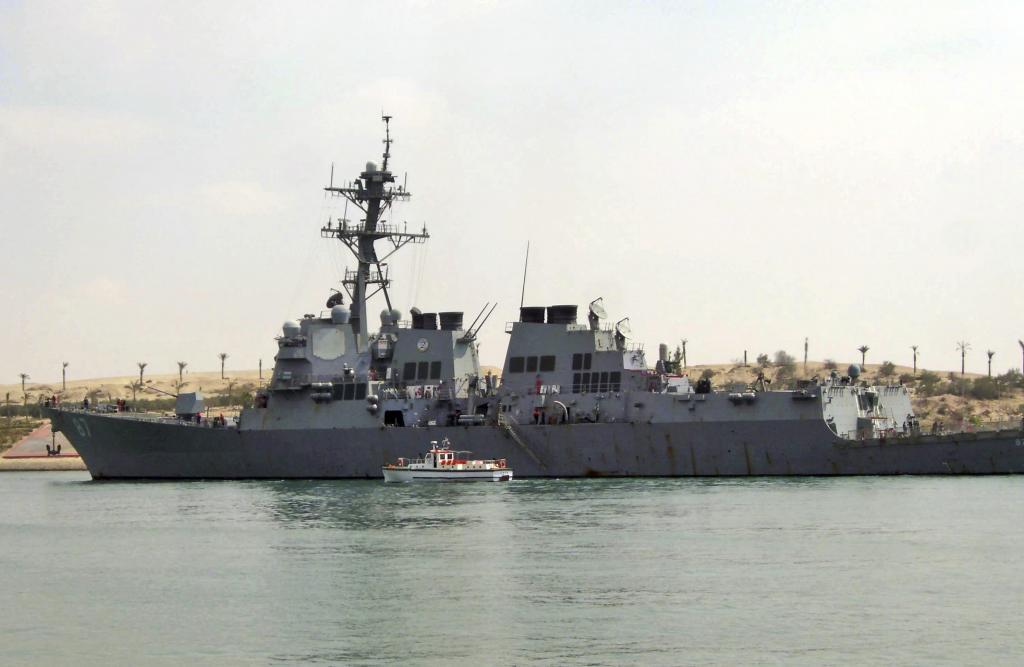
A day of high tension in the Strait of Hormuz and the Persian Gulf, where the ceasefire hangs by a thread. For the first time since the truce, the bombing alarms sounded again in the United Arab Emirates. The Iranian news agency Fars reported on Monday that a destroyer from the US was hit by two anti-ship missiles when attempting to enter the Strait of Hormuz after issuing, according to the regime, "five radio warnings" that "were ignored." The information does not clarify if the missiles caused damage to the warship, but other sources claim that the same vessel had to turn back due to the Iranian reaction. The United States has denied that the ship was hit by the missiles and labeled the information as "propaganda."
What is confirmed is that on Monday, the tanker Barakah, owned by the Emirati state company ADNOC, was hit by two Iranian drones off the coast of Oman, according to a statement from the company itself. A second tanker, this time South Korean, was also hit in the vicinity of the Strait.
Additionally, Iranian sources have announced that the ayatollahs have redefined their control over this geographical feature. They have now expanded what they call a "control zone" and have drawn two imaginary lines. To the south, the maritime border of this new flashpoint will be between the Mobarak Mountain and the Emirati port of Fujairah. To the north, the imaginary line runs from the Iranian island of Qeshm to the city of Umm Al Quwain.
President Donald Trump had announced hours earlier the launch of an operation, which he named "Project Freedom," to facilitate the safe passage of commercial vessels trapped in the Strait of Hormuz amid escalating tensions in the Middle East. Currently, according to real-time data provided by GPS vessel tracking pages, traffic in Hormuz remains as restricted as it has been for the past two months. The US military simultaneously announced the beginning of breaking the Iranian blockade by two merchant ships flying the American flag that successfully crossed the Strait. A source close to President Trump described this operation as the "start of a process that could lead to a confrontation with the Iranians."
As explained by the blond president, several countries not directly involved in the conflict have requested US assistance to release their vessels, many of which are blocked despite having no connection to the dispute. Washington has responded with a plan that began on Monday and, as Trump stated, involves escorting these ships through restricted waters to resume their commercial activities. The US Central Command declared that the operation is supported by more than 100 aircraft and 15,000 troops.
Hours later, The Wall Street Journal downplayed the significance of this mission by clarifying that "the new mechanism is effectively a coordination cell to move traffic through the Strait" and that "it currently does not involve US Navy warships escorting vessels." In other words, it is based on finding a "safe" route for these captains and shipping companies and communicating it to them so they can navigate through that geographical feature on their own, without escort but under military surveillance. They are requesting that ships wanting to leave the Persian Gulf do so hugging the coast of Oman and not the coast of Iran. Tehran, through its official agencies, states that "any force, especially the US military, will be attacked if it approaches the Strait of Hormuz. We fully maintain and manage the security of the Strait."
Trump framed the initiative as a humanitarian and goodwill gesture, emphasizing that some ships are already facing supply problems for their crews. However, it is very unlikely that any tanker or cargo ship would want to undertake that transit at this time through waters that remain mined and under the threat of Iranian bombardment. Just yesterday, several fast boats from Tehran attacked a ship attempting to pass through the Strait to the south. The insurers of these cargo ships also seem unwilling to continue covering navigation through an area considered a "war zone."
The US president also stated that there are "very positive" conversations with Iran, which could pave the way for diplomatic progress, although he warned that any attempt to interfere with the operation will be met with firmness. The White House presents the measure as an effort to ease pressure on international trade and reduce risks in one of the world's main energy routes.